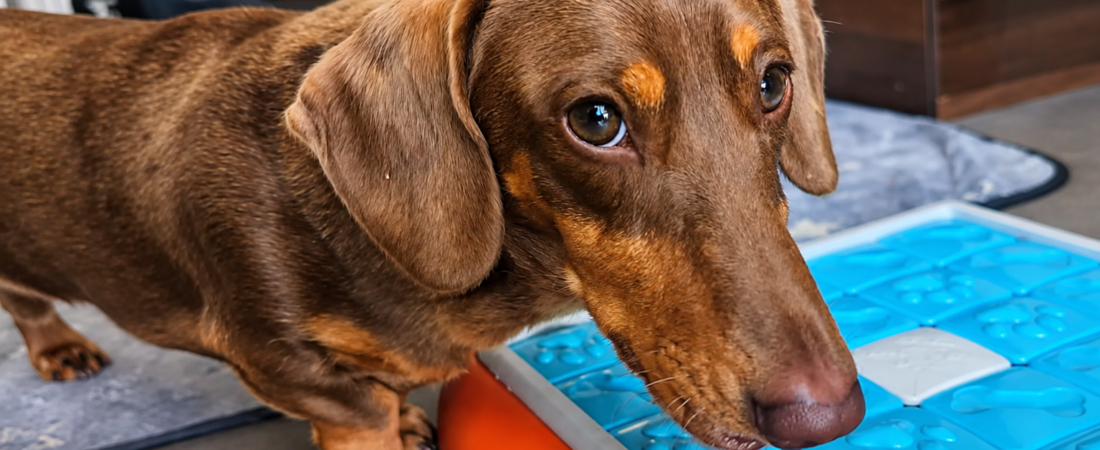
Quick answer: Some of the best mental stimulation games for dachshunds include snuffle mats, snuffle balls, puzzle feeders, scatter feeding, scent games, lick mats and short training sessions. These activities help keep their brains busy, encourage natural sniffing and problem-solving, and can tire them out in a really healthy way.
This post may contain affiliate links. If you buy through one of our links, we may earn a small commission at no extra cost to you.
Why Mental Stimulation Matters for Dachshunds
If you have a dachshund, you will probably already know this:
They are not the sort of dogs you can just tire out with a walk and call it a day.
They are clever little dogs.
Curious, stubborn, nosey, funny, determined and usually very convinced that whatever they want to do is the correct thing to be doing.
And if they get bored?
They will often come up with their own entertainment.
Sometimes that is funny.
Sometimes that is not so funny.
For example, Winston once got bored enough to steal my flip flop from inside the house and proudly carry it off into the garden like he had just won a prize.
So over time, we have learnt that mental stimulation is just as important as physical exercise.
Sometimes more so.
A good sniffy game, puzzle toy or short training session can tire Winston out far more than people would expect, because he has to actually think, problem-solve and use his nose.
Sniffing does not only have to happen indoors with snuffle mats and puzzle toys, either. We also use Winston’s walks as a form of enrichment, especially on slower sniff-led walks where he gets time to explore properly. We’ve written more about that in our guide to heel walking vs sniff walks.
And for dachshunds especially, that makes so much sense.
They were bred to use their brains and their noses, so giving them safe ways to do that at home can make a huge difference.
Mental Stimulation vs Enrichment: Is There a Difference?
This is one of those things that can sound more complicated than it really is.
Mental stimulation is anything that makes your dog think.
Enrichment is the bigger overall idea. It includes mental stimulation, but it can also include sniffing, licking, chewing, foraging, exploring and using natural behaviours in safe, appropriate ways.
Blue Cross explains enrichment as giving dogs opportunities to use natural behaviours like scavenging, sniffing, exploring and problem-solving, which is exactly how we think about Winston’s brain games.
So if you are wondering whether things like lick mats count, we would say yes.
A lick mat might not be the hardest puzzle in the world, but it still gives your dog something calming and engaging to do.
For us, we think of it like this:
- Mental stimulation = the thinking part.
- Enrichment = the bigger picture.
And ideally, a dachshund gets a bit of both.
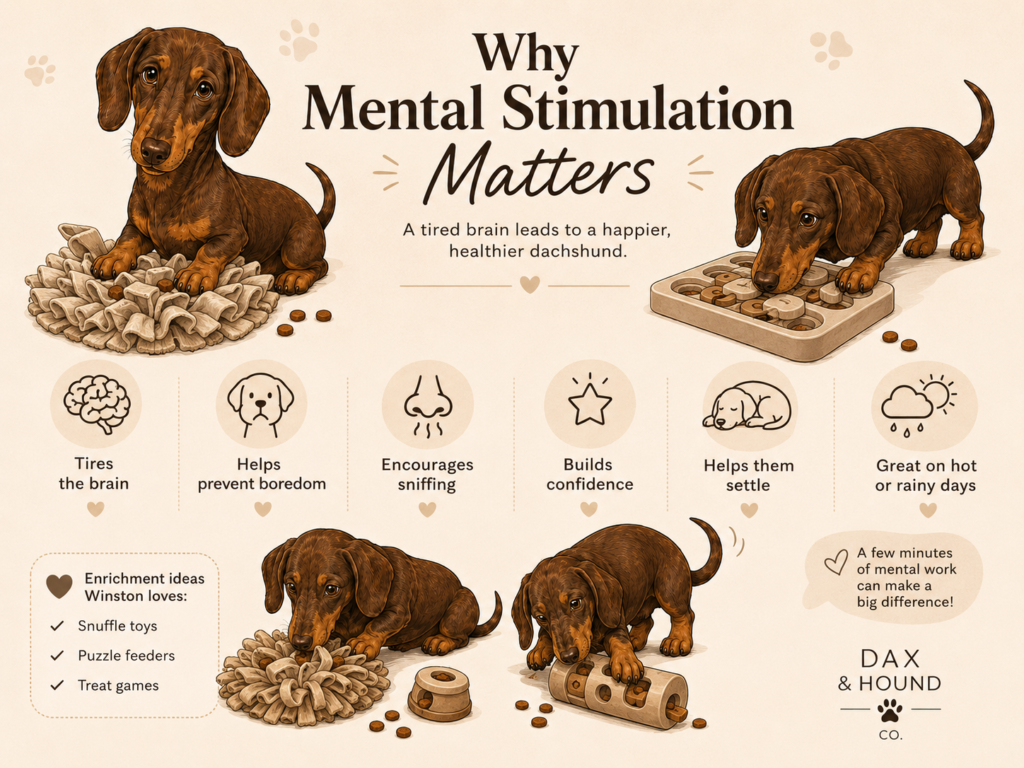
Why Brain Games Help So Much
One of the biggest things we have noticed with Winston is that mental stimulation helps with more than just “keeping him busy.”
It can help:
- prevent boredom
- encourage natural sniffing and foraging
- slow down mealtimes
- build confidence
- give them something positive to focus on
- help them settle afterwards
- make rainy days, hot days and quieter days much easier
And sometimes, if Winston has not had quite as much outdoor adventure as usual, doing a few little brain games during the day makes a huge difference.
That balance matters even more with dachshunds, because we want Winston to be fulfilled without relying only on longer and longer walks. We’ve written more about that balance in our guide to protecting your dachshund’s back.
Even ten minutes can take the edge off.
And with a dachshund, taking the edge off can be the difference between a peaceful evening and a suspiciously quiet dog stealing something from another room.
1. Snuffle Mats and Snuffle Balls
Snuffle toys have been some of our most-used enrichment toys for Winston.
A snuffle mat or snuffle ball is designed so you can hide kibble or treats in fabric folds, and your dog then has to sniff around and work out how to find them.
We have a few different snuffle mats and snuffle-style toys now, simply because we like to rotate them and keep things interesting for him.
Two snuffle toys we use are:
Benixmidart Snuffle Ball on Amazon
FANTESI Interactive Snuffle Ball on Amazon
Winston really enjoys these because they tap into his natural sniffing and foraging instincts.
Dogs Trust also has a simple guide to snuffle mats, explaining how they let dogs sniff and search for treats hidden in the mat.
They are also easy to adjust.
You can make them simple by loosely hiding the food near the surface, or make them harder by tucking treats deeper into the folds.
What we like about snuffle toys
- They are easy to use.
- They encourage natural sniffing.
- They can be used with treats or part of a meal.
- They are great for rainy days or hot days.
- They are easy to rotate with other toys.
Things to keep in mind
- Supervision is still a good idea.
- Some dogs may try to chew the fabric.
- They work best when rotated rather than left out all the time.
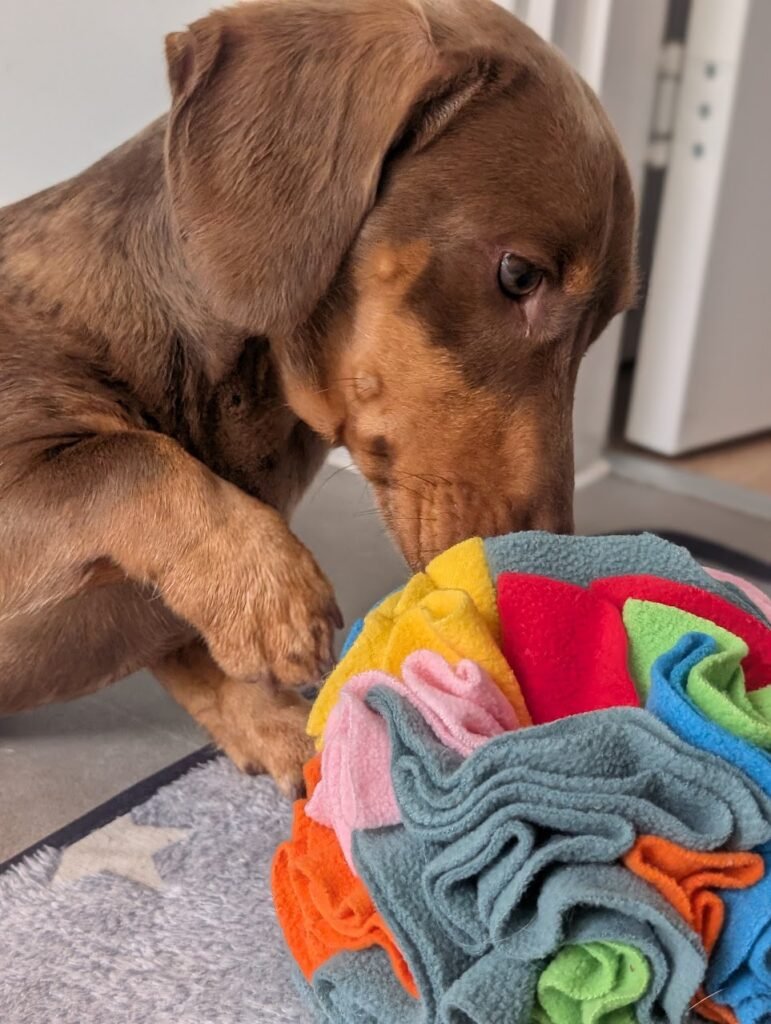
We like snuffle mats because they are easy to use with part of Winston’s normal food, and they encourage slower, calmer foraging.
On hot days especially, we rely more on calmer indoor enrichment instead of long walks. We shared more of our warm-weather routine in our guide to keeping a dachshund cool in hot weather.
2. Puzzle Feeders and Puzzle Boards
Puzzle toys have also been a big hit in our house.
These are the toys where your dog has to slide, lift, spin or move parts around to get to food.
Winston has a few different puzzle boards, including the:
Nina Ottosson by Outward Hound Challenge Slider on Amazon
We also have a spinning puzzle feeder with three layers and four sections in each layer. We put treats or part of Winston’s dinner inside, and he has to spin the sections around to get to the food.
These are really good if you want something that makes your dachshund properly stop and think.
Guide Dogs includes puzzle toys and puzzle feeders as enrichment ideas, and also reminds owners to use part of their dog’s normal food allowance rather than simply adding lots of extra treats.
You can almost see the little cogs turning.
And when Winston works one out, he looks very pleased with himself.
As if he has just solved a major crime.
What we like about puzzle feeders
- They encourage problem-solving.
- They can slow down mealtimes.
- They are good for treats or meals.
- You can increase the difficulty as your dog improves.
- They are useful when you need a calm indoor activity.
Things to keep in mind
- Start easy.
- Show your dog how it works at first.
- Do not let them get frustrated.
- Always supervise puzzle toys.
- Rotate different puzzles so they do not become too easy.
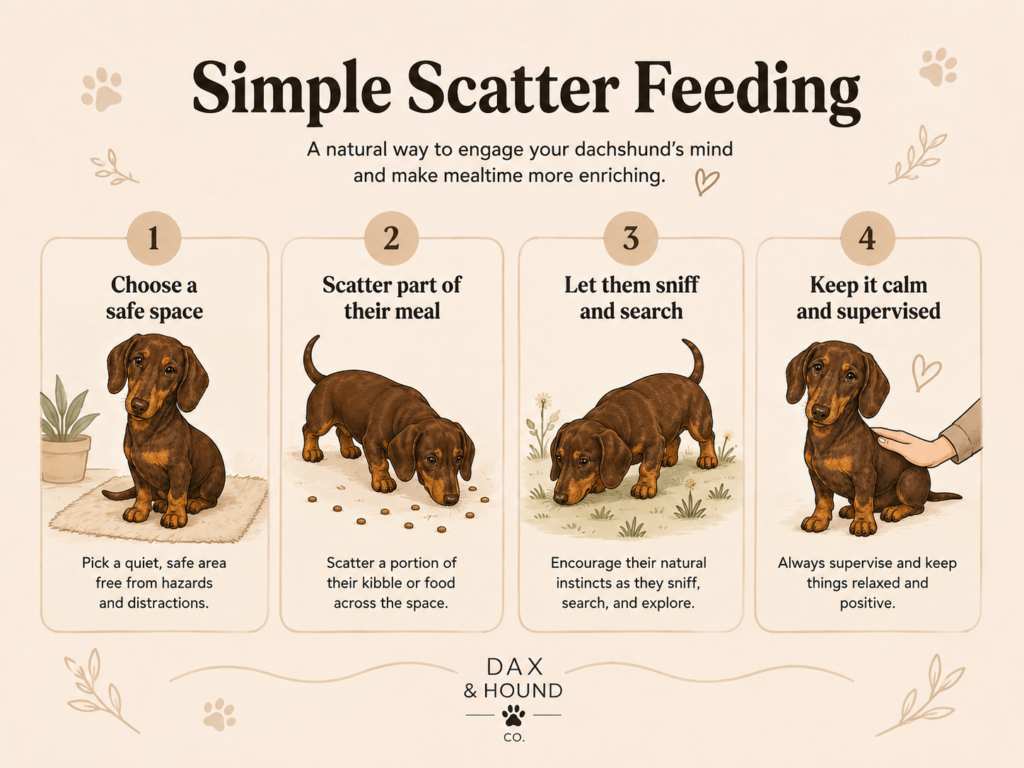
3. Scatter Feeding
Scatter feeding is one of the easiest things we do with Winston.
And honestly, it is also one of the most effective.
All you do is scatter some kibble or treats into grass, or around a safe indoor space, and let your dog sniff them out.
That is it.
No fancy setup.
No expensive toy.
No complicated instructions.
Just a dachshund, a nose and a mission.
We often do this in the garden when we want to give Winston something to do without overcomplicating things.
It lets him sniff, search and slow down a little.
We use scatter feeding when:
- Winston needs a quick activity.
- We want to slow him down.
- The weather is nice enough to use the garden.
- We want to give him a job without doing a full walk.
- He needs to use his brain for a few minutes.
It is one of those simple things that seems almost too easy to count.
But it absolutely does.
Especially for a breed that loves using its nose.
4. “Find It” Scent Games
This is one of my favourite things to do with Winston because it is so simple, but you can build it up over time.
We do lots of little “find it” games with him now.
Sometimes we hide treats.
Sometimes we hide toys.
Sometimes we hide specific objects and reward him when he finds them.
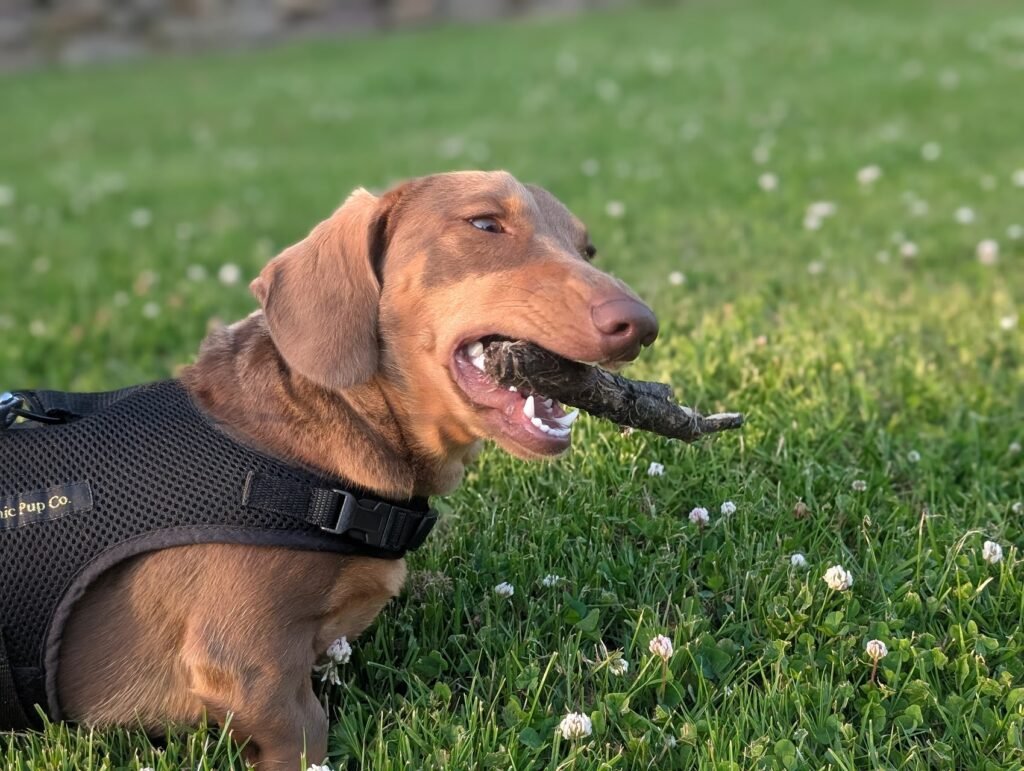
One of his favourites is a soft badger toy with a little Velcro compartment where we can put something smelly, like dog nip.
We hide it around the house — behind a sofa cushion, in his bed, under something soft, behind a table — and then ask him to “find it.”
At first, we made it really obvious.
But Winston caught on very quickly.
Too quickly, really.
After just a few goes, he realised that the reward was not actually the badger.
The reward was the treat after finding the badger.
So now he finds it and immediately looks at me as if to say:
“Right, I have completed the task. Payment please.”
Very dachshund.
Blue Cross has a helpful scent work guide if you want to build simple search games a little further.
5. The Carrot Puzzle Toy
We also use this interactive carrot puzzle toy with Winston:
Interactive Carrot Puzzle Toy on Amazon
It has little carrot-shaped toys that you can hide treats inside, and then tuck into the pockets.
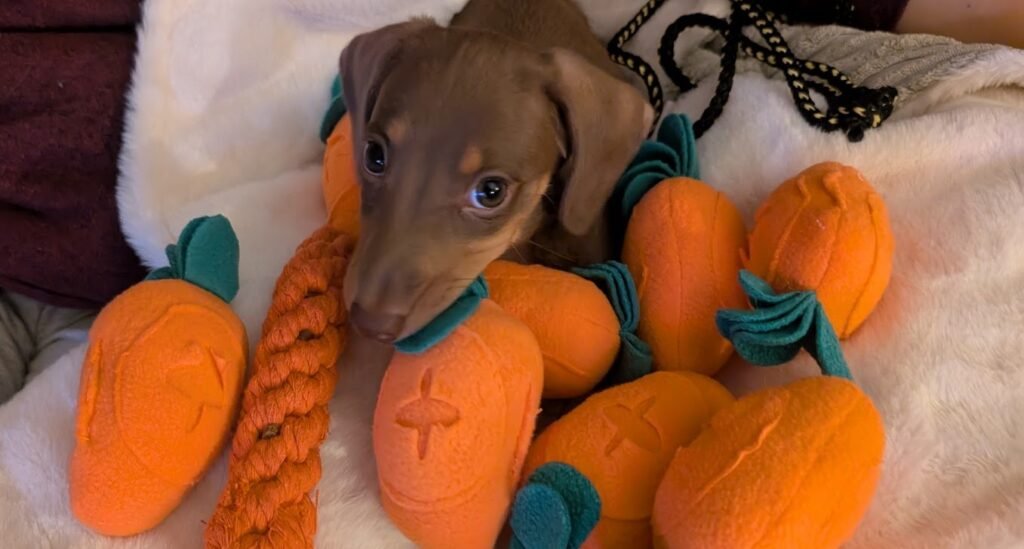
Sometimes we put treats in the carrots.
Sometimes we put a treat in the pocket too.
And recently, we have made it harder by placing plastic cups over each carrot so Winston has to work out that extra step first.
We also use the carrots on their own.
We put a treat inside each one, hide them around the house or garden, and then ask him to “find it.”
He loves this.
It turns into a little search mission, which is exactly the sort of thing that seems to suit a dachshund brain.
Nose down.
Tail busy.
Very serious work happening.
6. Lick Mats
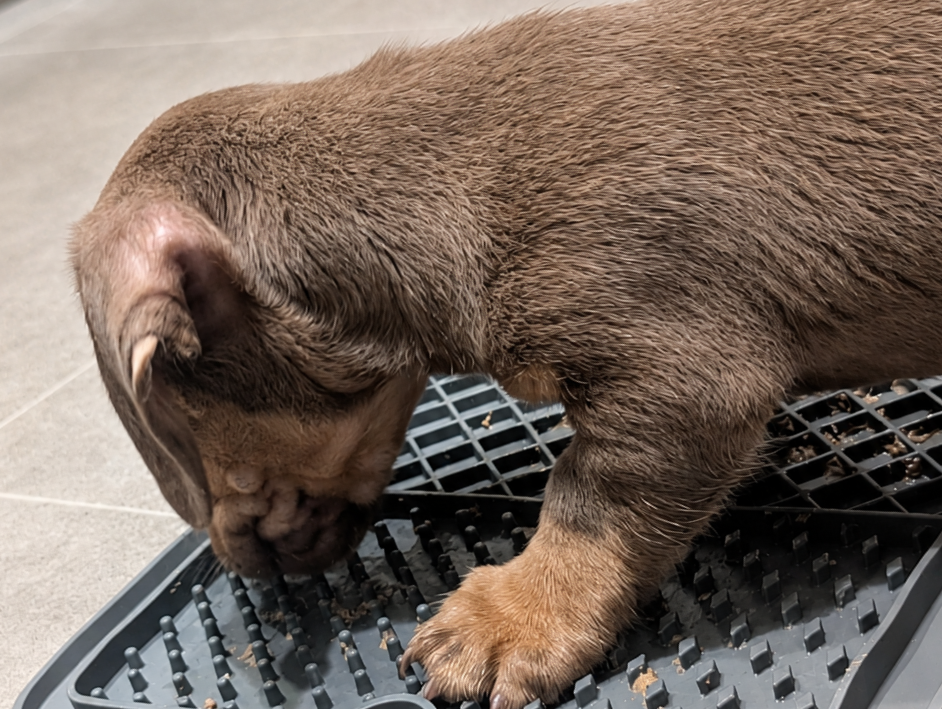
Lick mats are another thing we have used with Winston from when he was a puppy.
A lick mat is usually a silicone or rubber mat with a textured surface. You spread something dog-safe over it, and your dog has to lick it off slowly.
It is probably more calming enrichment than hard problem-solving, but I still think it belongs in this article.
Because it gives your dog something to focus on.
It slows them down.
It can help them settle.
And it still gets their brain involved in a gentle way.
You could use things like:
- dog-safe wet food
- soaked kibble
- dog-safe yoghurt
- mashed banana in small amounts
- dog-safe soft treats
- a suitable complete food paste
We used one with Winston as a puppy, and it was really helpful for calmer moments.
Lick mats were one of the simple things we had ready when Winston first came home. We’ve shared more of that early setup in our Dachshund Puppy Essentials Checklist.
Not every activity has to be a big challenge.
Sometimes the best thing is just something gentle that keeps them occupied and settled.
7. Basic Training Counts Too
This is one people sometimes forget.
Training is mental stimulation.
And in a pinch, it is one of the easiest forms of mental stimulation there is.
You do not need a toy.
You do not need a special setup.
You just need a few minutes, some rewards and a dachshund who is willing to cooperate.
Which, admittedly, may depend on the dachshund.
We try to do little bits of training with Winston most days.
Some of the more useful things we practise are:
- sit
- stay
- down
- wait
- come
- settle
And then there are the less essential, but very cute, ones:
- spin
- go around
- under our legs
- “bop” for nose five
- kisses, because we love Winston kisses
Training is such a good outlet because your dog has to listen, focus, think and respond.
Even five minutes can make a difference.
And with a dachshund, five minutes of proper focus is not nothing.
8. Hide-and-Seek Style Games
Hide-and-seek games are another easy way to get your dachshund using their brain.
You can hide treats.
You can hide toys.
You can hide yourself.
You can hide something that smells interesting.
Then ask them to find it.
Start really easy.
Do not make the first few goes too difficult, because you want them to understand the game and enjoy it.
Once they get the idea, you can make it gradually harder by hiding things:
- behind cushions
- under blankets
- in their bed
- behind furniture
- in different rooms
- around the garden
- under safe plastic cups
Winston seems to really enjoy having a job to do.
And “find it” games give him exactly that.
Even if he does sometimes act like he is doing us a favour.
9. Food Games Using Their Normal Meals
One thing we have found really useful is using Winston’s normal food for games.
Not every brain game needs to involve lots of extra treats.
You can use part of their breakfast or dinner in:
- snuffle mats
- snuffle balls
- puzzle feeders
- scatter feeding
- lick mats
- treat hunts
- slow feeders
This is especially helpful if you are trying to keep an eye on their weight.
And with dachshunds, that is always worth thinking about because they can be very convincing when they want food.
Winston would absolutely tell you he has never been fed in his life.
Even if he has just eaten.
Probably especially if he has just eaten.
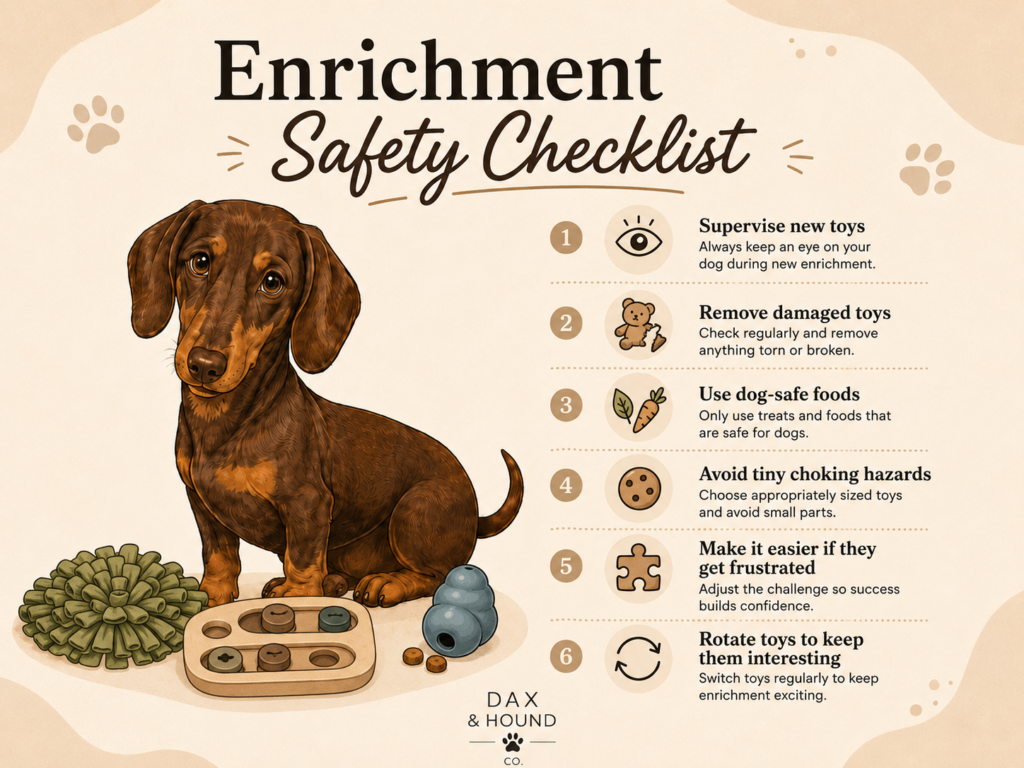
10. Keep It Safe and Supervised
As much as we love enrichment toys, it is important to use them safely.
Different dogs play in different ways.
Some sniff carefully.
Some gently work things out.
Some try to throw the entire toy across the room.
Some try to chew their way directly through the problem.
So we always think supervision is important, especially with anything that has fabric, small parts, removable pieces or food hidden inside.
Blue Cross also recommends supervising dogs with puzzle feeders, which is a good rule for any enrichment toy that contains food, fabric or moving parts.
A few things to remember:
- Choose toys that suit your dog’s size.
- Watch how they interact with new toys.
- Remove anything damaged.
- Do not leave puzzle toys out all the time.
- Make things easier if your dog gets frustrated.
- Avoid very tiny treats that could be inhaled quickly.
- Use safe, dog-appropriate foods only.
The aim is for enrichment to be fun, not stressful or risky.
11. Rotate Toys Instead of Leaving Everything Out
This has helped us a lot.
If every toy is out all the time, they stop feeling exciting.
They just become part of the furniture.
So instead of giving Winston access to every enrichment toy every day, we rotate them.
One day might be a snuffle mat.
Another day might be a puzzle board.
Another day might be scatter feeding, a lick mat and a bit of training.
It keeps things more interesting, and it means you do not need endless toys to keep your dog busy.
A few good options, rotated properly, can go a long way.
12. Start Easy, Then Make It Harder
This is probably one of the biggest things we have learnt.
Start easier than you think you need to.
It is really tempting to buy a puzzle toy, fill every compartment and expect your dog to just work it out.
But if it is too hard straight away, they may get frustrated or lose interest.
With Winston, we usually show him the idea first.
We make it easy.
We let him succeed.
Then once he understands the game, we make it a little harder.
That way, he enjoys it.
He has learnt that using his brain is rewarding, and that makes him much more interested in trying new things.
13. Know the Difference Between Tired and Overwhelmed
Mental stimulation should be enjoyable.
It should not leave your dog stressed, frustrated or frantic.
Some games are exciting.
Some are calming.
Some are harder.
Some are easier.
And different days call for different things.
If your dachshund starts getting annoyed, flinging the toy around, barking at it, giving up or looking frustrated, it may be too difficult.
That is your sign to make it easier or switch to something calmer.
Winston definitely has days where he wants a proper challenge.
And days where he would rather do something simple and then have a nap.
Relatable, really.
What We Use Most with Winston
If I had to narrow it down, the mental stimulation games we use most with Winston are:
- snuffle mats
- snuffle balls
- puzzle boards
- scatter feeding
- “find it” scent games
- the carrot puzzle toy
- lick mats
- short training sessions
We use some form of mental stimulation most days, even if it is only something small.
Sometimes it is part of his meal.
Sometimes it is a garden game.
Sometimes it is five minutes of training.
And sometimes it is simply damage control because we can tell a bored dachshund is about three minutes away from inventing his own entertainment.
And nobody needs another stolen flip flop situation.
Final Thoughts
Mental stimulation games have made such a difference for Winston.
They help tire him out in a good way, give him something purposeful to do, and make everyday life easier when walks are shorter, the weather is bad or he just needs a bit more to do.
And the best part is that it does not have to be complicated.
You do not need a huge setup.
You do not need to spend a fortune.
Some of the best things we do are incredibly simple.
A few treats in the grass.
A hidden toy.
A little “find it” game.
A short training session.
A lick mat.
A snuffle toy.
That is often more than enough.
Because if there is one thing Winston has taught us, it is that dachshunds really do need things to do.
If not, they will come up with their own plan.
And there is every chance that plan will involve stolen footwear.
At Dax & Hound Co., everything we share comes from life with Winston and the things we are learning along the way. We are not behaviourists or vets — just dachshund owners who have learnt that a busy little sausage dog is usually a much happier one.

Leave a Reply