
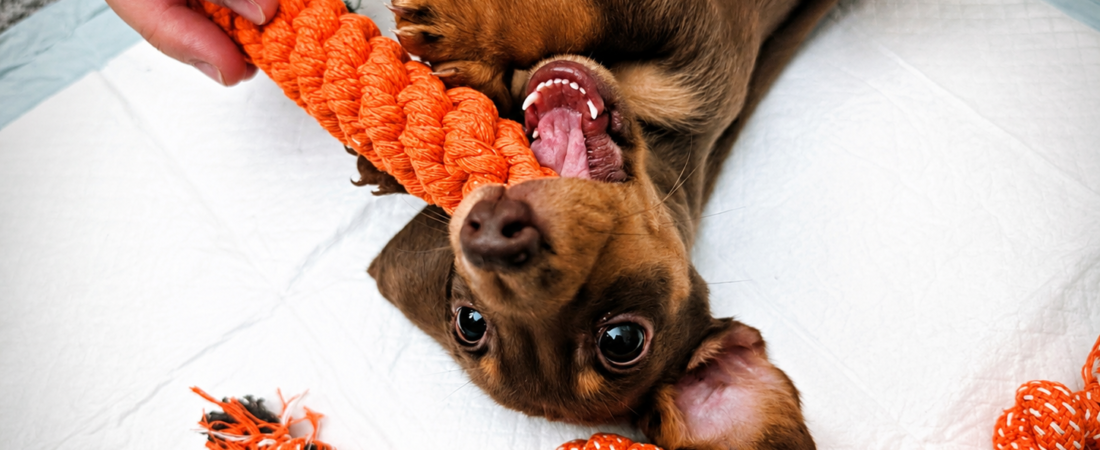
Quick answer: The main essentials for a dachshund puppy are a safe sleeping area, crate or puppy pen, food and water bowls, puppy food, toilet training supplies, safe toys, a collar or harness, lead, ID tag, grooming basics, cleaning products, vet registration, insurance, and a few dachshund-friendly extras like non-slip mats, ramps, stair gates and mental stimulation toys.
Before Winston came home, we genuinely thought we were prepared.
We had the crate.
We had the pen.
We had the bed, the puppy pads, the toys, the camera, the carrier, the bowls, the blankets, the cleaning spray — honestly, it felt like we had half the puppy aisle ready in our living room.
And in a practical sense, we were prepared.
But emotionally?
My goodness.
Nothing quite prepares you for how exhausting those first few weeks can feel.
Not in a bad way. Just in a very real, very tired, Googling-things-at-2am kind of way.
So this checklist is not about buying every puppy product on the internet.
It is about what we actually used with Winston, what helped, what we bought quickly after, what he ignored completely, and what we would absolutely buy again if we were bringing home a dachshund puppy all over again.
Because dachshund puppies are tiny, but they are not simple.
They are clever, stubborn, dramatic, full of opinions, and usually have absolutely no idea that their backs need protecting.
This post may contain affiliate links. If you buy through one of our links, we may earn a small commission at no extra cost to you.
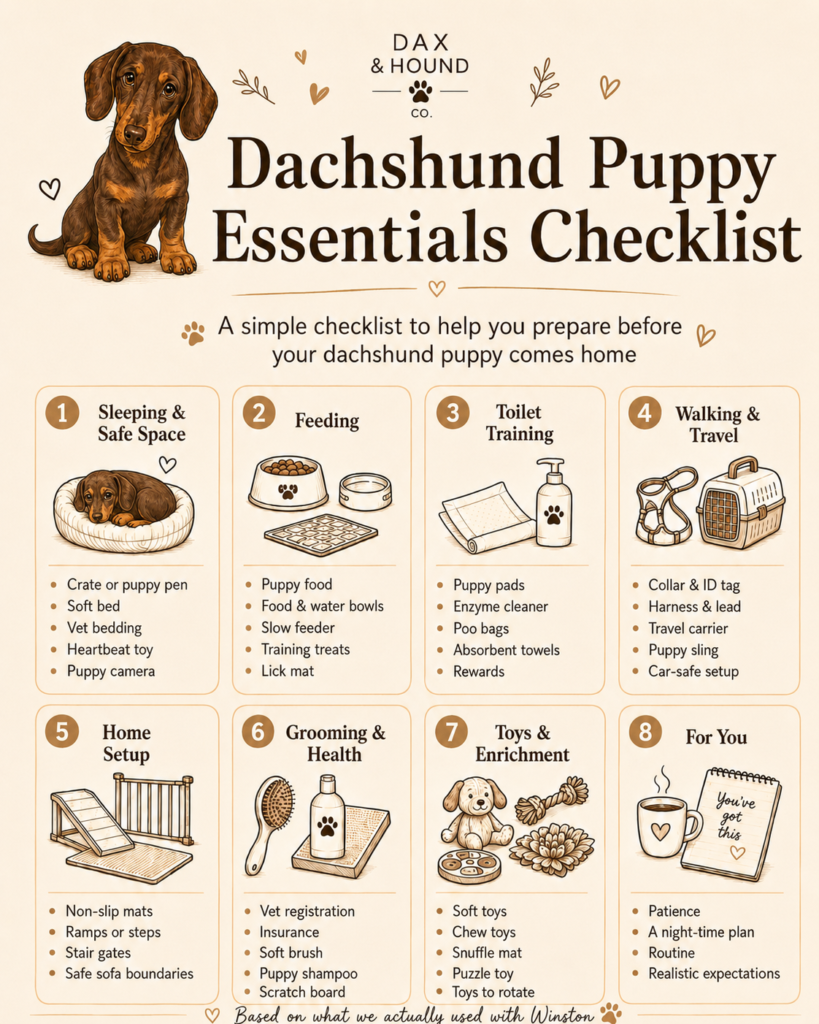
Dachshund Puppy Essentials Checklist
Here’s a simple checklist you can save or use while preparing for your dachshund puppy. Click each section heading to jump to the part of the guide with more detail.
Sleeping and Safe Space
- Crate or puppy pen
- Soft puppy bed
- Washable blankets
- Vet bedding
- Comfort toy
- Heartbeat toy
- Heat pack
- Jumper or blanket with familiar smells
- Water bowl
- Puppy pads
- Safe toys
- Baby gate or room divider
- Puppy camera, optional but very useful
Feeding
- Current puppy food
- Food bowl
- Water bowl
- Slow feeder
- Measuring scoop or kitchen scales
- Training treats
- Food storage container
- Lick mat
- Dog-safe spread or softened food for enrichment
Toilet Training
- Puppy pads
- Poo bags
- Enzyme cleaner
- Kitchen roll
- Absorbent towels
- Garden toilet area
- Small treats for rewards
- Spare bedding
- Patience
Walking and Travel
- Collar
- ID tag
- Puppy harness
- Lightweight lead
- Travel carrier or crate
- Puppy sling
- Car-safe setup
- Poo bag holder
- Portable water bottle, useful later
Dachshund-Friendly Home Setup
- Non-slip mats or rugs
- Ramp or steps where needed
- Stair gates
- Safe sofa boundaries
- Blocked-off stairs
- Safe crate and pen area
- Supervised furniture access
Grooming and Health
- Vet registration
- Vaccination paperwork
- Microchip details
- Insurance
- Flea and worming advice from your vet
- Soft brush
- Puppy shampoo
- Absorbent towels
- Nail clippers or nail file
- Scratch board, if needed
- Dog toothbrush
- Dog-safe toothpaste
Toys and Enrichment
- Soft toys
- Comfort toys
- Puppy-safe chew toys
- Lick mat
- Snuffle mat
- Simple puzzle toy
- Treat pouch
- Safe chews
- Interactive toys
- Toys to rotate
For You
- Patience
- Annual leave, if possible
- A night-time toilet plan
- A routine
- A folder for paperwork
- Lots of kitchen roll
- Realistic expectations
- Someone to remind you that you are doing fine
You definitely do not need to buy everything on the internet before your puppy comes home.
We probably bought more than we needed, because we were excited and wanted to feel prepared, but these are the things that either helped us straight away or became useful very quickly once Winston was home.
What We Actually Had Ready for Winston
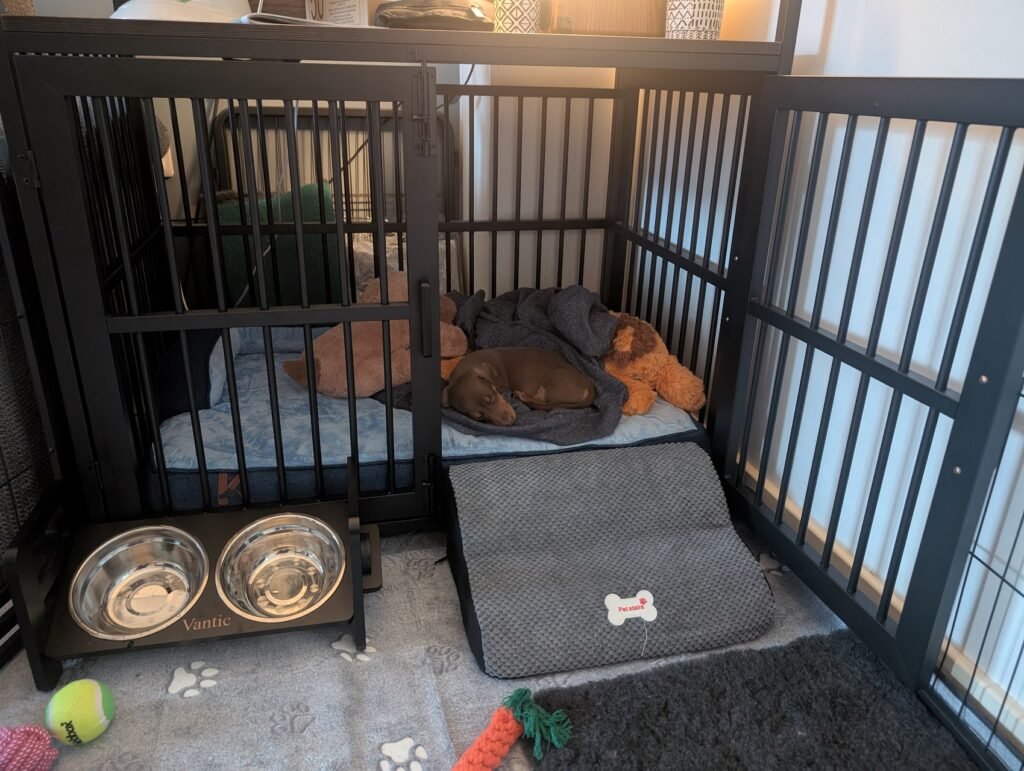
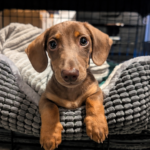
For Winston’s first setup, we had a larger furniture-style crate in the lounge with a memory foam bed inside.
Because the crate had a slightly higher lip than a typical puppy crate, we also added a little foam ramp so he could get in and out more easily.
Looking back, I actually think this helped him get used to ramps from the beginning, which has been really useful now that he is older.
Around the crate, we had a puppy pen so he had a safe area when he was awake. When he was napping, we would shut him in the crate, even if that meant carefully moving him from wherever he had fallen asleep.
And usually, that was on our laps.
Because when he was a tiny puppy, being close to us seemed to comfort him most.
When he was awake, we opened the crate up into the pen. Inside the pen, we had a washable waterproof mat, a disposable puppy pad in one corner, his water bowl, food bowl, toys, vet bedding, heartbeat toys, and a jumper that smelt of us and where he came from.
It sounds like a lot, and honestly, it probably was.
But at the time, we just wanted him to feel safe.
Sleeping and Safe Space
This was probably the most important part of Winston’s early setup.
Before you think about toys, treats, collars or cute little accessories, your dachshund puppy needs somewhere safe, calm, and comfortable to sleep and settle.
For Winston, that was a crate and pen setup in the lounge.
Some people use a crate.
Some use a pen.
Some use both.
We did a bit of both, and it worked really well for us.
His crate was his sleeping space, and the pen gave him a bit more room when he was awake but still needed to be somewhere safe.
This mattered because Winston was not one of those puppies who magically slept all the time.
He would keep going and going until he was overtired.
So having a safe area helped us introduce proper nap times.
And forced naps became a huge part of our puppy routine.
Our crate and pen setup
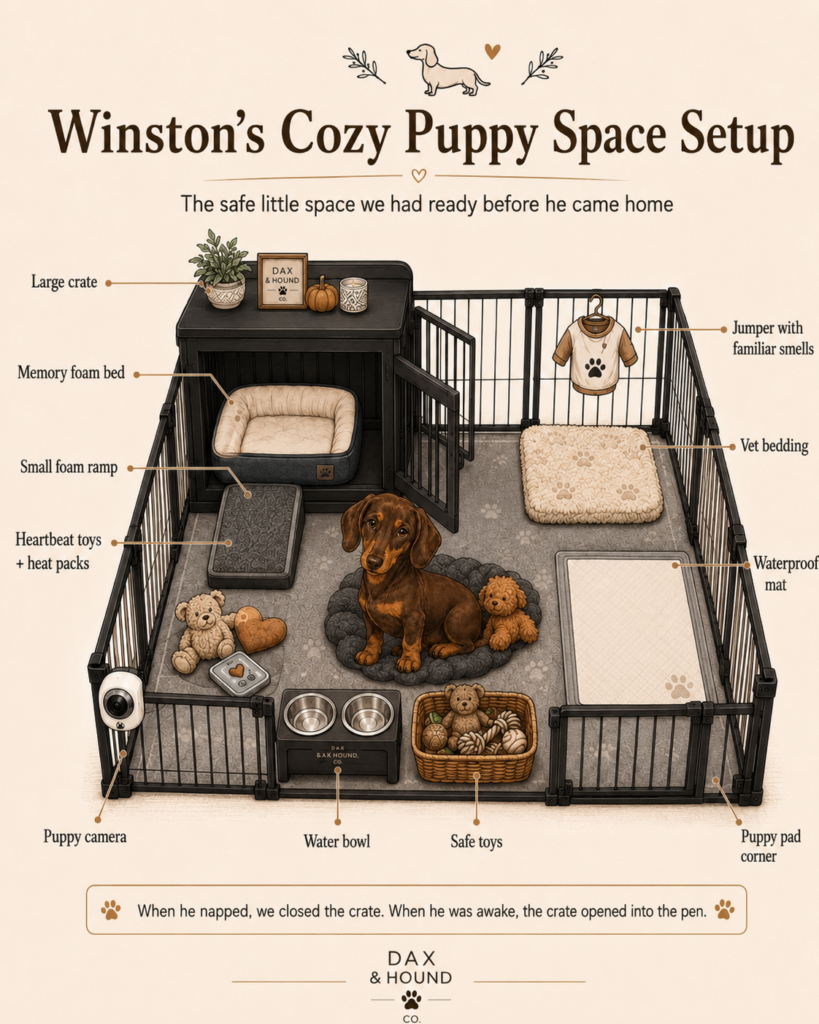
What we had in Winston’s puppy setup:
- a larger furniture-style crate
- memory foam bed inside the crate
- small foam ramp for getting in and out
- puppy pen around the crate
- washable waterproof mat
- puppy pad in one corner
- water bowl
- food bowl, later replaced with a slow feeder
- vet bedding
- soft heartbeat toys
- heat packs
- safe puppy toys
- a jumper that smelt of us and the breeder’s home
- puppy camera nearby
The goal was not to shut him away and ignore him.
It was to give him somewhere safe, familiar, and calm while he learnt how to settle.
Because a tired dachshund puppy can become a tiny gremlin very quickly.
Bed, blankets and vet bedding
Inside Winston’s crate, we had a memory foam bed.
We also had vet bedding in his pen area, and he still has several pieces of vet bedding throughout the house now.
It has been one of those things that has lasted well beyond the puppy stage.
Dachshunds love comfort.
Winston definitely does.
So soft, washable bedding was really useful from day one.
In the early puppy days, washable things are your friend.
There are accidents.
There are wet paws.
There is food.
There is teething.
There is mystery dampness.
There is washing.
So much washing.
I would not necessarily rush to buy the most expensive bed before your puppy comes home, because puppies chew, drag things around and have accidents.
But a safe, cosy, washable bed or blanket setup is definitely worth having.
What we’d look for:
- washable
- soft and cosy
- not too high to climb into
- suitable for a tiny puppy
- easy to move around
- quick to dry
- not full of small bits they could chew off
Winston’s bed and blankets helped make his little area feel like his own.
And when you first bring home a puppy, anything that helps them feel safe is worth having.
Heartbeat toys, heat packs and the jumper trick
This is one of the things we genuinely feel made a huge difference for Winston.
We had two soft dog toys with fake heartbeat inserts inside them. We also had little heat packs that could go inside the toys to make them warm and comforting.
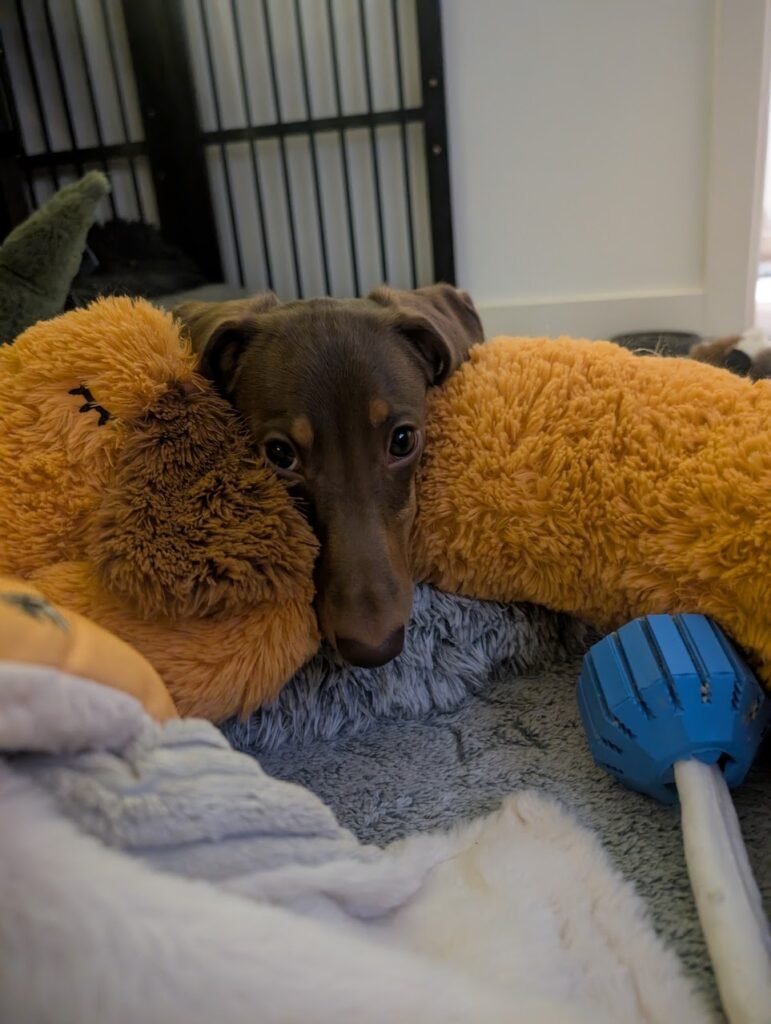
Winston would always tuck himself up next to them.
It was honestly so sweet.
We also sent a jumper to the breeder before Winston was ready to come home. Both of us had worn it, so it smelt like us, and then it picked up the smell of where he came from too.
So when he came home, it had a mixture of our smell and the smell of his first home.
We really feel that helped him settle.
He loved that jumper.
During the worst part of his teething phase, he did eventually tear through it, but in those first few weeks, it was such a comfort for him.
One little thing I still remember is warming his jumper in the dryer after his night-time toilet trips.
When we brought it back and put it in his crate, he would run in, burrow into it and settle back down.
It sounds like such a tiny thing, but at the time it felt like we had discovered magic.
First nights and sleeping downstairs
Winston slept in his closed crate on the first night with his jumper, heartbeat toys and heat packs.
One of us slept downstairs on the sofa near him.
He woke up several times crying because he needed the toilet, but other than that, he actually slept really well.
His bladder was just tiny.
Very tiny.
For the first week, we took it in turns to sleep downstairs because he needed to be taken out during the night. We quickly started making notes of his schedule, when he would usually wake up, and when he needed to go out.
After that first week, we started leaving him downstairs on his own and setting alarms to go down before he became unsettled.
The puppy camera helped massively with this.
We also found that Winston settled a lot better when we left his crate open into his pen, so he could come out if he wanted to.
That worked for us.
Full crating might work better for other puppies, but for Winston, having that little bit of choice seemed to help him feel more settled.
I think this is one of those things where you have to learn your own dog.
There is not always one perfect way.
There is the way that keeps your puppy safe, settled and comfortable.
Puppy camera
The puppy camera was one of the best things we bought.
Honestly.
We had it set up and ready before Winston came home, and it helped with so much more than just checking on him.
It recorded movement, so we quickly started to understand his schedule. We could see when he usually woke up, when he was just shifting around, and when he actually needed us.
It also helped massively with separation training.
We could leave the room or the house and watch for signs that he was becoming anxious, then return before he got to the point of crying or barking.
And honestly, in those early days of phantom puppy cries — when you are convinced you heard something, but they are actually fast asleep — it gave us so much peace of mind.
If you know, you know.
Those little sounds you think you hear when they’re asleep.
The sudden panic that they’re crying.
The checking, rechecking, listening, wondering, worrying — only to realise they are completely fine and fast asleep.
They are definitely a thing.
Why we found the camera so useful:
- it helped us learn Winston’s routine
- it gave us peace of mind at night
- it helped with phantom puppy cries
- it made separation training easier
- it let us check without disturbing him
- it helped us judge when he actually needed us
You do not absolutely need a puppy camera.
But for us, it was worth every penny.
Separation training
We had a plan for separation training from the start, but we took it very slowly.
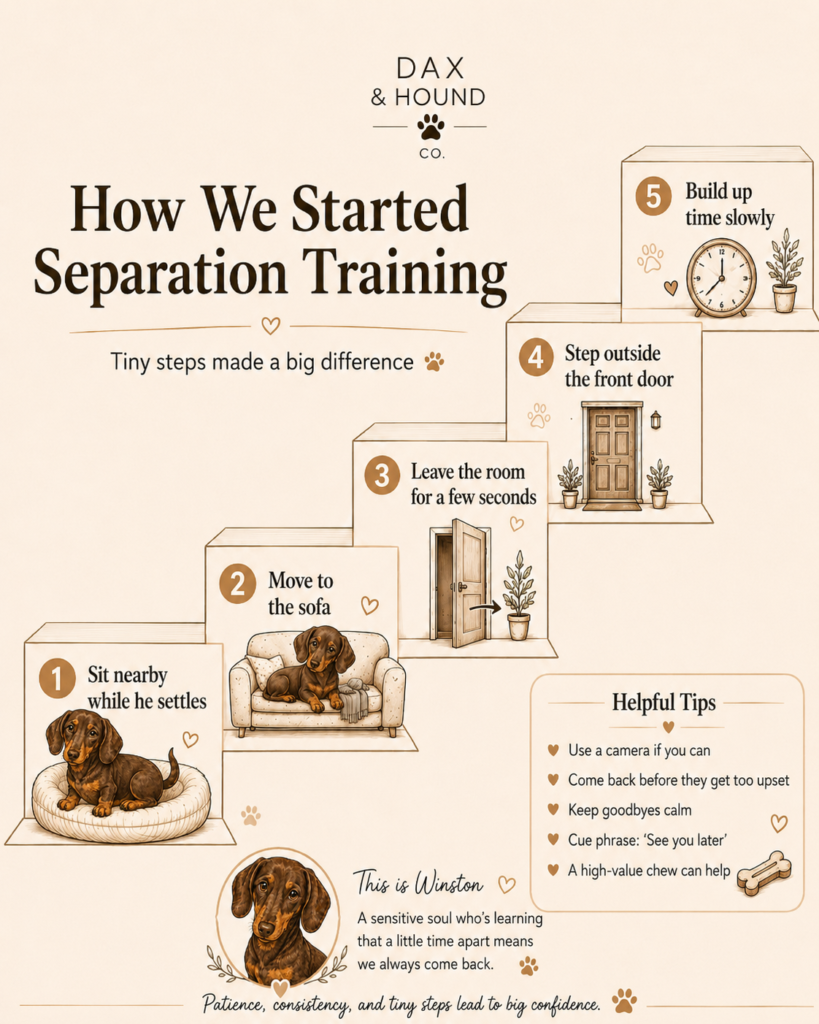
At first, we would help Winston settle for a nap or bedtime by sitting in his pen with him. He would very happily fall asleep on our laps.
Once he was asleep, we would place him in his crate and move to the sofa.
Then we built that up to leaving the room.
Then going upstairs.
Then going out into the hallway.
Eventually, going out the front door.
We also have a cue phrase that we have always used when we are leaving him for a longer period of time:
“See you later.”
The camera came in really handy here because we could watch him and return before he became too anxious.
We also learnt a really helpful technique where we would leave him with a high-value chew and then take it away as soon as we returned.
The idea is that your leaving becomes linked with something good that only happens when you are gone.
This worked fantastically for Winston.
It helped him understand that us leaving was not scary, and that something good happened when we did.
What helped Winston with separation training:
- starting very slowly
- leaving for just a few seconds at first
- using the camera
- returning before he became too anxious
- using a calm leaving phrase
- high-value chews when we left
- taking the chew away when we returned
- building up time gradually
It was not something we rushed.
And I am really glad we took it slowly.
Feeding
Feeding was one of those things we thought would be fairly simple.
Food bowl. Water bowl. Puppy food.
Done.
Except Winston had other ideas.
Food bowls, water bowls and slow feeders
We had food and water bowls ready before Winston came home.
But we very quickly replaced his normal food bowl with a slow feeder.
Because Winston scoffed his food.
We expected him to enjoy it, obviously.
We did not expect him to inhale it quite so dramatically.
So the normal food bowl was quickly replaced with a slow feeder, and that made mealtimes much better.
Useful feeding items:
- food bowl
- water bowl
- slow feeder
- measuring scales or scoop
- food storage container
- training treats
- washable mat underneath
A slow feeder was definitely one of those things we did not realise we would need quite so quickly.
But with Winston, we absolutely did.
Puppy food, treats and weighing portions
Winston came home on Wainwrights chicken puppy food.
After about a month, we transitioned him to Wainwrights salmon with rice because it seemed easier on his stomach.
Then, after another month or so, we started mixing in Platinum puppy chicken.
For a long time, he had around a 50/50 mix of the two dry foods.
We have always weighed and calorie-counted Winston’s food from day one, and we still do now.
Dachshunds can gain weight easily, and because of their long backs, we wanted to be really careful from the start.
Winston was also very food-motivated as a puppy, which made training much easier.
Very convenient for us.
Very convenient for him too, obviously.
For training, we mainly used Platinum chicken and lamb Click-Bits or part of his normal dry food allowance. Even though the treats were small, we still split them in half because he was even smaller.
Not literally, of course.
But my goodness, he was tiny.
Food things to prepare:
- the food your puppy is already eating
- training treats
- food scales
- slow feeder
- water bowl
- food storage
- plan for meals
- plan for toilet trips after food and drink
Keeping food consistent at first can be helpful because coming home is already such a huge change.
New home.
New people.
New smells.
New routine.
New everything.
So we would always be careful about changing food gradually and speaking to a vet if unsure.
Weight tracking and puppy scales
We bought small scales to monitor Winston’s weight while he was growing.
He only just about fits on them now, but they were really useful when he was tiny.
Because we were weighing and calorie-counting his food from day one, it made sense to keep an eye on his weight too.
Dachshunds can gain weight easily, and keeping them at a healthy weight is one of those things that really matters because of their long backs.
You do not necessarily need fancy scales, but having some way of tracking weight can be helpful, especially in the early months.
Weight and food tracking helped us with:
- portion control
- puppy growth
- treat allowance
- food changes
- peace of mind
- keeping Winston at a healthy weight
It might sound a bit extra, but for us, it was useful.
And honestly, in those early days, anything that gave us a little more confidence was welcome.
Toilet Training
Toilet training was one of the biggest early lessons for us with Winston. If you want the full routine we used, including puppy pads, night-time toilet trips, rainy weather and accidents, read our full guide: How to Toilet Train a Dachshund Puppy.
Toilet training was one of the hardest parts for us.
Not because Winston was bad at it.
He was a baby.
But because we had to be switched on constantly.
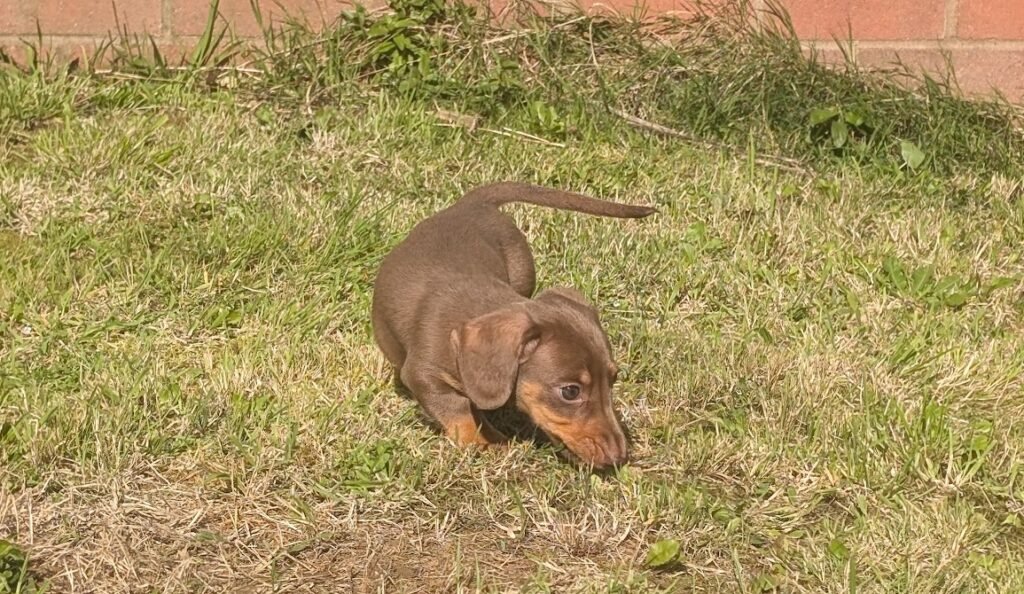
Every drink.
Every meal.
Every nap.
Every sniff.
Every suspicious little wander into a corner.
Puppy pads and toilet training supplies
We had a lovely plan when Winston came home.
The plan was simple.
Get home, take him straight outside, and start toilet training immediately.
Perfect.
Except the night we brought Winston home was one of the stormiest, windiest, rainiest nights we had all year.
Typical.
We did take him outside, but even we didn’t want to be out there, so we felt incredibly guilty putting this tiny little puppy outside in the wind and rain.
We gave it about 20 minutes and then decided to introduce puppy pads instead.
Puppy pads were a bit hit and miss at first, but within the first week, Winston did start using them.
Sometimes he missed a bit.
But he was trying.
Because we had time off work in those early weeks, we were very much on top of toilet training.
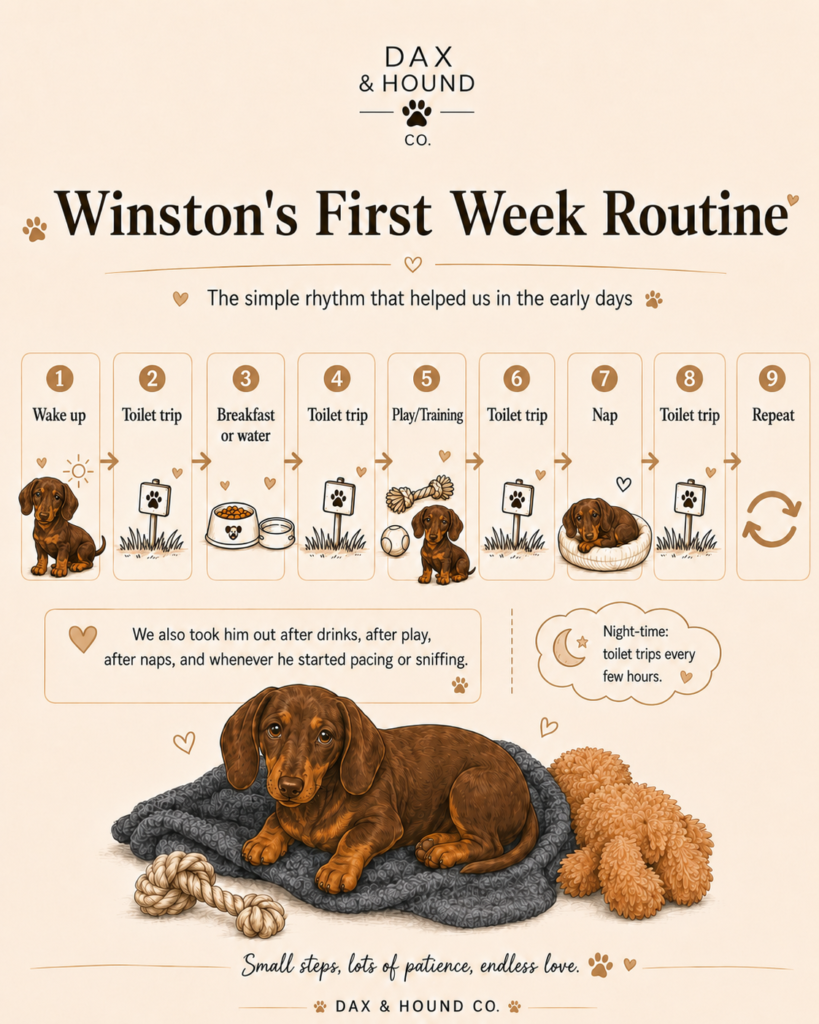
We took him out:
- every 30 minutes
- after every drink
- after every meal
- after every play or training session
- immediately after a nap
- whenever he started pacing or sniffing
We quickly noticed Winston’s signs.
He would suddenly start pacing, sniffing, or going over to a certain corner of the room.
That usually meant toilet.
So we learnt to move quickly.
When he went outside, we praised him and rewarded him.
A lot.
And he was fully toilet-trained within about two months of coming home. We have not had a single accident since.
Toilet training essentials:
- puppy pads
- poo bags
- enzyme cleaner
- kitchen roll
- washable blankets
- treats for rewards
- outdoor toilet area if possible
- lots and lots of patience
The biggest thing that helped us was routine, timing, watching his signs and rewarding him every time he got it right.
Not perfect.
Not instant.
But it worked.
Enzyme cleaner, towels and cleaning supplies
This is one of the less exciting parts of puppy life, but it matters.
Puppies have accidents.
Even when you are doing everything right.
Even when you are taking them out regularly.
Even when you are watching them like a hawk.
They are babies.
We had an enzymatic cleaner ready for early accidents in the house, and I am very glad we did.
It helps properly break down the smell, which is important because if a puppy can still smell where they have been before, they may be more likely to go there again.
We also had absorbent towels.
This was especially useful because when we got Winston, it felt like it rained non-stop for about two months.
That damn rain.
We were toilet training from day one, so he constantly had wet feet and a wet belly from going outside.
Towels by the door became essential.
Puppy cleaning kit:
- enzyme cleaner
- kitchen roll
- puppy pads
- poo bags
- absorbent towels
- washable mats
- spare bedding
- laundry detergent
- wipes if needed
It is not glamorous.
But neither is standing in the kitchen at midnight, wondering what that smell is.
We’ve written a separate guide all about toilet training a dachshund puppy, including the routine we followed with Winston, the signs we learnt to watch for, and what helped during those very wet early weeks.
Walking and Travel
Walking and travel essentials are not just about going for walks.
In those early weeks, they are also about getting your puppy home safely, going to vet appointments, and helping them experience the world before they are ready to walk on the ground properly.
Carrier and puppy sling
We had a small pet carrier ready for the day we collected Winston.
That was what we used to bring him home safely, and it was also useful for early vet trips.
It is far too small for him now, which is slightly emotional to think about, because he was genuinely that tiny.
We also had a puppy sling carrier, and this was one of the best things we did for early socialisation.
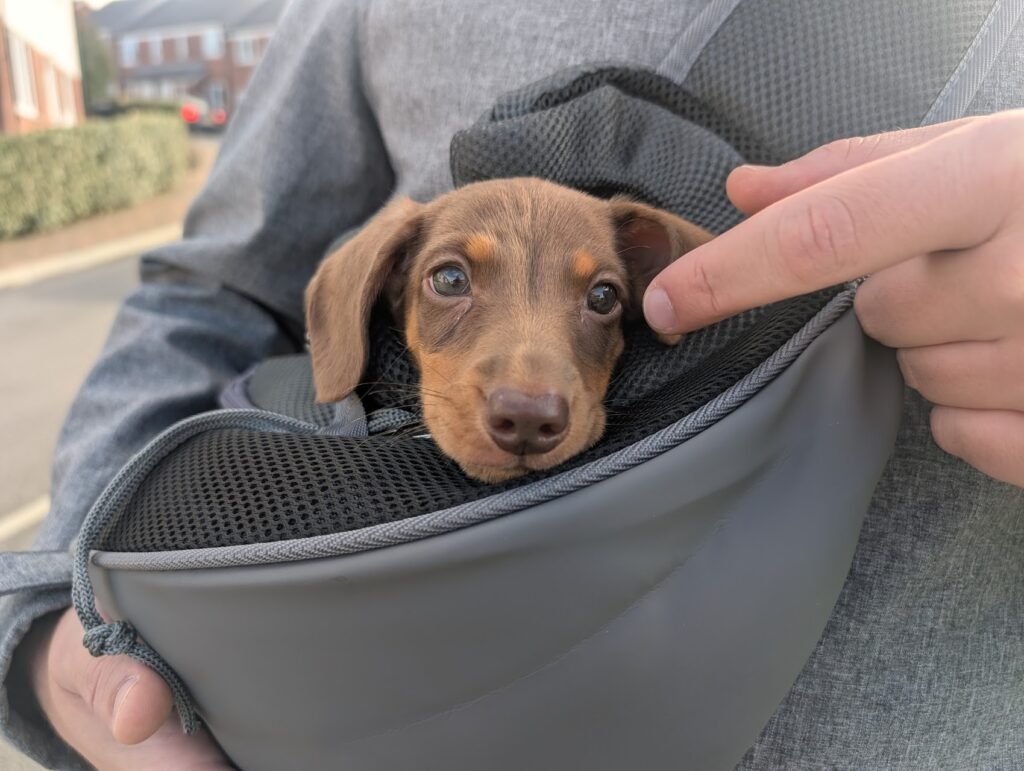
Before Winston was fully vaccinated, we used the sling to take him out for short little strolls without putting him on the ground.
This meant he could get used to people, noises, streets, traffic, and the outside world from the first week we had him, but in a way that still felt safe.
I genuinely think it helped him become the confident, non-reactive little dog he is now.
Travel and early socialisation essentials:
- small pet carrier
- puppy sling
- soft blanket
- poo bags
- treats
- calm, short outings
- safe handling
- vet guidance around vaccinations and going outside
The sling was especially useful because dachshund puppies are small, but they still need to experience the world.
Safely, gently and without overwhelming them.
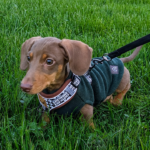
Collar, ID tag, lead and harness
We had a name tag and a collar ready for Winston.
And the collar was way too big.
We totally underestimated just how tiny he would be.
The small dog collar we bought was still too big for him, so we ended up getting him a cat collar at first.
Which is quite funny now, but at the time we were just shocked at how small he was.
That first collar is now too small for him, of course, because he grew so much.
Winston also does not really like wearing a collar in the house, so he only wears one when he is out on walks.
Walking basics:
- collar
- ID tag
- lightweight lead
- puppy harness
- poo bags
- treat pouch
- safe walking routine
For dachshunds, harness fit really matters.
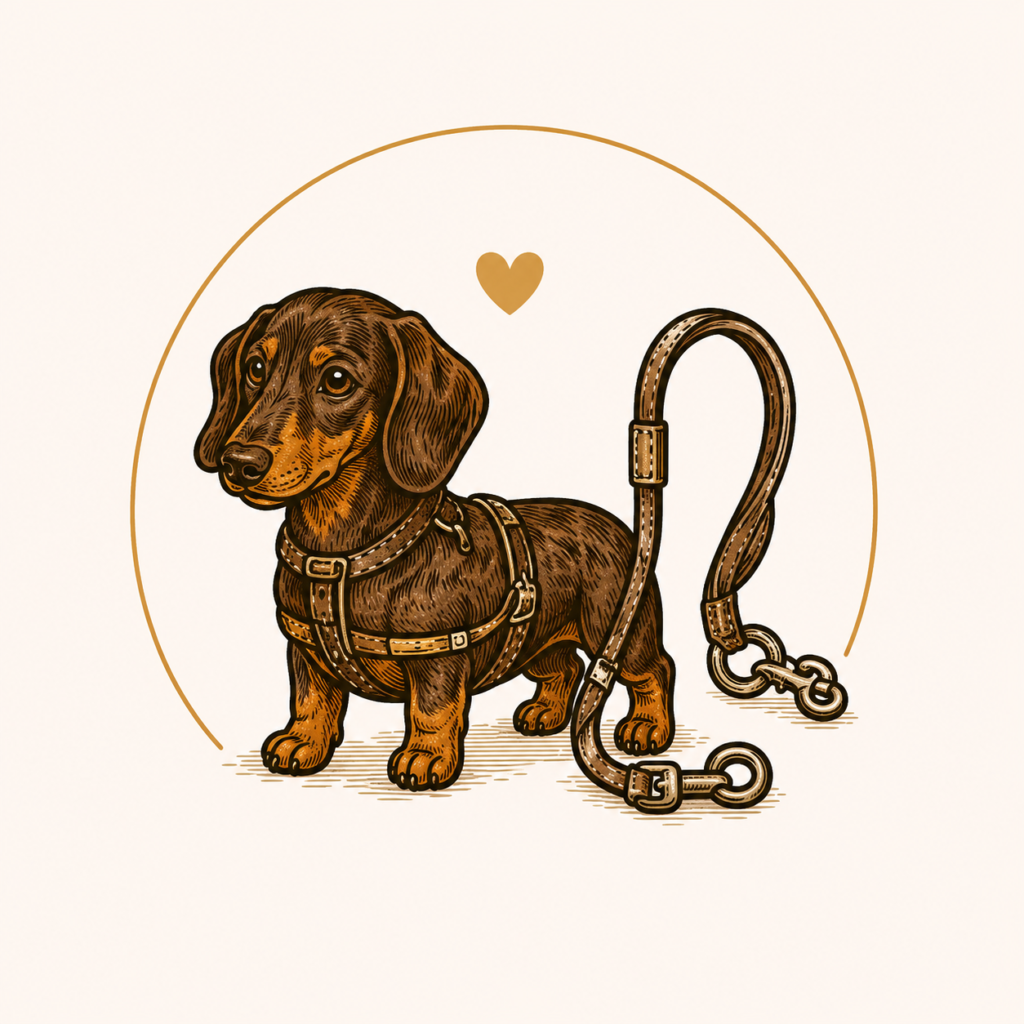
They are long and low, with deep little chests and short legs, so not every “small dog harness” will sit nicely on them.
We prefer a harness for Winston’s walks, but a collar and ID tag are still important too.
Dachshund-Friendly Home Setup
This is the part that feels especially important for dachshunds.
Before Winston came home, we had already done a lot of research on the breed, so we knew we wanted to be careful with his back from day one.
Not in a panicky way.
Just in a sensible, “let’s not let a tiny sausage dog launch himself off furniture” kind of way.
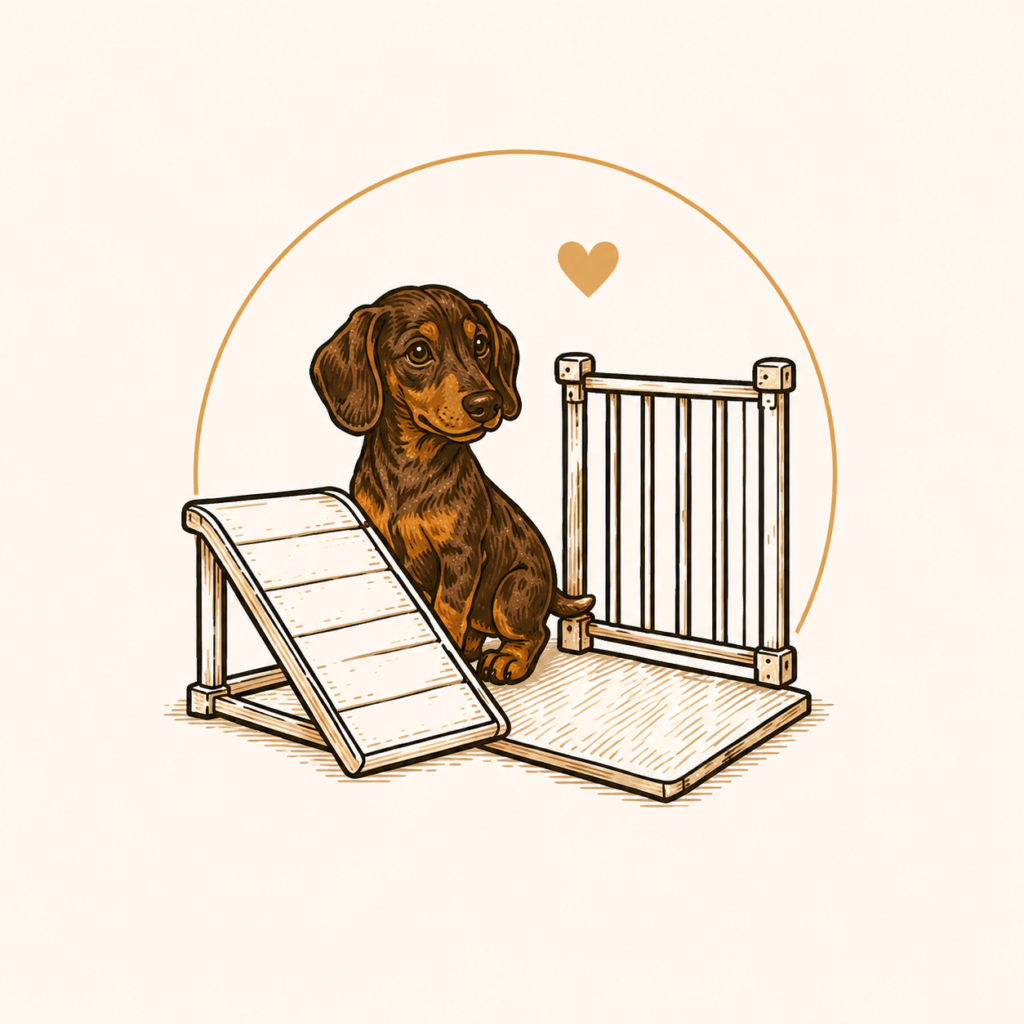
Stair gates and safe boundaries
The no-jumping rule was decided before we even got Winston.
We knew we wanted to protect his back as much as possible from day one.
That meant:
- no jumping off the sofa
- no access to stairs
- no free rein around unsafe furniture
- carrying him where needed
- using ramps when appropriate
- putting boundaries in place early
We bought stair gates for downstairs and upstairs.
When Winston was young, he was not allowed access to the stairs at all.
Now that he is older, he knows the only way up or down is by being carried, and he does not attempt them himself.
He also was not allowed free rein of the sofa until he was older and more sensible.
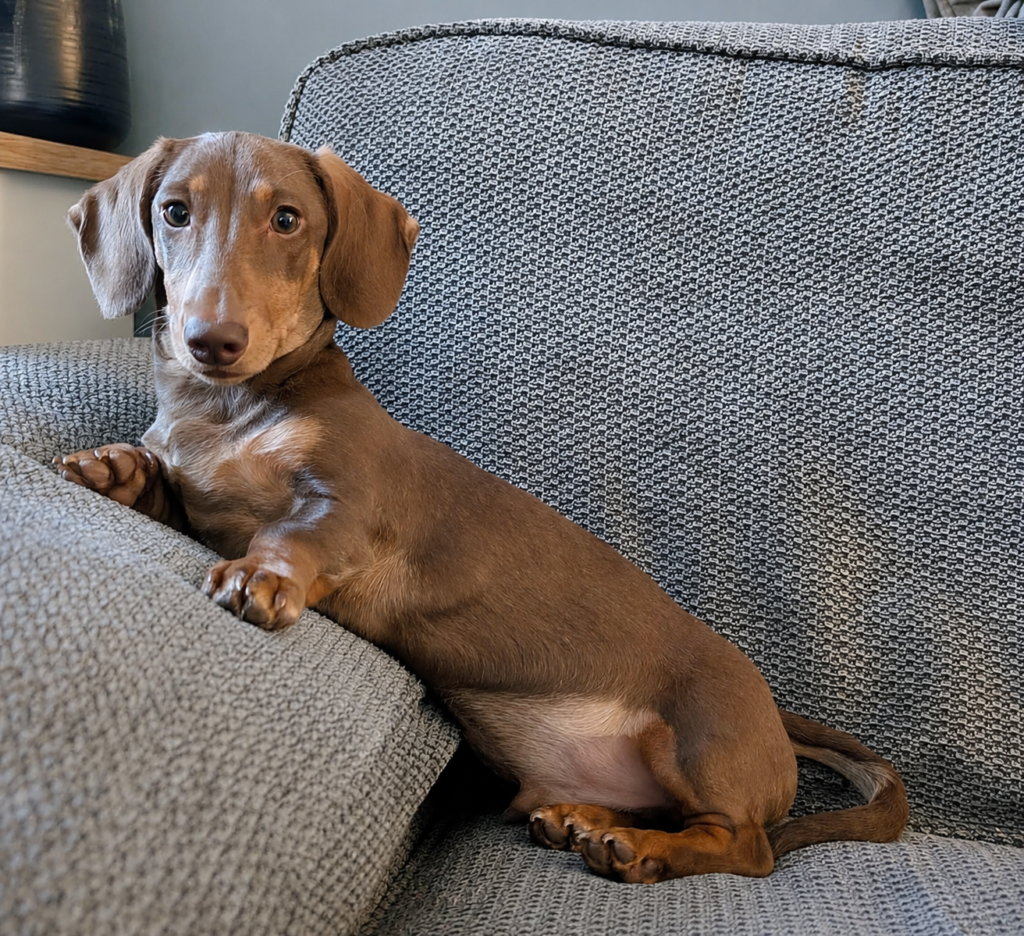
At one point, when he was very young, he did jump off the sofa, but Collette caught him using some very impressive mum reflexes.
Thankfully, he has not really tried since and now uses his ramp with confidence.
Useful safety items:
- stair gates
- room barriers
- non-slip mats
- ramps or steps
- safe crate/pen area
- supervised sofa access
- consistent rules around jumping
With dachshunds, I really think consistency helps.
If you do not want them jumping, start that boundary early.
Because once a dachshund learns they can do something, convincing them otherwise can be interesting.
And by interesting, I mean deeply inconvenient.
Ramps and back-friendly habits
The first little ramp we used was for Winston’s crate.
The lip into the crate was probably higher than ideal for such a tiny puppy, so the ramp made it easier and safer for him.
Looking back, I think it also helped him understand ramps early on.
Later, we added ramps and steps for getting in and out of the garden and onto the sofa.
When he was smaller, we used to carry him in and out of the garden until we had a proper setup for him.
The main areas we had to think about were:
- crate access
- sofa access
- kitchen/garden step
- slippery flooring
- stairs
- general jumping habits
We have hard flooring downstairs, so we used waterproof mats to give him better grip in his main area.
He has always been a confident little dog, but we still wanted his environment to make good choices easier for him.
And for us.
Grooming and Health
Some of the puppy essentials are not exciting, but they are important.
This is where things like vet registration, insurance, grooming, flea and worming advice, and basic health paperwork come in.
Not cute.
Not fun to photograph.
But very much worth sorting early.
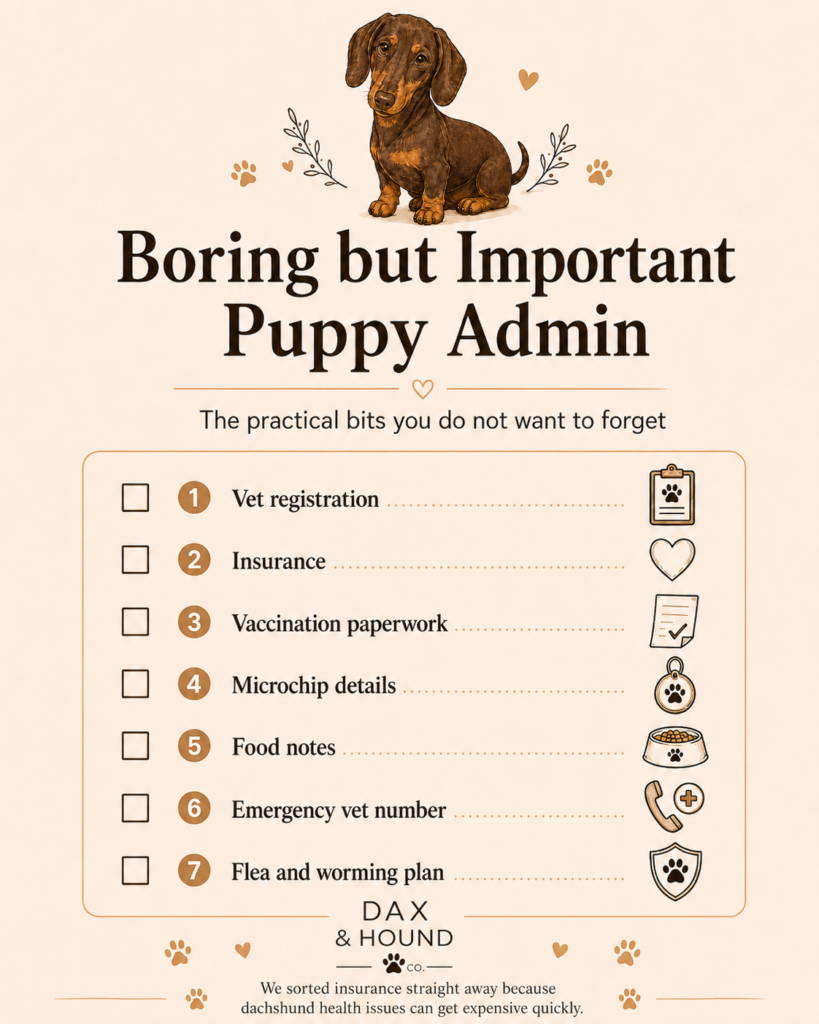
Vet registration, vaccinations and microchip details
Before or soon after your puppy comes home, it is worth getting registered with a vet and making sure you understand what has already been done.
You will usually want to check things like:
- vaccination records
- microchip details
- flea and worming advice
- weight checks
- feeding advice
- when it is safe to start walks
- any questions about your puppy’s health
Having a folder or safe place for paperwork is really useful.
In those early weeks, there is so much going on that it is easy to forget where things are.
Vaccination card.
Microchip information.
Insurance documents.
Food details.
Receipts.
Vet notes.
It all adds up.
So having it in one place can save a lot of stress.
Puppy insurance
Pet insurance was one of the things we sorted straight away.
It is not the most exciting puppy essential.
It is not cute.
It is not something you take lovely photos of for Instagram.
But for us, it felt really important.
We got Winston insured with Petplan straight away as recommended by a family member, and we chose the top level of cover because we were already aware of some of the risks and potential costs involved with dachshunds, especially IVDD.
Hopefully, it is something we never need in a serious way.
But we knew that if something did happen, we did not want money to be the thing that limited what we could do for him.
That was our thinking, anyway.
Insurance is a personal decision, and what works for one family may not be right for another, but I do think it is something worth looking into before your puppy comes home, rather than leaving it until later.
Especially with dachshunds.
They are wonderful little dogs, but they are also a breed where you need to be realistic about potential health costs.
Things to compare:
- level of cover
- annual vet fee limit
- lifetime cover options
- exclusions
- excess
- waiting periods
- dental cover
- whether hereditary or breed-related conditions are included
- how claims work
- whether your vet can claim directly
It is boring, but future you may be very glad you took the time.
Grooming basics
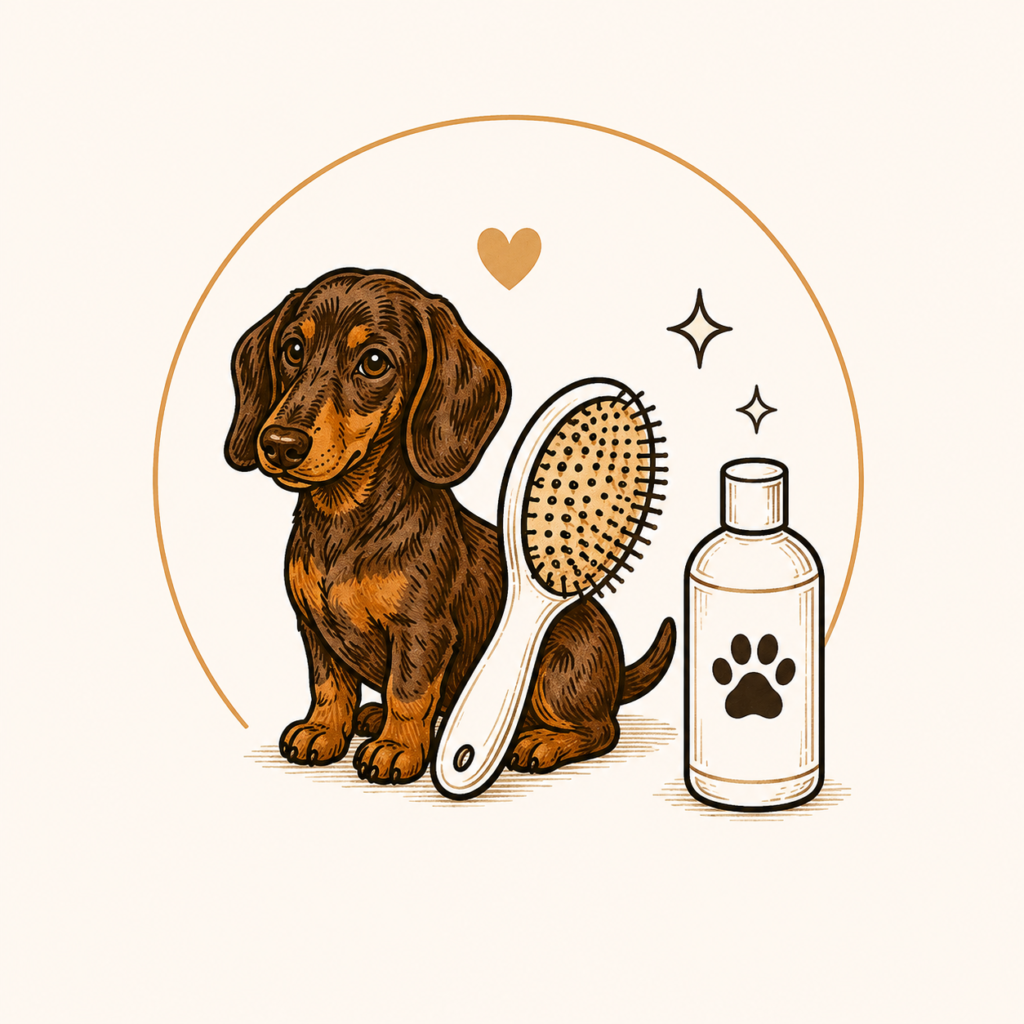
We got Winston a soft brush early on to help him get used to being groomed.
We also bought nail clippers.
We have never actually used the nail clippers.
Winston was not a fan and would not let us use them, so we later got a scratch board instead.
That works a treat, and he actually enjoys trimming his own nails.
With a reward, of course.
Because obviously.
We also had puppy shampoo ready, although I would always be careful not to over-bathe a puppy and to use suitable products.
Grooming essentials:
- soft brush
- puppy-safe shampoo
- absorbent towels
- nail clippers or nail file
- scratch board, if nail clipping is difficult
- dog toothbrush
- dog-safe toothpaste
- lots of praise
Getting them used to gentle handling early is really useful.
Paws.
Ears.
Teeth.
Harness area.
Collar area.
Body checks.
Little and often is much easier than suddenly trying to do everything when they are older and have decided they have strong feelings about it.
And dachshunds are very good at expressing strong feelings.
Toys and Enrichment
Toys and enrichment are not just about keeping a puppy entertained.
They help with teething, settling, confidence, boredom, and giving your puppy something appropriate to do.
Because if a dachshund does not have something appropriate to do, they may invent something.
And there is every chance you will not love their idea.
Puppy toys and safe chews
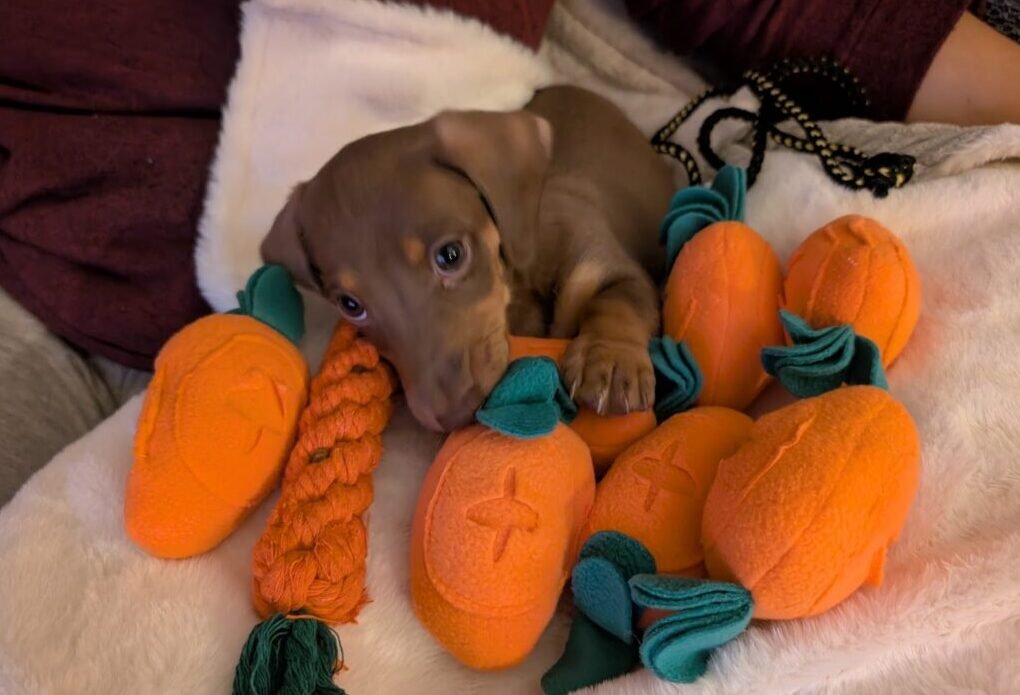
We had toys ready for Winston when he came home.
Some were useful.
Some did not survive the teething phase.
Some were basically ignored.
That is puppy life.
Winston loved soft things the most.
His heartbeat dogs, his jumper, vet bedding, soft toys — anything cosy seemed to be his favourite early on.
We also got him an interactive toy that sent him into full hyper puppy mode.
I have a video of it, and honestly, it is exactly what you would expect from a tiny dachshund discovering something exciting.
On the other hand, he never really bothered with some of the softer chew toys, like his Nylabone.
They remain basically untouched to this day.
Very Winston.
Good puppy toy options:
- soft toys
- comfort toys
- safe chew toys
- lick mats
- snuffle mats
- simple puzzle toys
- gentle tug toys
- interactive toys
- toys you can rotate
Always supervise new toys and check them regularly for damage.
Puppies can be surprisingly determined.
Dachshunds even more so.
Teething, chewing and “shark mode”
Winston was not hugely destructive as a puppy.
He liked to steal socks when we were doing laundry, but he did not really chew them.
When we returned to work and started leaving him alone for several hours, he did briefly chew the corners of the skirting boards.
But honestly, the damage was barely anything at all.
Just a little bit of chipped paint.
He also occasionally bit the sofa when he was being stroppy and overtired, but he never really did damage.
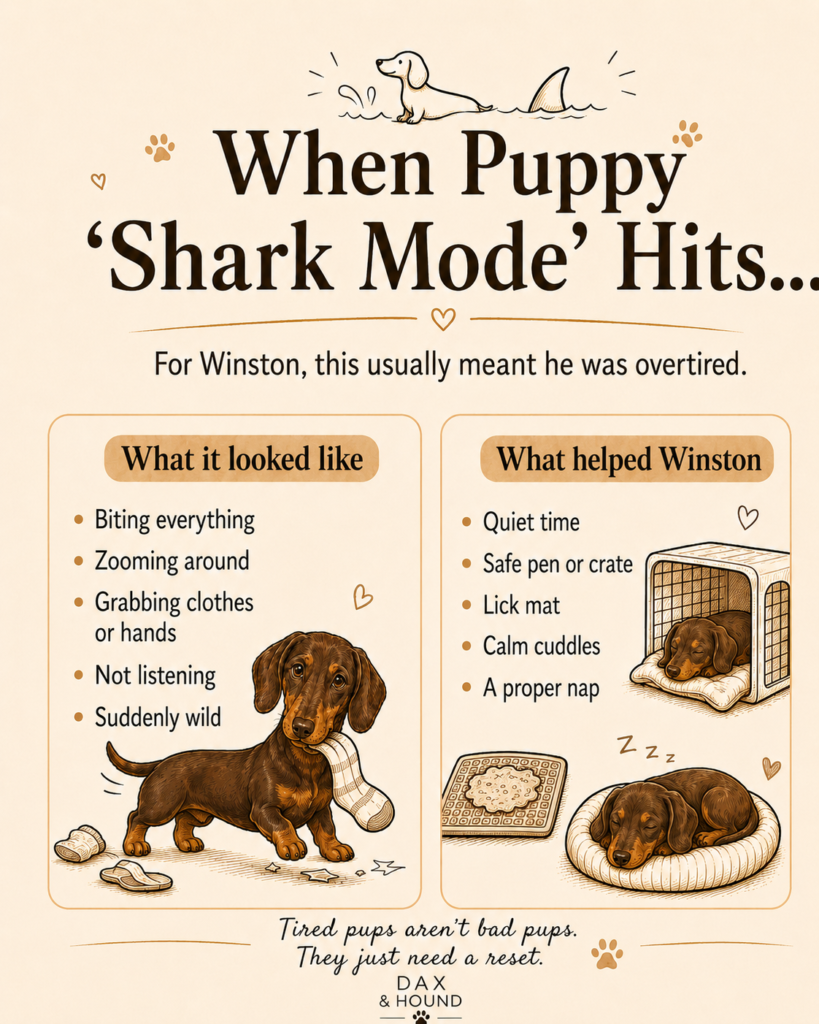
What we did learn very quickly was that Winston’s full-on “shark mode” usually meant he was overtired or overstimulated.
At first, it was easy to think he needed more play, more attention or more things to do.
But actually, a lot of the time he needed the opposite.
He needed to be left alone in his safe space so he could nap.
Once we realised that, things got a lot easier.
A tired puppy does not always look tired.
Sometimes they look like a tiny land shark with teeth.
Mental stimulation and enrichment
We started mental stimulation with Winston straight away.
We had a simple puzzle toy and a snuffle mat ready, because we wanted him to start using his brain from the beginning.
He took to them very quickly, and now he can easily manage more advanced puzzle toys.
This is something I am really glad we introduced early.
Dachshunds are clever little dogs.
If they are bored, they will often find something to do.
And it may not be something you would have chosen.
We also used lick mats from early on.
We would put moistened puppy food on them or dog-safe peanut butter, and they were amazing at helping him calm down and settle more easily.
A lick mat might not be the hardest puzzle in the world, but it still gives them something to focus on.
And sometimes that is exactly what you need.
Enrichment ideas for dachshund puppies:
- lick mats
- snuffle mats
- simple puzzle toys
- scatter feeding
- treat searches
- safe chews
- short training sessions
- food-based games
- calm licking activities
Mental stimulation helped tire Winston out without overdoing physical exercise, which is especially useful for dachshund puppies.
Little legs.
Long backs.
Big brains.
A lot of opinions.
For You
This is the bit that does not always make it onto puppy essentials checklists.
But it should.
Because you can buy the crate, the pen, the bowls, the toys and the camera.
You can read the guides.
You can prepare the house.
And still feel completely overwhelmed once your puppy is actually home.
What we didn’t expect
The biggest thing we did not expect was how overwhelming it would feel at first.
We had wanted a dog for years.
We loved Winston instantly.
We had prepared as much as we could.
But those first few weeks were still exhausting.
There were moments where we genuinely wondered if we had made a mistake.
That feels awful to admit now, because we cannot imagine life without him, but I think it is important to say.
Bringing home a puppy can be a huge adjustment, and feeling overwhelmed does not mean you do not love them.
It means you are tired, learning, and suddenly responsible for this tiny little life that needs you for everything.
The hardest parts for us were toilet training and learning when Winston had tipped over into overtired “shark mode”.
Toilet training meant being constantly alert.
Every sniff.
Every pace.
Every drink.
Every nap.
Every tiny sign.
And the shark mode took us a little while to understand.
But once we realised he often needed less stimulation, not more, things became much easier.
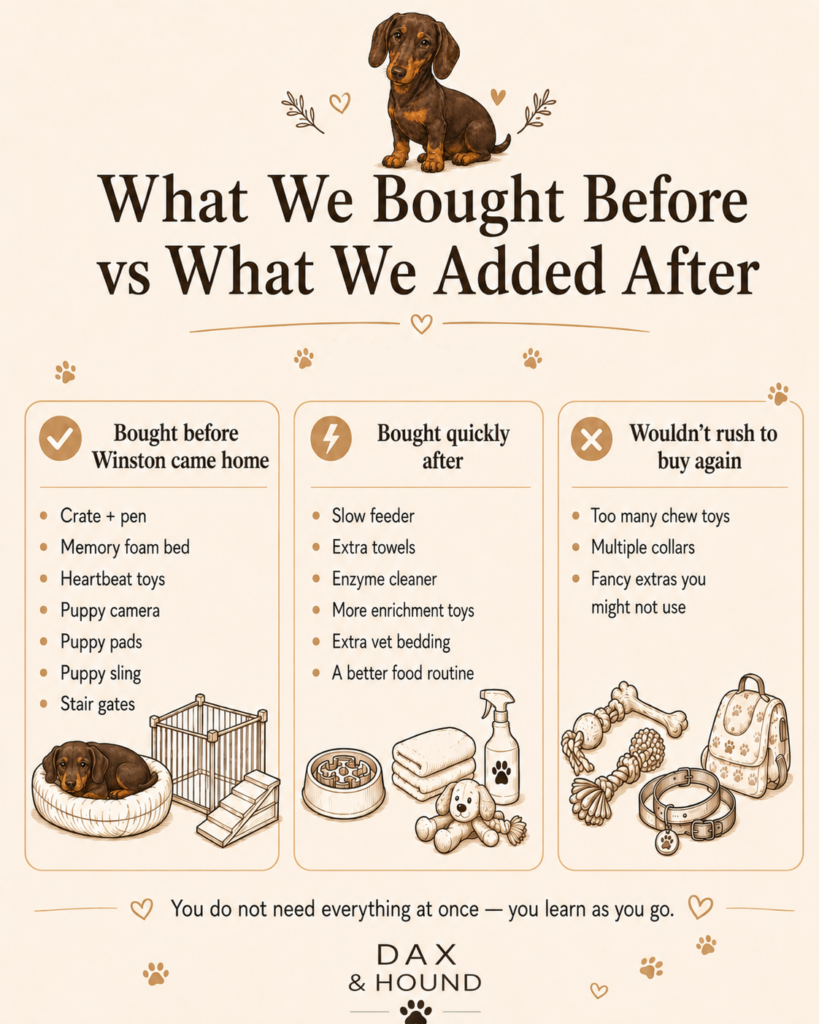
What we would 100% buy again
If we were bringing Winston home all over again, the things we would absolutely buy again are:
- the crate and pen setup
- memory foam bed
- small ramp for the crate
- waterproof washable mat
- vet bedding
- heartbeat toys
- heat packs
- worn jumper or blanket with familiar smells
- puppy camera
- carrier for vet trips
- puppy sling for early socialisation
- stair gates
- slow feeder
- enzyme cleaner
- absorbent towels
- lick mats
- snuffle mat
- simple puzzle toy
- small weighing scales
- pet insurance
Some of these were practical.
Some were for comfort.
Some were for our sanity.
All three mattered.
What we wouldn’t rush to buy again
We probably would not rush to buy lots of chew toys straight away, because Winston ignored some of them completely.
The Nylabone-style softer chews, for example, were not really his thing.
We also would not buy too many collars or harnesses before knowing his actual size, because we completely underestimated how tiny he would be.
The “small dog” collar we bought was still too big for him.
He needed a cat collar at first.
He also does not like wearing a collar in the house, so now he only wears one when he is out on walks.
I also would not go overboard on expensive beds before knowing whether your puppy is likely to chew or have accidents.
Start with the essentials.
Then learn your puppy.
Winston taught us very quickly what he liked, what he ignored and what he was determined to destroy.
Every puppy is different.
And dachshunds are especially good at having opinions.
What I wish someone had told us
I wish someone had told us that it is completely normal to feel overwhelmed.
Even when you love them.
Even when you wanted them for years.
Even when you prepared properly.
Those first few weeks can be a lot.
There were moments where we genuinely thought, “Have we made a mistake?”
And now we cannot imagine life without Winston.
So if you are in those early puppy weeks and you feel exhausted, emotional, or like you are second-guessing everything, you are not alone.
It does get easier.
You learn them.
They learn you.
And slowly, the chaos starts to turn into routine.
Final Thoughts
Bringing home a dachshund puppy is one of the loveliest things, but it is also a lot.
You can have all the products ready and still feel completely unprepared when this tiny little long-bodied puppy suddenly arrives and changes your whole routine.
That is normal.
The essentials help.
The crate helps.
The pen helps.
The puppy pads, blankets, bowls, toys and cleaning supplies all help.
But what matters most is making your puppy feel safe, loved and gently guided.
For us, those first few weeks with Winston were exhausting, emotional, funny, chaotic and completely full of love.
We learnt as we went.
We made mistakes.
We praised the tiny wins.
We introduced routines slowly.
And somewhere in the middle of all the night-time checking, phantom puppy cries, puppy pads, naps, 2am Googling and wondering if we were doing everything wrong, Winston became the centre of our little world.
And for all the hard bits, there were also moments that made everything worth it.
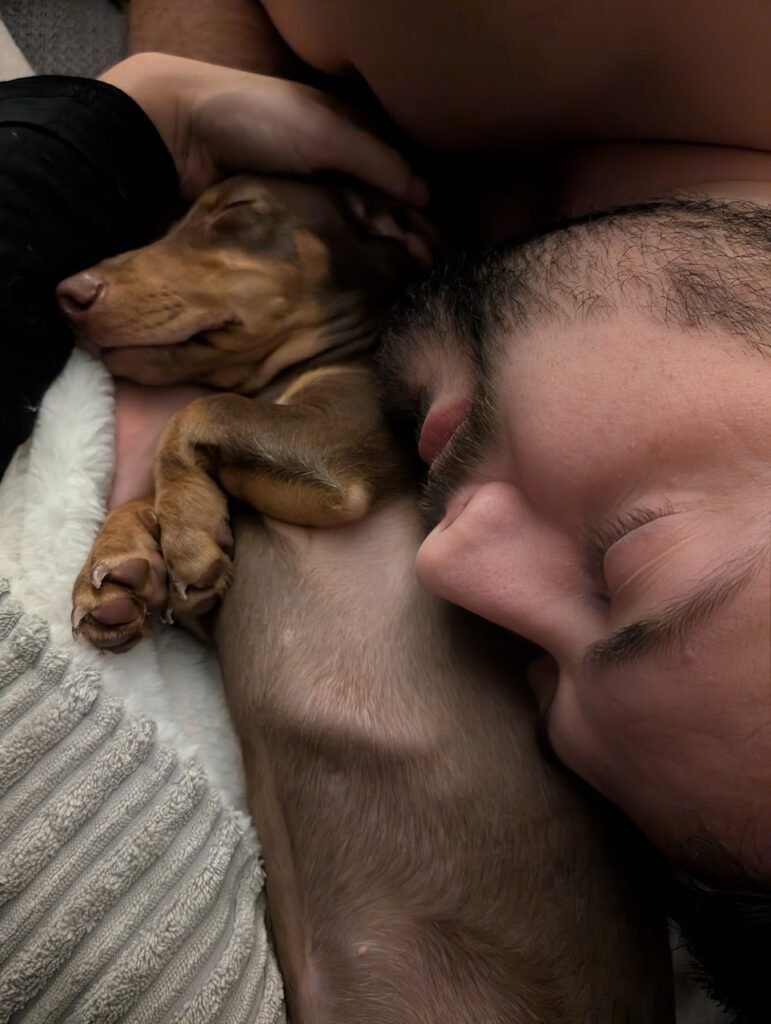
Like when Winston would lie between us on the sofa and sleep like an angel.
Tiny, warm, completely safe, and somehow already the centre of everything.
Those are the moments you remember most.
Because once you bring a dachshund home, they are not just a dog.
They are family.
Small legs, long body, big personality, and all.
At Dax & Hound Co., everything we share comes from life with Winston and the things we’re learning along the way. We’re not vets — just dachshund owners who care deeply about helping our little long-backed friends live happy, comfortable lives.
Leave a Reply