Quick answer: Heel walking and sniff walks both have their place. Heel walking can be useful for training, safety, and focus, but sniff walks are not “bad walking.” Letting a dog sniff gives them mental stimulation, allows them to explore their environment, and can be especially useful for dachshunds because it tires their brain without turning every walk into a long, physical march.
One thing I have noticed since having Winston is that people have very different ideas about what a “proper walk” should look like.
Some people seem to think a dog should walk neatly beside you the whole time.
Head up.
No stopping.
No drifting.
No sniffing the same patch of grass for what feels like 47 minutes.
And if your dog is a boy, there can sometimes be even more judgement around it, as if sniffing and checking smells automatically means they are being difficult or badly behaved.
But honestly, I do not see it that way.
Not with Winston anyway.
Because when Winston is sniffing, he is not doing nothing.
He is working.
His little nose is busy.
His brain is busy.
He is gathering information, making choices, processing what has been there before him, and enjoying the walk in a way that actually makes sense to him.
And to me, that matters.
Because a walk with your dog is not just for you.
It is for them.
Of course, that does not mean letting your dog drag you wherever they fancy, pull across roads, ignore you completely, or behave badly. Manners still matter. Safety still matters. Training still matters.
But I do think we need to stop seeing sniffing as a problem.
Especially with dachshunds.
They are small dogs with tiny legs, big personalities, busy noses, and clever little brains. They do not need every walk to be a human-paced route march.
Sometimes they need a sniff.
Actually, quite often they need a sniff.
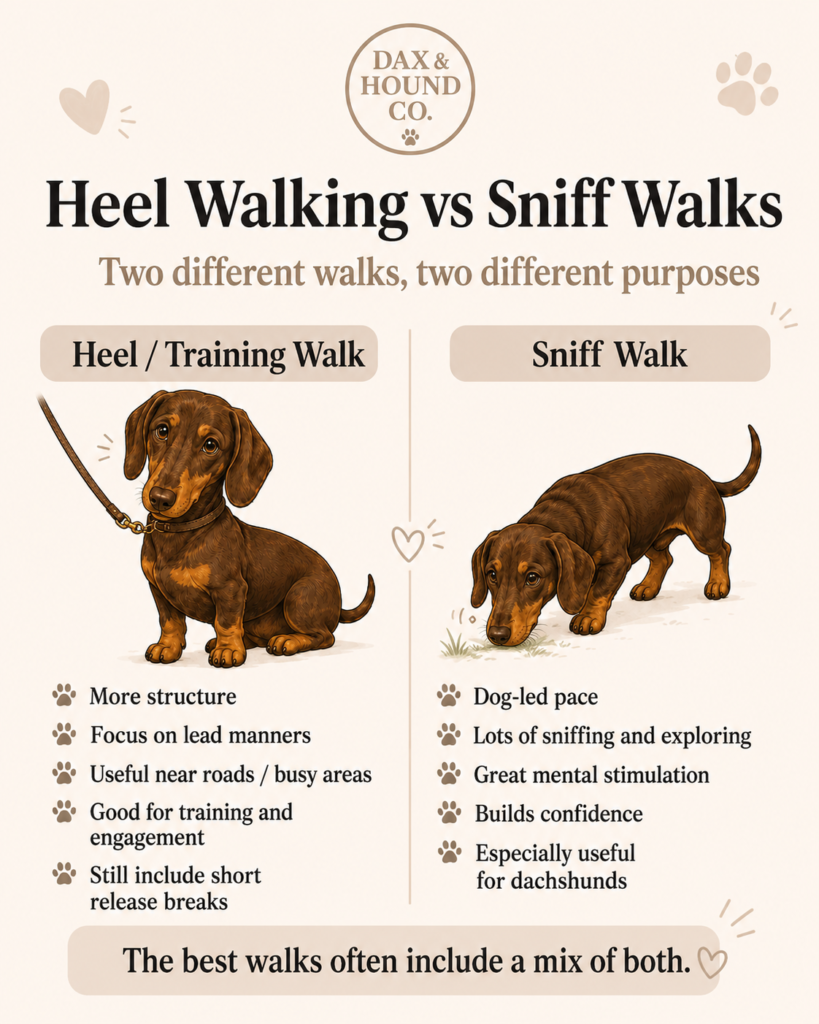
What Is Heel Walking?
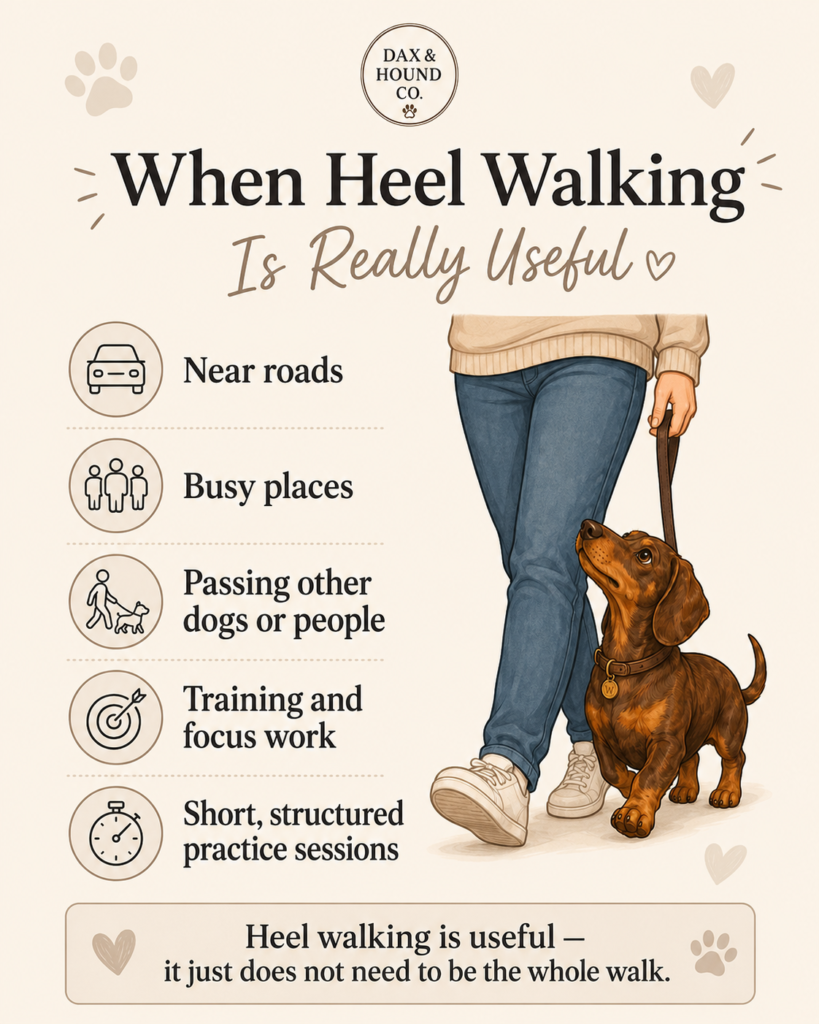
Heel walking usually means your dog walks close beside you, often near your left or right leg, staying focused and moving at your pace.
It can be really useful.
There are definitely times when I want Winston close to me rather than wandering at the end of the lead.
For example:
- near roads
- passing people or dogs
- going through busy areas
- crossing paths or pavements
- when we need more control
- when we are working on training
- when I need him to pay attention
Heel walking can help build focus and communication.
It can also make walks safer, especially if you have a dog who gets excited, distracted, or wants to investigate absolutely everything at once.
But I do not think heel walking should be the whole walk for most dogs.
At least, not all the time.
Because if the entire walk is only about staying beside the human, where is the dog’s part of the walk?
Where is the sniffing?
Where is the exploring?
Where is the choice?
Where is the little dachshund investigation committee?
Because Winston definitely runs one of those.
What Is a Sniff Walk?
A sniff walk is exactly what it sounds like.
It is a walk where the main goal is not distance.
It is not speed.
It is not steps.
It is giving your dog time to sniff, explore, and take in the world around them.
Blue Cross uses the term “sniffari” to describe a walk where the dog gets to choose the direction and pace, and says this can help satisfy dogs and support their mental wellbeing, even though it may be much slower than a normal walk.
That really sums up how we see Winston’s sniff walks.
They are slower.
Sometimes painfully slower.
Sometimes we appear to have left the house just so Winston can inspect one particular wall or square inch of grass.
But he comes home satisfied.
Not just physically tired, but mentally settled.
And that is the bit I think people sometimes miss.
A dog does not have to walk miles to have had a good walk.
Sometimes, a short, sniffy walk can do more for them than a longer walk where they are constantly being hurried along.
Sniffing Is Mental Stimulation
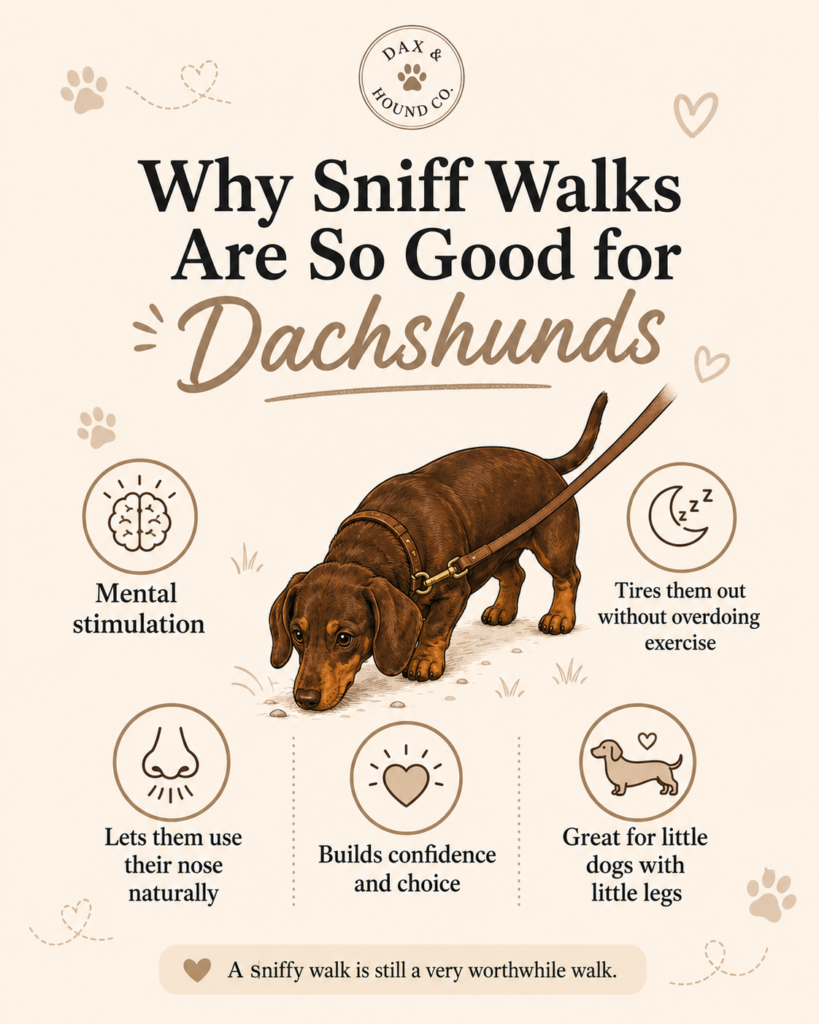
Dogs experience so much of the world through smell.
So when they are sniffing, they are not wasting time.
They are reading the environment.
Guide Dogs describes sensory enrichment as activities that stimulate a dog’s senses, including sniffing new smells and exploring new places. Blue Cross also says enrichment helps dogs express natural behaviours and that a slow sniff walk allows dogs to explore at their own pace, which can be especially rewarding for dogs who are on a lead.
That makes complete sense to me.
Because I can see it with Winston.
If he has had a good sniffy walk, he often seems more satisfied than if we have simply covered a certain distance.
His brain has had something to do.
His nose has had a job.
And with dachshunds, that really matters.
They are clever little dogs. Stubborn, yes. Dramatic, absolutely. But clever.
If Winston does not get enough mental stimulation, he will usually find his own entertainment.
And in our house, that can quickly become a suspicious sock or flip-flop situation.
We use sniff walks as one part of Winston’s enrichment, alongside things like puzzle feeders, snuffle games and simple training. We’ve shared more of those ideas in our guide to mental stimulation games for dachshunds.
Why Sniff Walks Make Sense for Dachshunds
Dachshunds are not built like long-legged dogs.
That sounds obvious, but I think it matters.
Winston’s little legs have to take a lot more steps to cover the same distance as a bigger dog. So when people talk about “a proper walk,” I always think you have to consider the dog in front of you.
A dachshund may not need endless distance to feel fulfilled.
They often need:
- steady movement
- safe exercise
- mental stimulation
- sniffing opportunities
- confidence-building
- training
- time to explore
- a walk that suits their body
PDSA says walks give dogs the chance to sniff new smells, explore new places, and meet people and dogs, all of which are important for mental wellbeing and confidence. They also specifically describe a slow, meandering walk with sniffing and exploring as great for a dog’s mental health.
That is exactly why I do not see a sniffy dachshund walk as a failed walk.
It might not look very impressive on a fitness app.
It might not cover much ground.
But for Winston, it can be brilliant.
He gets to use his nose, make choices, slow down, think, explore, and come home feeling like he has actually done something.
And because dachshunds can be prone to back problems, I would much rather Winston has a walk that is mentally satisfying and physically sensible than feel like I need to march him around for the sake of distance.
But Doesn’t Sniffing Mean They Are Being Disobedient?
Not necessarily.
This is where I think the conversation gets a bit muddled.
A dog sniffing is not automatically being naughty.
A dog sniffing does not mean they are ignoring you on purpose.
A dog sniffing does not mean they are “not walking properly.”
It means they are being a dog.
The problem is not sniffing itself.
The problem would be if the dog is:
- pulling hard to get to smells
- dragging you into the road
- refusing to move when needed
- ignoring safety cues
- reacting badly to people or dogs
- marking somewhere inappropriate
- becoming frantic or overstimulated
That is different.
That is where training comes in.
For us, the aim is not to stop Winston sniffing.
The aim is to teach him that sniffing happens within boundaries.
He can explore.
He can pause.
He can choose the pace on certain walks.
But he still needs to listen.
He still needs to move on when asked.
He still needs to be safe.
He still needs to remember there is a human attached to the other end of the lead.
Which, admittedly, is not always his top priority.
Why We Use Both Types of Walk with Winston
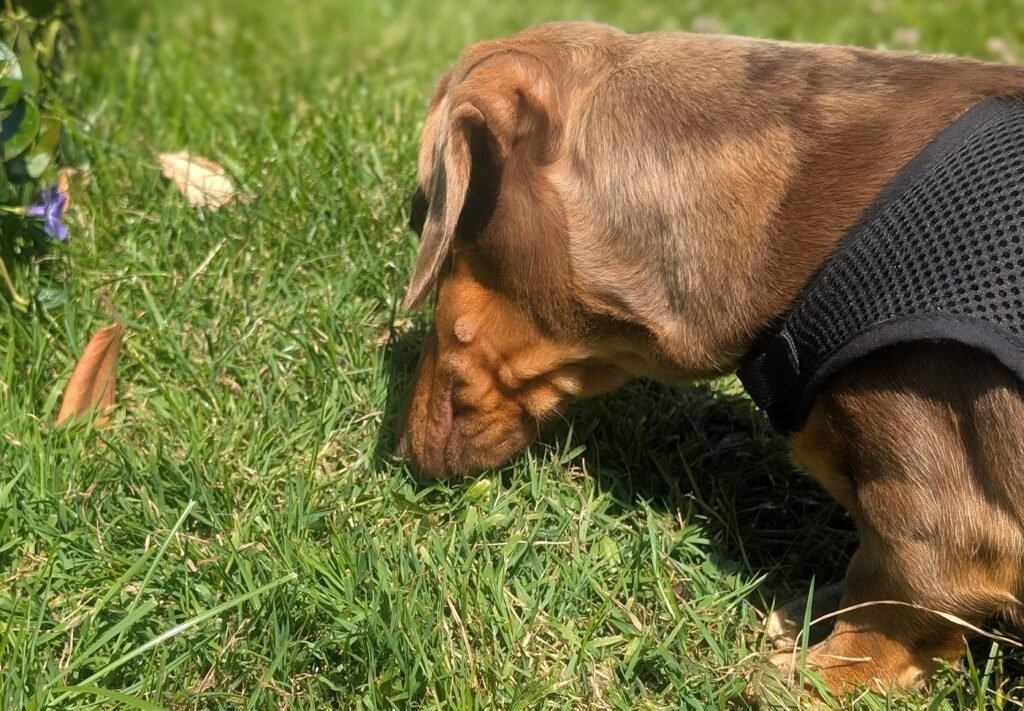
We do not only do sniff walks.
And we do not only do training walks.
We tend to do a mix of both because they give Winston different things.
One walk might be more focused on training and obedience.
On those walks, we might practise:
- loose lead walking
- checking in with us
- waiting
- moving on from distractions
- staying calm around other dogs or people
- listening when there are smells he would rather investigate
But we still give him sniff breaks.
We use a “break” cue, which basically tells him he is free to relax and sniff for a bit.
That has been really helpful because it makes the walk clearer for him.
There is a time to focus.
And there is a time to be a tiny detective.
Then we also do walks that are much more Winston-led.
On those walks, we let him choose more.
He can pick the direction within reason.
He can stop and sniff.
He can spend longer investigating a patch of grass, a wall, a leaf, a gatepost, or whatever invisible masterpiece another dog has apparently left behind.
We still have rules.
He cannot pull us all over the place.
He cannot be rude.
He cannot make unsafe choices.
But within those boundaries, he gets more freedom.
And I honestly think that has been really good for his confidence.
Why Choice Matters on Walks
I think choice is a big part of this.
Dogs spend a lot of their lives being told what to do.
When to eat.
Where to sleep.
Where to walk.
When to stop.
When to come back.
When to leave something.
Some of that is necessary. They live in a human world, and we have to keep them safe.
But where we can safely give them choices, I think we should.
Dogs Trust talks about enrichment through choice and says enrichment can prevent boredom, build confidence, and teach skills such as problem-solving and searching. Their enrichment advice also specifically says to allow dogs plenty of opportunity and time to sniff on walks.
That is why Winston’s sniff walks feel important to us.
They are not just lazy walks.
They are not us “letting him get away with it.”
They are part of giving him a little bit of control over his own day.
And for a small dog in a big world, I think that matters.
When Winston gets to choose the route sometimes, he seems more confident. He investigates, pauses, thinks, changes direction, checks things out, and makes little decisions.
Obviously, we are still the adults in the situation.
Although Winston may disagree.
But it feels like a nice balance.
We guide him when we need to.
He gets freedom where it is safe.
Heel Walking Has Its Place Too
As much as I love a sniff walk, I do not think every walk should be a complete free-for-all.
Dogs do need to learn how to walk nicely.
They need to understand lead pressure.
They need to know how to move with you.
They need to be able to pass people, dogs, roads, bikes, prams, and distractions without turning into a furry kite.
PDSA says the best way to stop a dog pulling is to show them that walking on a loose lead gets a reward and pulling does not, and they also advise not punishing dogs for pulling because they learn faster with positive training. Dogs Trust also advises that loose lead walking takes patience and time, and that dogs can learn that walking with a loose lead means they get to move forward, while pulling means they do not.
That is the kind of walking we want with Winston.
Not a robotic heel every second.
Not glued to our legs for the entire walk.
Just polite, safe, connected walking.
A dog who can sniff and enjoy himself, but also come back to us mentally when needed.
That feels much more realistic for normal life.
Especially with a dachshund.
Because if Winston has decided a particular smell requires urgent legal analysis, I am not sure a strict heel is always going to be the hill I choose to die on.
What Our Walks Usually Look Like
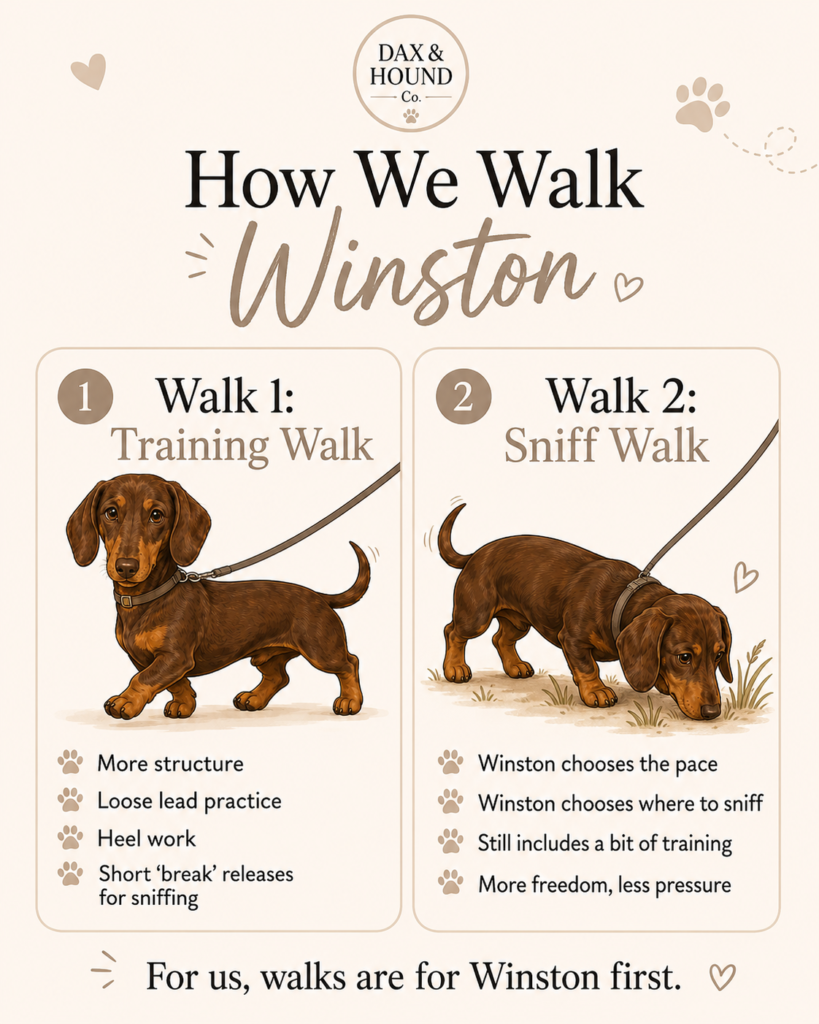
Every day is slightly different, but our general approach with Winston is something like this.
One more focused walk
This is where we put a bit more emphasis on training.
We practise nice lead walking, attention, listening, moving on when asked, and calm behaviour.
But we still build in sniff breaks using his “break” cue.
So it is not:
“Walk perfectly, or you get no fun.”
It is more:
“Walk with me for a bit, listen, stay connected, and then you can go and sniff.”
For Winston, that makes the training feel fairer.
And honestly, it makes it easier for us, too.
One more sniffy walk
This is the walk where Winston gets more choice.
We usually let him decide more of the direction and pace.
If he wants to spend a few minutes sniffing one spot, that is fine.
If he wants to turn left instead of right, and it is safe, we often let him.
If he wants to pause, think, sniff, double back, investigate, and generally act like he is conducting a very serious neighbourhood survey, we let him.
Within reason.
He still needs manners.
He still needs to listen.
But the overall purpose of that walk is different.
It is not about obedience first.
It is about enrichment.
And I think that is a really valuable thing for dogs.
Sniff Walks Can Be Especially Useful When You Do Not Want to Overdo Exercise
This is one of the biggest reasons I think sniff walks are useful for dachshund owners.
Dachshunds need regular exercise.
They are not ornaments.
They are active little dogs, and keeping them fit matters.
But that does not mean every walk needs to be long, fast, or intense.
PDSA notes that miniature dachshunds need regular daily exercise and also reminds owners to take exercise easy while a dachshund is still growing. Dachshund Health UK also says exercise is about mental stimulation as well as physical activity.
That is where sniff walks can be brilliant.
A sniff walk can help tire the brain without pushing the body too hard.
It can be useful:
- on warm days
- after a busy day
- when your dog seems mentally wired but physically tired
- when you do not want to walk too far
- for puppies who are still growing
- for older dachshunds
- for dogs who need calmer outings
- when you want enrichment without lots of distance
This is also why sniffy, slower walks can be useful in warmer weather, when we still want Winston to have a bit of enrichment without overdoing it. We shared more of our summer routine in our guide to keeping a dachshund cool in hot weather.
It is not about avoiding exercise.
It is about making walks better quality.
For Winston, a 20-minute sniffy wander can sometimes do more than a longer walk where he has not really had time to explore.
And I think that is worth remembering.
How to Do a Sniff Walk Without Losing All Control
A good sniff walk is not the same as letting your dog do whatever they want.
That distinction matters.
Here is what works for us with Winston.
Use a longer lead where safe
Not an extendable lead in busy areas, and not where it could be dangerous.
But a bit more lead length can help your dog explore without constant tension.
Choose quiet places
Sniff walks are easier when you are not fighting traffic, crowds, dogs, bikes, and a pavement that is about two inches wide.
Let them choose sometimes
If it is safe, let them pick the direction.
It is a simple way to give them a bit of choice.
Use a release cue
We use “break” so Winston knows when he is free to sniff and relax a bit more.
You could use any word, as long as you are consistent.
Still have rules
Sniffing is allowed.
Dragging is not.
Exploring is allowed.
Launching into the road is not.
Choice is allowed.
Tiny sausage dictatorship is not.
Practise moving on
Sometimes you will need your dog to leave a smell and keep walking.
That is normal.
We try to make moving on calm and positive, rather than turning every sniff into a battle.
Reward check-ins
If Winston looks back at us or comes away from a smell when asked, we praise him.
Because that is exactly the kind of behaviour we want more of.
Freedom, but with connection.
When Heel Walking Is More Useful
There are still times when I would not choose a sniff walk.
For example:
- near roads
- in car parks
- around livestock
- in crowded places
- when passing nervous dogs
- when walking through narrow paths
- when your dog is overstimulated
- when you need close control
- when practising training skills
In those moments, I want Winston closer and more focused.
Not because sniffing is bad.
But because the situation needs more structure.
That is the balance.
Sometimes the walk is about exploration.
Sometimes it is about manners.
Sometimes it is about safety.
And sometimes it is about getting home before the rain gets heavier because Winston has suddenly remembered exactly where the house is.
Funny how dachshunds can find perfect direction when heavy rain is involved.
What If Your Dog Sniffs Too Much?
I think this depends on what “too much” means.
If your dog is sniffing calmly, enjoying themselves, listening when needed, and not pulling you everywhere, I personally would not see that as a problem.
That sounds like a dog being a dog.
But if the sniffing becomes frantic, obsessive, stressful, or impossible to interrupt, it may be worth looking at what is going on.
Ask yourself:
- Is my dog overstimulated?
- Are they anxious?
- Are they getting enough enrichment at home?
- Are they pulling to every smell?
- Do they know how to move on?
- Have I taught a clear cue?
- Am I expecting too much focus for too long?
Sometimes the answer is not less sniffing.
Sometimes the answer is better structure.
A bit of training.
A clearer release cue.
More sniff time in appropriate places.
Shorter focused sections.
More rewards for checking in.
A calmer route.
Or simply accepting that your dog’s idea of a good walk looks different to yours.
Which, frankly, is fair.
I would not want Winston planning my ideal day either.
It would mostly involve digging cheese, suspicious leaves, and someone carrying me home.
Our View: Walks Should Meet the Dog’s Needs Too
This is probably the part I feel most strongly about.
A dog walk should not just be about the human getting steps in.
It should not just be about making the dog move from A to B.
And it definitely should not be about making them look perfectly obedient for other people.
A walk is one of the best parts of a dog’s day.
It is their chance to get out, smell things, see the world, move their body, use their brain, build confidence, and just be a dog.
So yes, I want Winston to have manners.
I want him to listen.
I want him to walk safely.
I want him to understand that sometimes he needs to move on.
But I also want him to enjoy his walks.
I want him to sniff.
I want him to choose sometimes.
I want him to have a bit of freedom.
I want the walk to feel like it belongs to him, too.
Because it does.
Final Thoughts
Heel walking and sniff walks are not enemies.
You do not have to choose one forever.
For us, the best balance with Winston has been a mixture of both.
Some structure.
Some training.
Some obedience.
Some sniffing.
Some choice.
Some “come on, Winston, we are not investigating that drain for the rest of our lives.”
And honestly, that feels right.
Sniffing is not failed walking.
It is not bad behaviour by default.
It is not a sign that your dog is doing it wrong.
For many dogs, and especially for busy-brained little dachshunds, sniffing is part of what makes a walk satisfying.
So if your dachshund spends half the walk with their nose glued to the floor, I would not automatically worry that they are not walking properly.
They might be having exactly the walk they need.
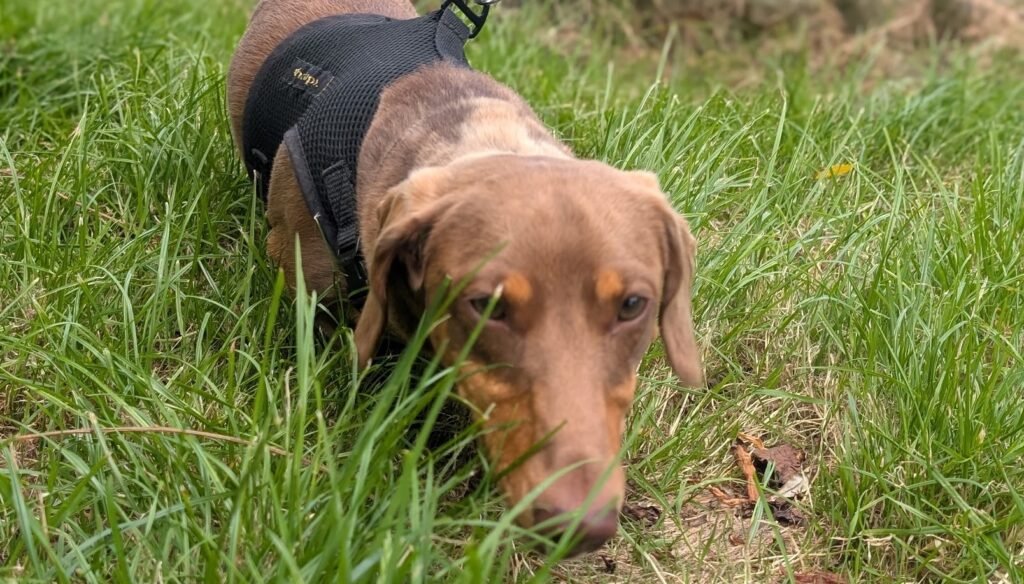
At Dax & Hound Co., everything we share comes from life with Winston and what we are learning as dachshund owners. We are not trainers or vets — just two people trying to give our little long-backed dog a happy, safe, and interesting life, one very slow sniff at a time.

Leave a Reply