
Quick answer: Neutering can have genuine benefits, including preventing unwanted litters and reducing certain reproductive health risks. But for dachshunds, the decision deserves more thought than a simple “do it as soon as possible.” Some research has found an association between early neutering and a higher risk of intervertebral disc herniation in dachshunds, while other studies are less clear. The best approach is to look at your individual dog, their sex, age, health, behaviour, lifestyle, and breed risks, and discuss the timing carefully with a vet who understands dachshunds.
We’ve linked the main research and guidance we found throughout this article so you can read more and discuss it with your own vet.
This is one of those topics I have gone backwards and forwards on writing about.
Not because it is not important.
Because it is one of those dog-owner subjects where people can be very quick to judge.
Neutering often gets spoken about as if it is simply the next thing you do once your puppy reaches a certain age.
Vaccinations.
Microchip.
Insurance.
Neutering.
Done.
But with Winston, it has never felt quite that simple.
We have been asked about it by other owners. We have had comments at the vets. We have also been given very different views from different people, including one of the vet receptionists with dachshund experience, who advised us not to do it unless it became necessary, and certainly not too young.
And that is the thing that made us stop and really think.
Because Winston is not just “a dog.”
He is a dachshund.
A long-backed, short-legged, IVDD-prone breed where timing, growth, hormones, and spinal health all feel like they should at least be part of the conversation.
This article is not here to tell anyone what to do.
It is not anti-neutering.
It is not anti-vet.
It is simply a look at the pros, the cons, the timing, the research we found, and why dachshund owners should not feel awkward for asking more questions before making a permanent decision.
This article is based on our own experience with Winston and our own reading. It is not veterinary advice. Please speak to your vet before making any decision about neutering your dog.
What Does Neutering Actually Mean?
People often use the word “neutering” to describe both male and female dogs.
For male dogs, neutering usually means castration, where the testicles are removed.
For female dogs, it usually means spaying, where the ovaries are removed, often with the uterus as well.
The decision can look different depending on whether your dachshund is male or female, because the benefits and risks are not identical.
A male dachshund and a female dachshund are not having exactly the same procedure, with exactly the same health considerations, for exactly the same reasons.
That is part of why I think this topic needs more care.
It should not just be:
“How old is the dog?”
It should be:
- Is the dog male or female?
- How old are they?
- Are they physically mature?
- Are there any medical reasons to neuter?
- Are there any behaviour concerns?
- Are those behaviours hormone-related or not?
- What are the breed-specific risks?
- What are the risks of doing it now?
- What are the risks of waiting?
- What does the current evidence actually say?
That feels much more sensible to me than treating neutering as a standard box to tick.
Why Dogs Are Commonly Neutered
There are valid reasons why people choose to neuter their dogs.
For males, neutering removes the risk of testicular cancer and can reduce the risk of some prostate-related issues.
For females, spaying prevents pregnancy, seasons, false pregnancies, and pyometra, which is a serious womb infection.
Neutering also prevents accidental litters, which is a big responsibility and not something any owner should take lightly.
For some dogs, it may also help with certain hormone-driven behaviours, such as roaming to find a mate or some types of marking.
So this is not a case of “neutering is pointless.”
It can be the right decision for many dogs.
The question for us has always been more specific than that:
Is it the right decision for Winston, at this age, for the reasons being given, as a dachshund?
That is where the conversation becomes more nuanced.
Why We Did Not Want to Rush the Decision
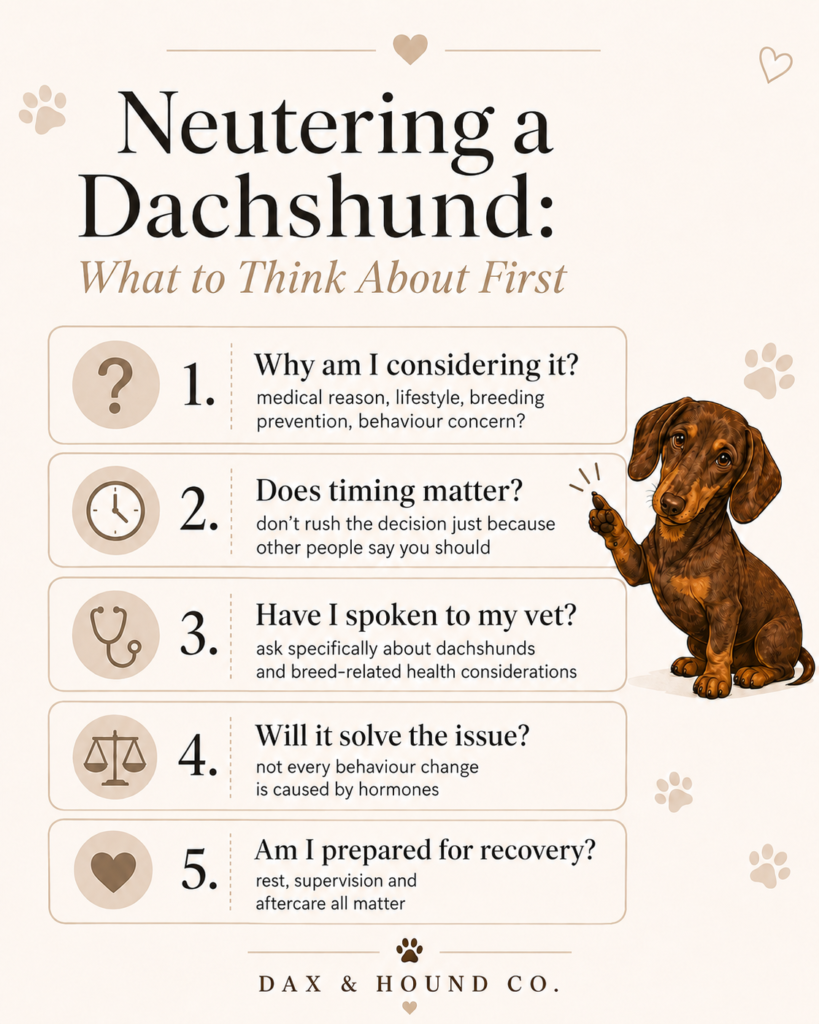
One of the things we found frustrating was how casual some of the advice could feel.
For example, we were told that once Winston started lifting his leg to wee, that would mean he was ready to be neutered.
That felt too basic for such a permanent decision.
Especially with a dachshund.
We were not comfortable making the decision based on social expectation, routine timing, or comments that sounded more like old rules of thumb than individual advice.
If there is a strong medical reason, that is one thing.
If there is a genuine welfare issue, that is one thing.
If behaviour is a concern and a vet or qualified behaviourist thinks neutering may help, that is worth discussing properly.
But “he is growing up now” did not feel like enough of an answer for us.
Dachshunds Are Not Just Generic Small Dogs
Dachshunds have very specific bodies.
That is part of why we love them.
It is also why we have to think carefully about them.
They are long-backed, low to the ground, and one of the breeds most associated with intervertebral disc disease.
IVDD is not a vague, distant concern for dachshunds.
It is one of the biggest health worries that comes with the breed.
That is why we are careful with Winston’s weight.
That is why we use ramps.
We’ve written more about the ramps we use with Winston here for safer sofa and garden access.
That is why we set boundaries around jumping.
That is why we do not let him run up and down stairs.
And it is also why we wanted to understand whether neutering, especially early neutering, could affect dachshund spinal health.
Because if a medical decision could potentially change IVDD risk, even slightly, we want to know about it before we make that decision.
Not to panic.
Not to avoid every risk in life.
Just to make an informed choice.
What the Dachshund IVDD Research Says
The main study we found was a 2018 Dachshund-specific study looking at neuter status as a risk factor for intervertebral disc herniation.
This study used owner-reported survey data from 1,964 dachshunds and looked at IVDD incidence in dogs aged between 3 and 10 years. The study found a significant association between neutering and intervertebral disc herniation risk in dachshunds. It also found that dachshunds neutered before 12 months had a significantly increased risk compared with those neutered later.
The paper reported that early-neutered males had a risk ratio of 1.54, and early-neutered females had a risk ratio of 2.12, compared with dachshunds neutered later.
That got our attention.
It does not mean every early-neutered dachshund will develop IVDD.
It does not mean neutering definitely causes IVDD.
It was a retrospective study, so it looked back at existing data rather than controlling every possible factor from the start.
But it is still dachshund-specific research, and it seems important enough that owners should be aware of it.
Especially when early neutering is sometimes spoken about as if there are no possible breed-specific downsides.
Is the Research Completely Clear?
No.
And I think that matters.
A 2020 breed-specific neutering study looked at 35 breeds and found that, in some breeds, neutering may be associated with increased risks of certain joint disorders and cancers. However, in that study, the authors did not find an evident increase in intervertebral disc disorder in neutered dachshunds in their sample.
There is also a 2024 study looking at female dachshunds with surgically confirmed thoracolumbar intervertebral disc extrusion. In that group of dogs, neuter status and age of neutering were not found to affect age at onset or severity of the disc extrusion.
But that 2024 study was asking a slightly different question.
It looked at female dachshunds who already had disc extrusion and whether neutering status related to how early or severe it was.
That is not exactly the same as asking whether neutering changes the overall chance of developing IVDD in the first place.
So, the evidence is not perfectly neat.
There are different study designs.
Different populations.
Different questions being asked.
But from what we have read, there is enough dachshund-specific concern that I do not think early neutering should be treated as an automatic decision with no discussion.
What About Hormones and Spinal Health?
This is the part where I think it is easy to overstate things, so I want to word it carefully.
There is a theory that sex hormones may play a role in skeletal development, joint health, and possibly intervertebral disc health.
That does not mean we can say with certainty that keeping a dachshund entire will protect them from IVDD.
We cannot say that.
But it does make sense to ask whether removing hormones before a dog is fully mature could matter, especially in a breed already prone to spinal disc problems.
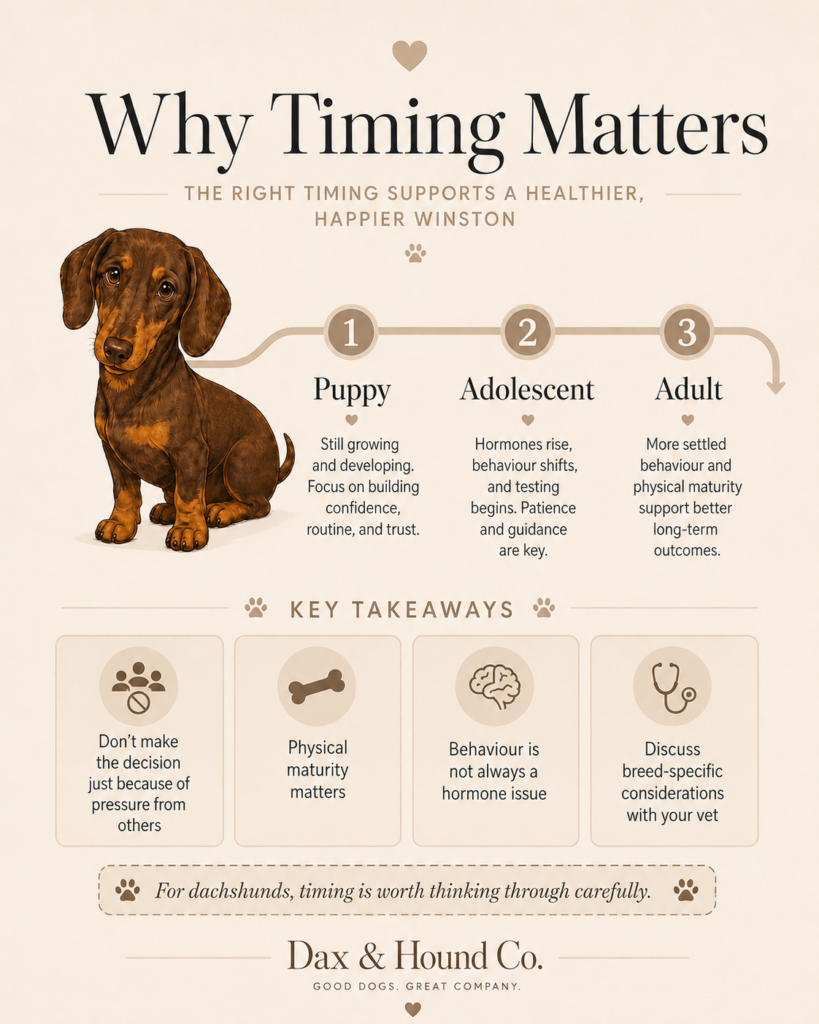
The updated BVA and BSAVA neutering guidence says dogs should generally be neutered after skeletal maturity has been reached, usually between 12 and 23 months, and that breed, size, sex, behaviour, and individual circumstances should be considered.
That is much more in line with how we think about Winston.
Not “never neuter.”
Not “always neuter early.”
More like:
Let them mature, look at the individual dog, and make the decision carefully.
What Current Guidance Seems to Be Moving Towards
What stood out to me is that some official guidance now seems to be moving away from the old one-size-fits-all approach.
The updated BVA and BSAVA guidance says that, if male dogs are neutered, medical or surgical castration should not be carried out before physical maturity for the breed unless there is a compelling reason to do so. It also says vets should have a careful discussion with owners so the implications of neutering are understood before a decision is made.
That feels like a much better conversation.
Not rushed.
Not generic.
Not based on one normal behaviour or a standard age.
Just a proper discussion about the dog in front of you.
Dachshund IVDD UK also advises being very cautious about spaying or neutering dachshunds before 12 months and says delaying beyond 12 months, such as to 18–24 months, may be worth considering to reduce IVDD risk.
Again, that is not the same as saying every dachshund must stay entire.
It means timing matters.
And that is exactly the point.
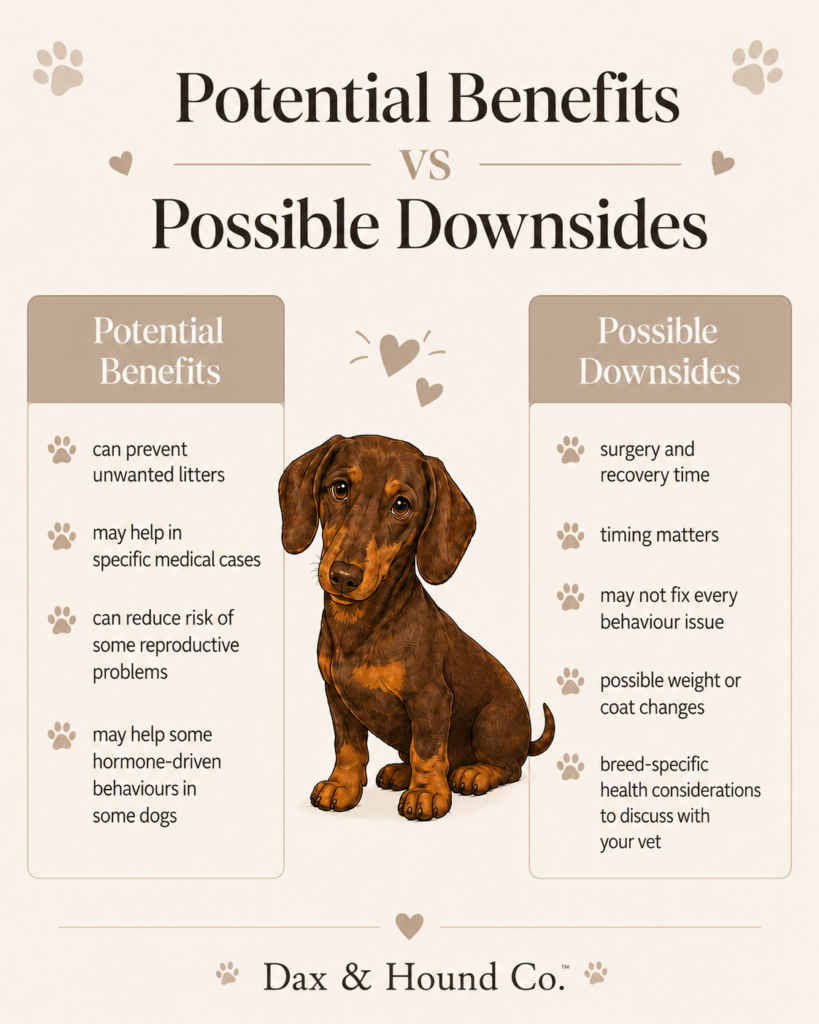
The Possible Benefits of Neutering a Dachshund
Neutering can have real benefits.
For male dachshunds, possible benefits can include:
- preventing testicular cancer
- reducing the risk of some prostate problems
- reducing roaming linked to females in season
- reducing some hormone-driven behaviours in some dogs
- removing the possibility of accidental breeding
For female dachshunds, possible benefits can include:
- preventing pregnancy
- preventing seasons
- preventing pyometra
- preventing false pregnancies
- reducing some reproductive health risks
- making mixed-sex households easier to manage
For some families, these benefits may clearly outweigh the possible downsides.
For example, if a male dog is distressed around females in season, repeatedly trying to escape, or at real risk of accidental mating, neutering may become a welfare and safety discussion.
For female dogs, pyometra is a serious condition and is absolutely something owners need to understand.
So I do not think the answer is to dismiss neutering.
The answer is to weigh it properly.
The Possible Downsides of Neutering
Neutering is common, but it is still surgery.
That means there is an anaesthetic.
There is recovery.
There is wound care.
There can be cost.
There can also be longer-term changes.
Possible downsides may include:
- weight gain or reduced calorie needs
- coat changes in some dogs
- urinary incontinence risk in some females
- behaviour changes in some dogs
- possible worsening of nervousness in some cases
- timing-related risks for some orthopaedic conditions
- possible breed-specific concerns
For dachshunds, the question of IVDD risk should be part of this conversation.
Not as a scare tactic.
Not as proof that neutering is wrong.
But as one of the things you discuss before making the decision.
Because if we are told to think about Winston’s back when it comes to stairs, jumping, weight, and ramps, then I think it is fair to also ask how neutering timing fits into the bigger back-care picture.
Male Dachshunds and Neutering
Because Winston is male, this is the side we have thought about most personally.
For male dogs, the reasons for neutering are often linked to reproductive health, preventing breeding, roaming, or behaviours that are thought to be hormone-related.
But not every behaviour in a male dog is a neutering issue.
And not every maturing male dog needs immediate surgery.
With Winston, we have not had a strong medical or behavioural reason to rush.
He is not reactive.
He is not aggressive.
He is not difficult around other dogs in a way that makes us feel neutering is urgent.
So for now, our approach is to keep learning, keep discussing it with the vet, and not make a permanent decision simply because other people expect us to.
That may change in the future.
But if it does, we want it to be because it makes sense for Winston.
Not because we felt pushed into it.
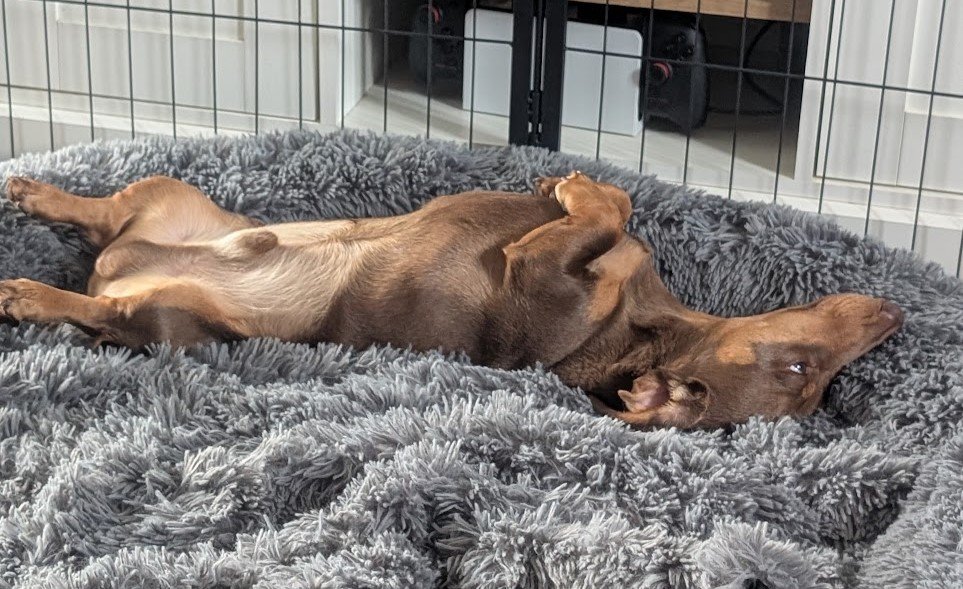
Female Dachshunds and Neutering
Female dachshunds come with a slightly different set of considerations.
Spaying prevents pregnancy and seasons, and it removes the risk of pyometra, which can be life-threatening.
That is a serious point in favour of spaying for many owners.
But female dachshunds are also part of the IVDD conversation.
The 2018 Dachshund study found that neutered females were at significantly higher risk of intervertebral disc herniation than entire females, and early-neutered females had a higher risk compared with those neutered later.
That creates a difficult balance.
On one side, reproductive health risks matter.
On the other side, spinal health matters too.
That is exactly why I do not think female dachshund owners should be given a rushed, simple answer either.
It needs to be talked through properly.
Behaviour: Why Neutering Is Not Always a Quick Fix
One thing I think owners should be careful with is using neutering as the first answer to behaviour.
Some behaviours may be hormone-related.
Some may not.
A dog might mount because they are excited, stressed, overstimulated or unsure.
A dog might mark because of hormones, but also because of habit, environment, stress or training.
A dog might become reactive for reasons that have nothing to do with testosterone.
So if the main reason for considering neutering is behaviour, I think it is worth asking:
- Is this actually hormone-driven?
- Has the behaviour been properly assessed?
- Could training help?
- Could stress or confidence be part of it?
- Would a qualified behaviourist be useful?
- Could neutering make this better, worse or make no difference?
That does not mean neutering never helps behaviour.
Sometimes it may.
But it is not a magic reset button.
And with dachshunds, where timing may carry extra considerations, I think behaviour-based neutering decisions deserve more than a quick assumption.
Questions I Would Ask Before Neutering a Dachshund
If you are thinking about neutering your dachshund, these are the questions I would want to ask.
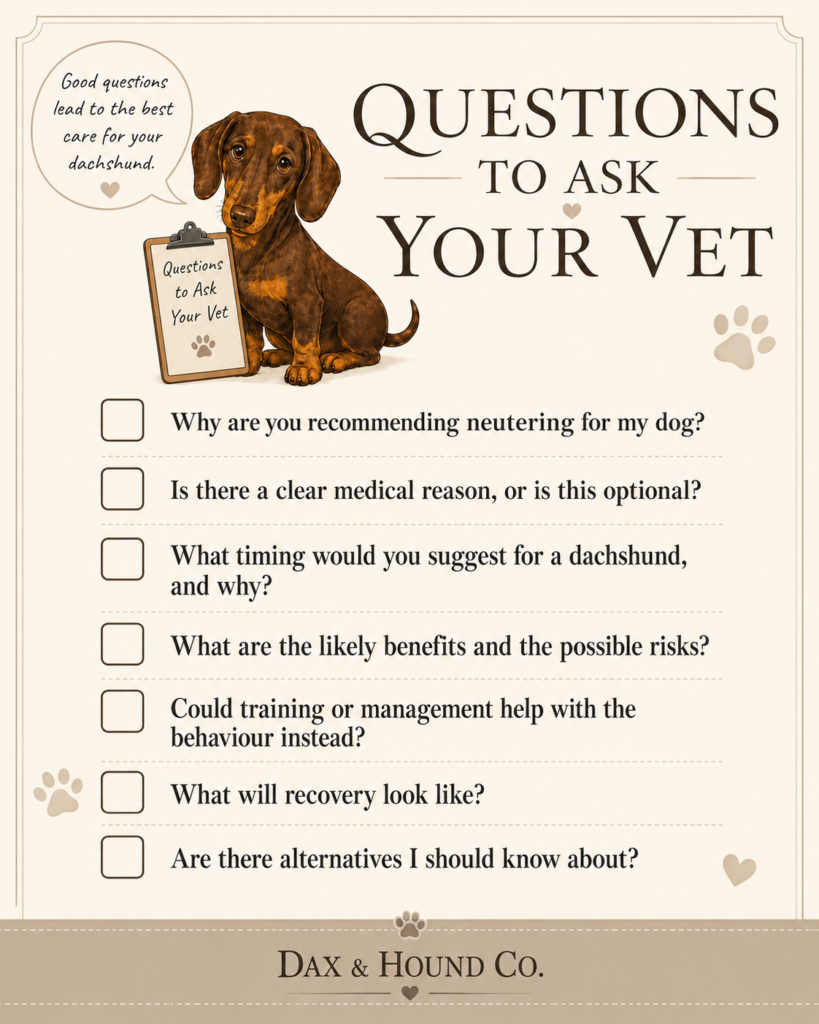
1. What are the benefits for my dog specifically?
Not just dogs generally.
Your dog.
Your dog’s sex, age, health, temperament, lifestyle and breed.
2. Is there a medical reason to do it now?
That could change the whole conversation.
3. What are the risks of doing it at this age?
Especially if your dog is still young or still developing.
4. What are the risks of waiting?
This is particularly important for female dogs because of pyometra.
5. How does dachshund IVDD risk affect your recommendation?
This is the question I would not skip.
6. Is my dog physically mature?
If timing matters, maturity matters.
7. If behaviour is the reason, are we sure neutering is likely to help?
A qualified behaviourist may be useful if behaviour is the main concern.
8. Are there alternatives or temporary options?
For some male dogs, chemical castration may sometimes be discussed as a temporary way to see how reducing testosterone affects behaviour before committing to surgery.
That will not be necessary or suitable for every dog, but it is worth knowing the conversation exists.
What We Are Doing with Winston

We are not pretending there are no benefits to neutering.
But we are also not making the decision because of pressure, habit, or a general comment that he is “ready” just because he is growing up.
For us, the decision needs to take into account:
- his age
- his breed
- his IVDD risk
- his behaviour
- his health
- the pros and cons of waiting
- the pros and cons of doing it
- the fact that it is permanent
We took a similar approach when Winston first came home — researching the breed, setting the house up carefully, and trying to make choices that suited a dachshund rather than just following generic puppy advice. You can read more about that in our Dachshund Puppy Essentials Checklist.
At the moment, we do not feel there is a strong enough reason to rush.
That may change.
If it does, we will look at it again.
But we want the decision to be thoughtful, not automatic.
One of the most reassuring pieces of advice we were given came from someone at the vet who actually has a dachshund. Their view was not to do it unless necessary, and not too young.
That made sense to us.
Not because it gave us permission to ignore everything else.
But because it acknowledged that dachshunds are not always best served by blanket advice.
So, Should You Neuter Your Dachshund?
The honest answer is:
Maybe.
But I do not think it should be rushed or assumed.
Neutering may be the right choice for your dachshund.
Waiting may be the right choice.
Staying entire for now may be the right choice.
Doing it later may be the right choice.
Doing it for a clear medical reason is different from doing it because it is “just what people do.”
A male dachshund and a female dachshund may need different discussions.
A nervous dog and a confident dog may need different discussions.
A young dog and a physically mature dog may need different discussions.
That is why asking questions is not being difficult.
It is being responsible.
Especially with a breed like dachshunds, where spinal health is already such an important part of day-to-day care.
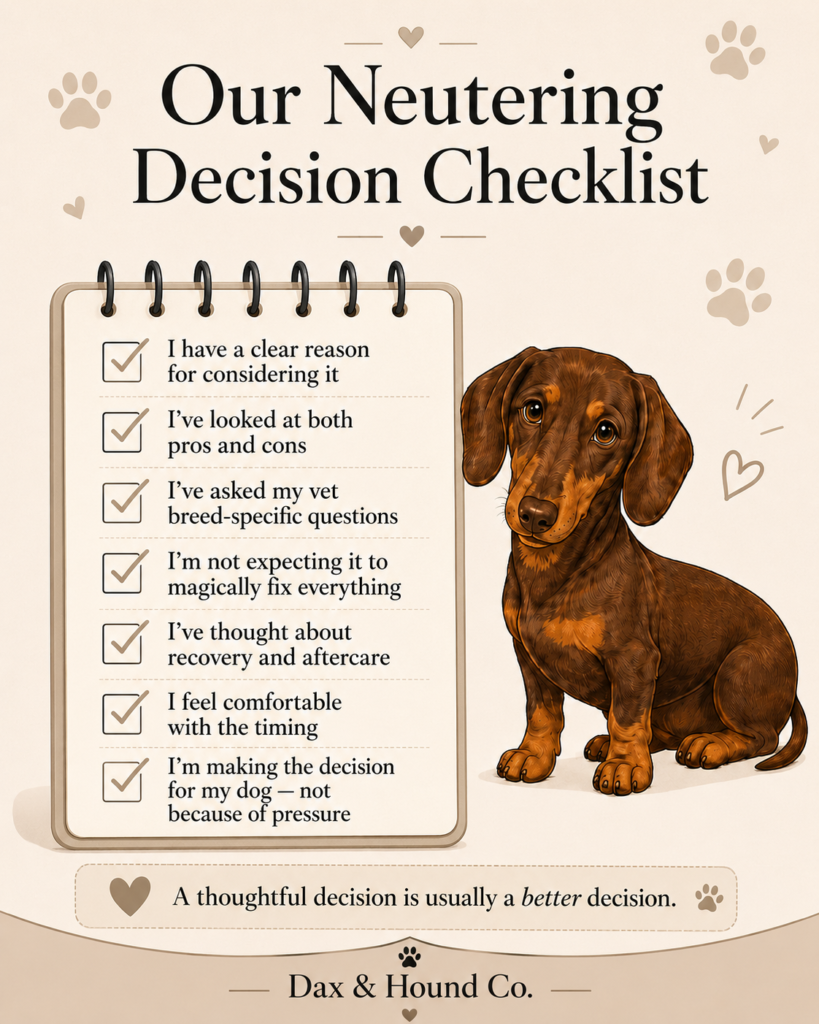
Final Thoughts
Neutering is not a simple good-or-bad decision.
It has benefits.
It has risks.
It has timing considerations.
And for dachshunds, it also sits alongside the bigger conversation about IVDD, physical maturity and long-term health.
For us, the biggest lesson has been that we do not have to make a permanent decision just because it is expected.
We can ask questions.
We can read the research.
We can speak to the vet.
We can think about Winston as an individual dog.
And we can take our time.
That does not mean everyone will make the same choice.
It just means the choice deserves more care than a quick rule of thumb.
At Dax & Hound Co., we share these guides from real life with Winston, our own research, and the things we are still learning as dachshund owners. We are not vets — just two people trying to make thoughtful, informed choices for our little long-backed dog, and hoping it helps other dachshund owners feel more confident asking questions too.


Leave a Reply