
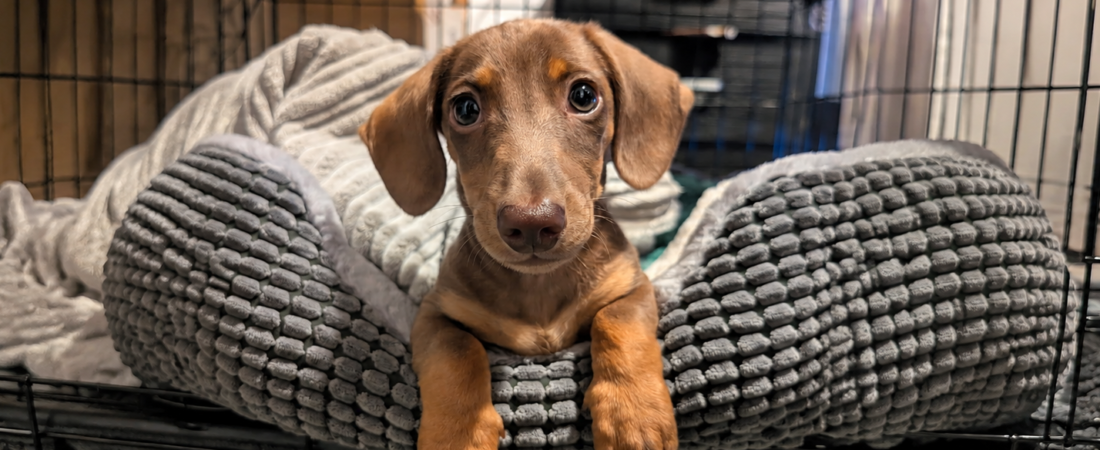
Quick answer: To crate train a dachshund puppy, make the crate feel safe, cosy and positive from the start. Let them explore it, reward them for going in, avoid using it as punishment, keep early sessions short, and build up slowly. For dachshunds, it also helps to think about their tiny bladder, little legs, long back, and need for reassurance in those first few overwhelming weeks.
Crate training was one of the things we thought we were prepared for before Winston came home.
We had read about it.
We had bought the crate.
We had set everything up.
We had made his little area look cosy.
And then we brought home an actual tiny dachshund puppy and realised very quickly that crate training is not just about putting a puppy in a crate.
It is about helping them feel safe.
Especially when they have just left everything they know.
Their mum.
Their littermates.
The breeder’s home.
The smells they recognise.
The routine they were used to.
And then suddenly they are in your house, with your noises, your smells, your sofa, your floors, your voices, and two humans staring at them lovingly while also quietly panicking about whether they are doing everything right.
That was us, anyway.
With Winston, our aim was never to make the crate feel like a cage or a punishment. We wanted it to feel like his space. Somewhere he could sleep, settle, nap, and feel secure.
It did not all happen perfectly.
But looking back, there are a lot of little things that helped.
This is what worked for us with Winston.
Not a perfect textbook method.
Just real life with one very small dachshund puppy, a cosy crate setup, a jumper that smelt like us, and two very tired humans trying to do their best.
This post may contain affiliate links. If you buy through one of our links, we may earn a small commission at no extra cost to you.
First, What Is Crate Training Actually For?
Crate training should not be about shutting a puppy away and hoping they “get used to it.”
That is not how we saw it at all.
For us, Winston’s crate was meant to be:
- a safe sleeping space
- a calm place to rest
- part of his puppy routine
- somewhere cosy and familiar
- a way to help with night-time settling
- a safe area when we could not supervise him properly
PDSA describes the main aim of crate training as giving a dog a safe space of their own, and Blue Cross also says the crate should be a positive place, not somewhere used as punishment.
That is really important.
Because if a puppy only ever goes in the crate when they are being told off, ignored, or shut away when they are upset, they are probably not going to see it as their safe little den.
They are going to see it as the place where the fun stops.
And that was the opposite of what we wanted for Winston.
Our Crate Setup for Winston
Before Winston came home, we had set up a larger furniture-style crate in the lounge.
It looked more like a sideboard than a normal wire crate, which worked nicely because it fitted into the room rather than feeling like something temporary shoved in a corner.
Inside, we had:
- a memory foam bed
- soft bedding
- heartbeat toys
- heat packs
- his familiar-smelling jumper
- space around the crate for his puppy pen
- puppy pads in one area
- water nearby during the day
- a washable waterproof mat underneath everything
Because the crate had a bit of a lip at the entrance, we also used a small foam ramp so Winston could get in and out more easily.
That mattered to us because he is a dachshund.
Even as a tiny puppy, we were already thinking about his back, his legs, and not encouraging unnecessary jumping or awkward climbing.
It sounds like such a small detail, but for dachshunds, small details are often the point.
A low, easy entrance made the crate feel more accessible for him.
Not something he had to scramble into.
Make the Crate Feel Like a Good Place Before Bedtime
One thing I am really glad we did was introduce Winston to the crate properly before expecting him to sleep in it.
When he first came home, we did not just wait until bedtime and then suddenly pop him in, close the door and hope for the best.
We spent time around the crate.
We let him explore.
We rewarded him near it.
We made it calm.
We made it cosy.
We encouraged him to go in and out.
We wanted him to think:
“Oh, this place is nice.”
Not:
“Why have I been abandoned in this wooden puppy prison?”
The RSPCA says a crate can become a safe haven where a puppy feels secure, but the puppy needs to gain confidence with the crate before being left alone in it.
That makes complete sense to me.
Because the crate itself is not magic.
The feeling your puppy has about the crate is what matters.
For Winston, food helped.
He was very food motivated as a puppy, so we used tiny treats and bits of his normal food to reward him for going near the crate, stepping inside, and settling in there.
Another thing that helped was feeding Winston his meals in the crate.
Breakfast, lunch, and dinner all became little opportunities to make the crate feel like a good place. It meant the crate was not just somewhere he went at bedtime or when he needed to settle — it was also where nice things happened.
Because Winston was so food motivated, this worked really well for him.
He started to associate the crate with something positive and familiar, rather than seeing it as somewhere he was being shut away.
It sounds simple, but feeding meals in the crate was one of the easiest ways we found to help him feel happier about going in there.
Another little thing we did was gently move Winston into his crate whenever he fell asleep somewhere else.
If he fell asleep in his pen, on the sofa, or on one of our laps, we would carefully pick him up and place him in his crate so he could carry on sleeping there.
We did not make a big thing of it.
We did not wake him up for training.
We just quietly helped him settle in the place we wanted him to see as his sleeping space.
Over time, I think this helped because the crate became linked with calm, sleepy moments rather than only being somewhere he went when we needed him to settle.
It was never about forcing him in.
It was more like gently showing him, “this is your cosy little sleep spot.”
The Familiar-Smelling Jumper
This was one of the best things we did.
Before Winston came home, we sent a jumper to the breeder that smelt like us and the place he was coming from.
When he arrived home, that jumper went into his crate.
And he loved it.
It was familiar.
It was soft.
It smelt like us.
It smelt like where he had been.
And I think it helped bridge that gap between his old world and his new one.
In those first few nights, when everything was strange and new, that jumper became part of his comfort.
Later, after night-time toilet trips, we would sometimes pop it in the tumble dryer very briefly so it was warm, then put it back in his crate.
He came to expect it.
He would burrow into it, tuck himself up and settle much faster.
It sounds a bit ridiculous when you write it down.
Two grown adults warming a tiny dog’s jumper in the tumble dryer at night.
But honestly, when you are exhausted and something helps your puppy feel safe enough to sleep, you do not question it too much.
You just think, brilliant, the magic jumper works.
The First Night with Winston
The first night was always going to be a big moment.
For him and for us.
Winston had just left everything he knew, so we did not want to put him downstairs alone and expect him to magically cope.
One of us slept downstairs near him for the first week.
Not right in the crate.
Not fussing him constantly.
Just close enough that he was not completely alone in a new house.
Dogs Trust advises creating a safe, comfortable doggy den and, when settling a puppy at night, starting near them and gradually moving away rather than suddenly leaving them to cope alone.
That is pretty much what we did.
The first night, Winston did wake up several times.
But not because he was being difficult.
He was tiny.
His bladder was tiny.
His whole life had changed in a day.
So when he woke, we took him out for the toilet, kept things calm, brought him back in, helped him settle, and went again.
It was tiring.
Of course it was.
But it also felt like the right thing to do.
He was not crying it out alone.
He was learning that we were there, that his crate was safe, and that night-time was for sleeping, not partying.
Although I am sure he would have voted for partying if given the option.
Crate Training and Toilet Training Go Together
With a dachshund puppy, crate training and toilet training are very closely linked.
A tiny puppy cannot hold their bladder for long.
So if they cry in the night, especially in the early weeks, it may not be because they are being dramatic.
They may genuinely need the toilet.
And with dachshunds, you quickly learn that tiny legs can move surprisingly fast when there is a toilet emergency.
We started making notes of when Winston usually woke up and needed to go out.
That helped us spot a pattern.
Then we used alarms so we could get to him before he became too unsettled.
The crate helped because it made night-time more structured.
But the important part was not expecting too much from him too soon.
A crate should never be used as a way of making a puppy hold it longer than they physically can.
That is not fair.
So our early rhythm was:
- toilet before bed
- settle in crate
- listen/watch for waking
- take him out calmly
- reward if he went
- back inside
- warm jumper if needed
- back to sleep
No exciting play.
No big fuss.
No “it is 3am and apparently we live at a puppy festival now.”
Just toilet, comfort, sleep.
That routine helped him understand what night-time was supposed to be.
Slowly.
Very slowly at first.
But it did help.
Why We Used a Puppy Camera
The puppy camera was one of those things I was not sure we needed until we had it.
Then I was very glad we did.
In the early days, we were so tuned into Winston that we kept thinking we had heard him.
A tiny noise.
A shuffle.
A possible cry.
A noise that may or may not have been puppy-related.
When you are tired, you can convince yourself you have heard anything.
The camera helped us check without disturbing him.
If he was asleep, we left him.
If he was awake and moving around, we knew he probably needed us.
That stopped us rushing down every five minutes and accidentally waking him when he was perfectly fine.
It also helped later with separation training, because we could see whether he was settled, moving about, or starting to worry.
For us, it gave reassurance without interfering.
And in those early weeks, reassurance is not a small thing.
Should You Shut the Crate Door?
This is one of those things where I think you have to look at your puppy and your setup.
Some puppies settle well with the crate door closed once they have been introduced properly.
Some find it stressful.
Some do better with a crate attached to a pen.
Some are happier with the door open but still using the crate as their bed.
With Winston, we used the crate as part of a pen setup.
At first, he did sleep in the closed crate at night, but over time we found he settled better when the crate opened into his pen.
That became a better fit for him.
He could still use the crate as his cosy sleeping area, but he had a little bit more space and choice.
And that is a good example of something I think new puppy owners should hear more often:
You are allowed to adapt.
If the original plan does not quite suit your puppy, that does not mean you have failed.
It means you are learning the dog in front of you.
Dogs Trust suggests using a crate as part of a playpen setup and gradually building up the time a puppy spends inside with the door closed, using treats and praise when they relax.
That approach feels much more sensible to me than forcing one rigid version of crate training.
The goal is not “my puppy must be shut in a crate for a certain number of hours.”
The goal is:
“My puppy feels safe, sleeps well, and can settle calmly.”
There is a difference.
Do Not Use the Crate as Punishment
This is probably one of the biggest things.
We never wanted Winston’s crate to mean:
“You are in trouble.”
If he was overtired and going into shark mode, he did sometimes need a nap.
But even then, we tried to keep the crate or pen calm rather than making it feel like a telling off.
Because there is a big difference between:
“You are being punished, go away.”
And:
“You are exhausted, tiny chaos sausage. Let’s help you settle.”
Puppies do not always know when to stop.
Winston definitely did not.
Sometimes the wild biting, zooming, silliness and general gremlin behaviour was not because he needed more play.
It was because he needed sleep.
So we used his crate and pen as part of his rest routine, but we tried not to make it emotional.
No anger.
No shouting.
No dumping him in there because we had lost patience.
Just calm, quiet, safe, sleepy.
Which sounds very peaceful written down.
In reality, there were definitely moments where we were both standing there like, “How can something this small be this much?”
But the principle still stands.
The crate should feel safe.
Not scary.
How We Built Up Time Away from Winston
Crate training also fed into separation training.
We did not want Winston to suddenly go from being with us constantly to being left alone with no practice.
So we built it up slowly.
Very slowly.
At first, we would sit near him while he settled.
Then move slightly further away.
Then sit on the sofa.
Then leave the room briefly.
Then go upstairs.
Then step into the hallway.
Then eventually go out of the front door for short periods.
We used a phrase — “see you later” — so leaving became predictable.
We also used the puppy camera so we could return before he became too upset.
One thing that really helped was giving him something special when we left, then taking it away again when we came back.
That way, us leaving meant something good appeared.
Not forever.
Not as a bribe for hours.
Just a controlled little routine that helped him form a better association.
PDSA advises building up alone time gradually once your dog is relaxed in the crate, starting with short periods and increasing slowly.
That gradual bit mattered a lot for Winston.
We did not want him to practise panic.
We wanted him to practise being calm.
What Made the Biggest Difference for Winston
Looking back, these were the things that helped Winston most.
Making the crate cosy before expecting him to sleep there
We did not want the crate to appear only at bedtime like a strange puppy trap.
It was part of the room from the start.
Using familiar smells
The jumper was genuinely one of the best comfort items.
It helped him settle, especially after night-time toilet trips.
Staying nearby at first
Sleeping downstairs was tiring, but it helped him feel less alone while he adjusted.
Pairing the crate with good things
Food, treats, warmth, calm voices and soft bedding all helped make the crate feel positive.
Keeping night-time boring
Toilet trips were not play sessions.
They were calm, quiet and straight back to bed.
Adapting the setup
The crate-open-into-pen arrangement worked better for Winston over time, so we changed the plan.
Using the camera
It helped us understand whether he actually needed us or whether we were just imagining puppy noises through exhaustion.
Thinking like dachshund owners
The ramp, the low entrance, the cosy bedding, the safe setup — it all came back to making things work for a tiny long-backed puppy.
Common Crate Training Mistakes
These are the things I would try to avoid.
Expecting too much too soon
A puppy who has just come home is not being awkward because they need reassurance.
They are a baby.
Only putting them in the crate when you leave
If the crate only means “humans disappear,” it can quickly become negative.
Using the crate as punishment
The crate should feel safe, not like a consequence.
Ignoring toilet needs
Young puppies cannot hold it for long. Crying at night may mean they need to go out.
Making night-time too exciting
The 3am version of you needs to be boring.
Kind, but boring.
Not adapting
If your puppy does better with a pen attached, or the door open, or a different setup, that is useful information.
Comparing your puppy to everyone else’s
Some puppies settle quickly.
Some take longer.
Some are confident.
Some are sensitive.
Some are Winston and require a heated emotional-support jumper.
They are all different.
What If Your Dachshund Puppy Hates the Crate?
If your puppy panics in the crate, I would not just keep pushing through and hope it improves.
There is a difference between a puppy grumbling for a moment because they are tired and a puppy genuinely panicking.
Signs your puppy may be really struggling include:
- frantic barking or crying
- trying to escape
- panting
- drooling
- scratching at the crate
- toileting from distress
- refusing to go near the crate
- becoming anxious as soon as they realise the door might close
If that happens, it may be worth going back a few steps.
Make the crate positive again with the door open.
Feed near it.
Reward calm behaviour.
Keep sessions tiny.
Use a pen instead if that feels less stressful.
And if your puppy seems very distressed, speak to a vet, qualified trainer or behaviourist.
Crate training should not be about forcing a puppy to panic until they give up.
It should be about helping them feel safe enough to relax.
That can take time.
And that is okay.
Do Dachshunds Need a Crate?
Not necessarily.
I do not think every dachshund must be crate trained in one exact way.
Some families use crates.
Some use pens.
Some use puppy-proof rooms.
Some use a mix.
For us, the crate and pen setup was really helpful with Winston, especially during the early puppy stage.
It gave him a safe space.
It helped with sleep.
It helped with toilet training.
It helped when we could not supervise every second.
It helped us build a routine.
But the point was never the crate itself.
The point was safety, calmness and confidence.
So if a crate works for your dachshund, brilliant.
If a pen setup works better, that can be brilliant too.
The best setup is the one that keeps your puppy safe, helps them settle, and does not make them feel scared.
Our Simple Crate Training Routine with Winston
If I had to summarise what we did with Winston, it would look like this:
- Set up a cosy crate and pen area before he came home.
- Used soft bedding, heartbeat toys and his familiar-smelling jumper.
- Let him explore the crate without pressure.
- Rewarded him for going in and settling.
- Stayed nearby during the first nights.
- Took him out for toilet trips when needed.
- Kept night-time calm and boring.
- Used the puppy camera to understand what he was doing.
- Built up short periods away from him gradually.
- Adapted the setup when he seemed happier with the crate open into his pen.
Nothing about it was instant.
But it worked because it became familiar.
And familiar is very comforting when you are a tiny puppy in a very big new world.
What We Would Do Again
If we were crate training Winston again, I would absolutely do these things:
- send a jumper or blanket to the breeder again
- make the crate cosy before he came home
- use a pen around the crate
- use a low ramp or easy entrance for a dachshund puppy
- reward him for choosing the crate himself
- sleep nearby at first
- use the puppy camera
- keep night-time toilet trips boring
- warm the jumper briefly after night-time trips if it helped him settle
- build alone time slowly
- adapt instead of forcing the original plan
The main thing I would remind myself is this:
The aim is not to “win” crate training.
The aim is to help your puppy feel safe.
That is a much kinder way to look at it.
Final Thoughts
Crate training a dachshund puppy is not about shutting them away and hoping they learn to cope.
At least, that is not how we see it.
For Winston, it was about creating a soft, familiar, safe little space where he could sleep, settle and slowly learn that his new home was safe.
The crate helped us.
The pen helped us.
The routine helped us.
The jumper helped more than I ever expected.
And time helped most of all.
Those first few weeks can feel intense. You are tired, your puppy is tiny, everything is new, and suddenly your life revolves around naps, toilet trips, bedding, alarms and whether the noise you just heard was real or imagined.
But it does get easier.
Slowly, Winston learnt the routine.
Slowly, we learnt him.
And slowly, the crate stopped feeling like “training” and became just another normal, safe part of his little world.
At Dax & Hound Co., we share these guides from real life with Winston and the things we are still learning as dachshund owners. We are not trainers or vets — just two people trying to make thoughtful, gentle choices for our little long-backed dog, and hoping it helps other dachshund owners feel a bit more prepared too.


Leave a Reply