
Quick answer: To toilet train a dachshund puppy, take them outside regularly, especially after sleeping, eating, drinking and playing. Watch for little signs like sniffing, pacing, circling or heading towards the same spot, reward them straight away when they go outside, and clean any accidents properly with an enzyme cleaner. It takes time, consistency and a lot of patience.
Toilet training was one of the first big lessons we had with Winston.
Not just for him.
For us too.
Because before you bring a puppy home, you imagine it being fairly simple.
You take them outside.
They do what they need to do.
You praise them.
They slowly learn.
Lovely.
In reality, it involved a lot more standing by the door, watching for tiny clues, rushing outside at odd times, cleaning up little accidents, and learning very quickly that a dachshund puppy can go from “peacefully playing” to “needs the toilet immediately” with almost no warning.
Winston was tiny when he came home, and so was his bladder.
So those early weeks were intense.
But they were also the weeks where we really started to understand him. We learnt his signs, his routine, what helped him settle, and how much consistency mattered.
This is what worked for us with Winston.
Not a perfect textbook method.
Just real life with one very small dachshund puppy, a lot of rain, and two humans trying their best.
This guide focuses just on toilet training, but if you’re still preparing for your puppy, we’ve also shared our full Dachshund Puppy Essentials Checklist with everything we actually used when Winston came home.
This post may contain affiliate links. If you buy through one of our links, we may earn a small commission at no extra cost to you.
Quick Dachshund Puppy Toilet Training Checklist
These are the things we found most useful when toilet training Winston:
- puppy pads
- poo bags
- enzyme cleaner
- kitchen roll
- absorbent towels
- washable pads
- small training treats
- a regular routine
- a safe outdoor toilet spot
- a night-time toilet plan
- patience
- more patience
- probably another roll of kitchen roll
You do not need anything fancy.
But you do need to be consistent.
And in the beginning, you will probably spend a lot of time asking, “Was that a toilet sniff?”
Sometimes it will be.
Sometimes they are just sniffing.
Very helpful of them.
Start with a Simple Routine
The biggest thing that helped us was routine.
In the first few weeks, we did not wait for Winston to tell us he needed to go out. He was too young to reliably know that himself, never mind communicate it clearly to us.
So we took him out at the times he was most likely to need the toilet.
For Winston, that meant going outside:
- first thing in the morning
- after every nap
- after eating
- after drinking
- after play
- before bedtime
- during the night
- whenever he started sniffing or pacing
- sometimes every 30 minutes, just to be safe
This also lines up with the general toilet-training advice from the RSPCA, who recommend watching for signs such as sniffing, fidgeting or circling, and rewarding your puppy when they go in the right place.
It sounds like a lot because it was a lot.
But it gave him plenty of chances to get it right.
And that was the main aim in the early days.
The more often we got him outside before an accident happened, the more opportunities we had to reward the behaviour we actually wanted.
Tiny puppy goes outside.
Tiny puppy gets praise.
Tiny puppy gets treat.
Tiny puppy slowly starts to understand the system.
That was the plan.
And thankfully, Winston was very food-motivated, which made life a lot easier.
Learn Your Puppy’s Toilet Signs
One thing I would tell any new dachshund puppy owner is this:
Watch them properly.
Not in a panicky way, but in a “I am learning your little habits” way.
At first, we were on high alert for everything Winston did.
A sniff.
A pause.
A little wander.
A sudden change in direction.
A suspicious amount of interest in one patch of floor.
It all felt like it could mean something.
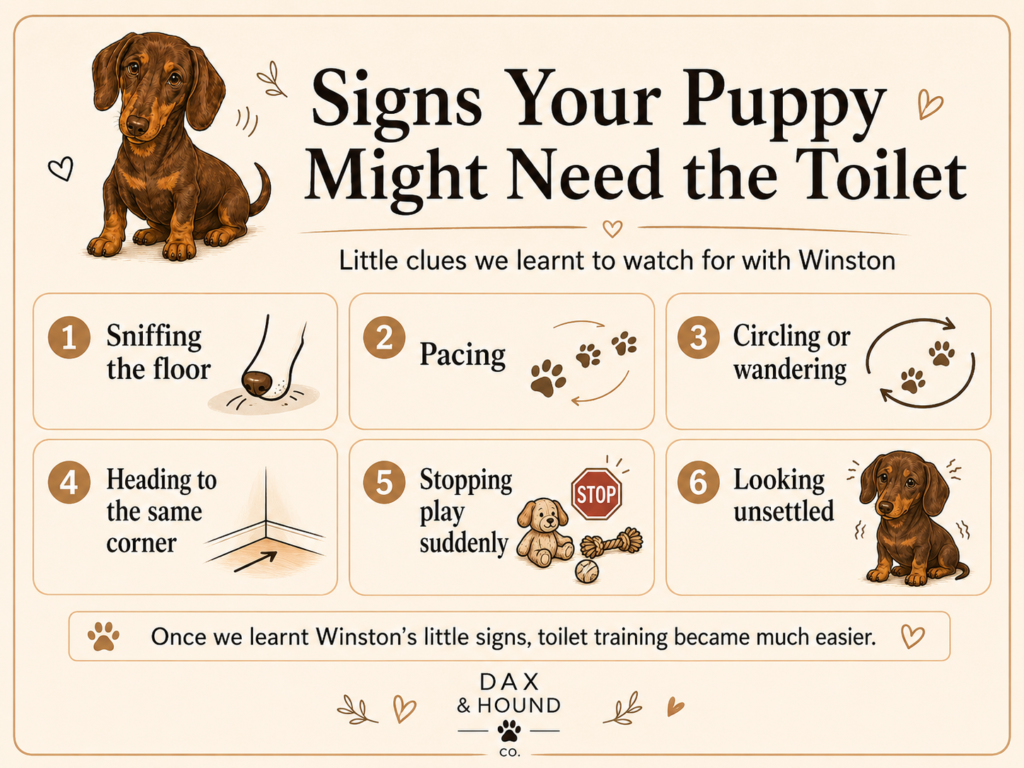
Over time, we started to notice Winston had a few clear signs.
He would often:
- start pacing
- sniff the floor more than usual
- drift towards a certain corner
- look unsettled
- stop playing suddenly
- move away from where he had been resting
- wander like he had a tiny mission
The corner thing was one of the biggest clues for us.
If he suddenly went over to a particular area and started sniffing around, that usually meant we had a very small window of time to get him outside.
And when you are toilet training a puppy, “small window of time” really does mean small.
Not “I’ll just finish this first.”
Not “in a minute.”
More like: shoes on, puppy up, go. Often you won’t have time for shoes.
Puppy Pads or Outside?
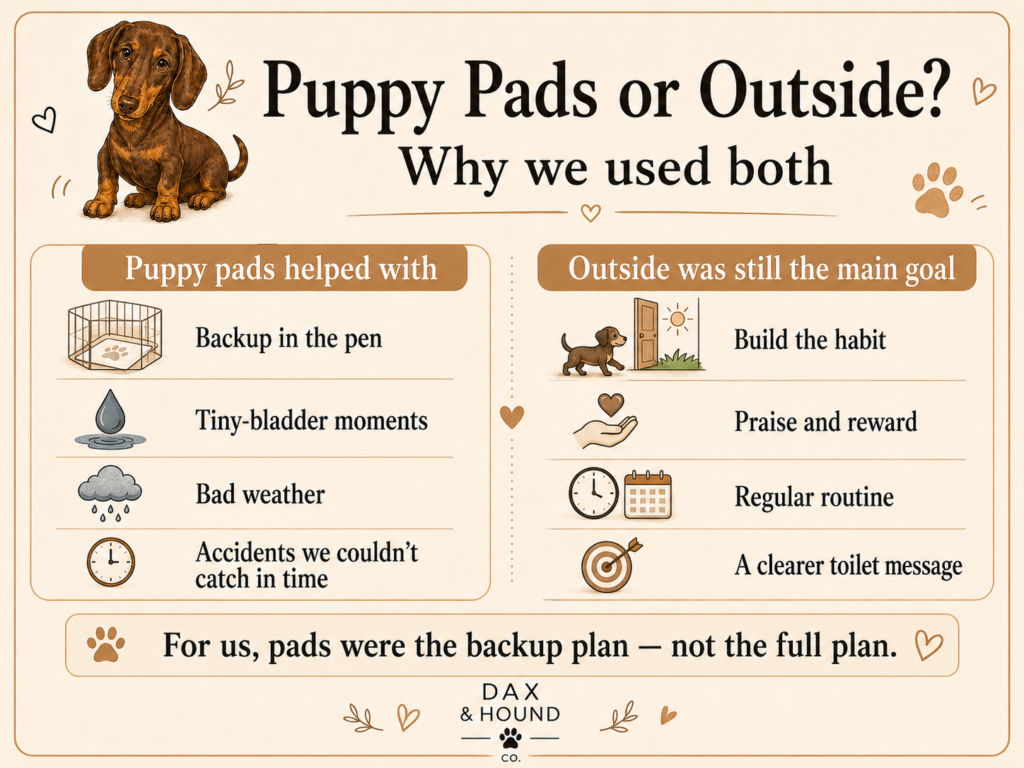
We used both.
The main focus was always getting Winston outside, but puppy pads were useful in his pen during the early stage.
In my head, toilet training was going to be very organised.
Outside from day one.
Consistent routine.
Nice and straightforward.
But Winston came home during awful weather, and those first few days were a mix of rain, wet paws, night-time toilet trips, and trying to work out what was realistic for such a tiny puppy.
So we used puppy pads as a safety net.
Not as the full plan.
Just as something there in case we missed the signs or could not get him out quickly enough.
At first, he did not always get it exactly right. Sometimes he used the pad, sometimes he missed it slightly, and sometimes he seemed to understand the idea but not the exact target.
Which is fair enough.
He was a baby.
For us, puppy pads helped reduce stress while still keeping the main routine focused on going outside.
I know some people prefer not to use them at all, and that is completely fine. I think it depends on your home, your puppy, your routine, and what works practically.
The important thing is that your puppy is learning where you want them to go, and that you are being consistent with the direction you are taking.
Blue Cross also has a helpful puppy toilet training guide if you want another perspective on using pads or newspaper while still building an outdoor routine.
Reward Straight Away
Whenever Winston went to the toilet outside, we praised him and rewarded him immediately.
That part mattered.
Not once we were back indoors.
Not once we had taken our coats off.
Not after a little delay.
Straight away.
We wanted him to understand exactly what he had done right.
We used tiny training treats or part of his normal food allowance. Because he was so small, we often broke treats into even smaller pieces.
He did not care.
A tiny reward was still a reward.
And Winston has always appreciated a good snack opportunity.
The praise was important too. We made it clear he had done something brilliant, even if all he had done was have a tiny wee in the garden.
Because to us, at that stage, it was brilliant.
Every successful outdoor toilet trip felt like a win.
And those little wins add up.
What to Do When Accidents Happen
Accidents will happen.
Even if you are doing everything properly.
Even if you are watching them constantly.
Even if you have taken them out what feels like 400 times that day.
They are puppies, and they are learning.
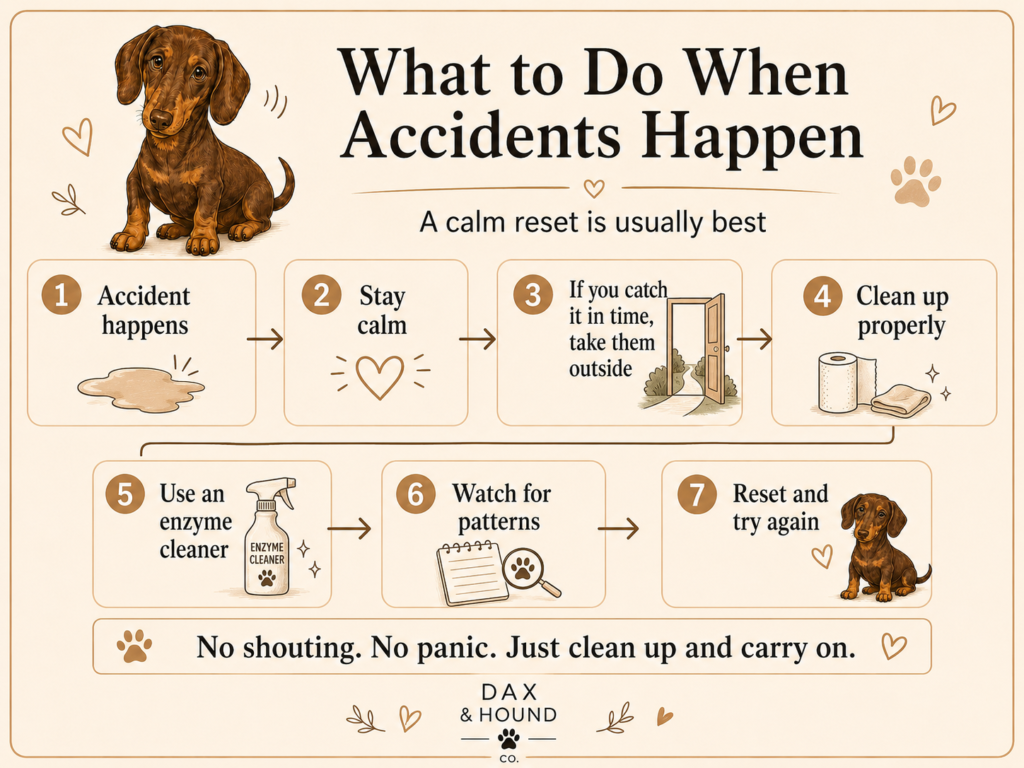
When Winston had an accident, we did not tell him off.
If we caught him just about to go, we calmly picked him up and took him outside.
If we found it after the fact, we cleaned it up and carried on.
That was it.
No shouting.
No big reaction.
No making him feel scared or confused.
Just act as though nothing has happened, then quietly clean it up.
Because really, most puppy accidents are not them being naughty. They either did not know what to do yet, could not hold it, or we missed the signs.
Annoying for us?
Yes.
Their fault?
Not really.
An enzyme cleaner was one of the most useful boring things we bought. Normal cleaning products might make the area smell clean to us, but dogs have a much better sense of smell. If there is still a trace left behind, they may be more likely to use the same spot again.
So clean it properly, reset, and keep going.
Toilet Training in Rainy Weather
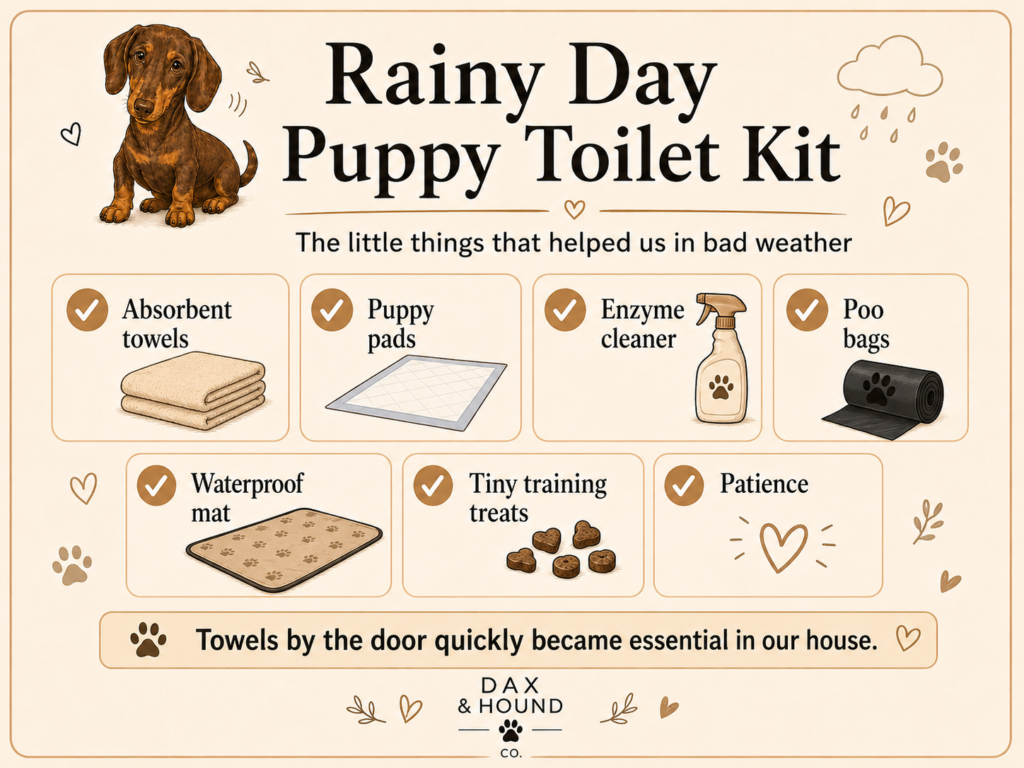
This was a big one for us.
Winston came home during what felt like endless rain.
And because dachshunds are so low to the ground, wet grass does not just mean wet paws.
It means wet belly.
Wet legs.
Wet everything.
So we quickly learnt that absorbent puppy towels by the door were not optional.
They were essential.
Rain can make toilet training feel harder because nobody really wants to stand outside in bad weather, especially with a tiny puppy who is looking at you like this whole situation was your idea.
But we tried to keep outdoor toilet trips short and boring.
Out we went.
Toilet opportunity.
Praise and reward if he went.
Back inside.
We were not trying to turn every toilet trip into an adventure.
The goal was simply to build the habit.
If your dachshund puppy is not keen on bad weather, try to keep things calm and predictable. Same area if possible, lots of praise when they get it right, and a towel ready for the tiny wet sausage afterwards.
Night-Time Toilet Trips
The first week with Winston, we took turns sleeping downstairs near him.
He settled quite well overall, but he needed to go out during the night because his bladder was so small.
That part was not him being difficult.
He simply could not hold it for long.
We started making notes of when he usually woke up, and that helped us spot a bit of a pattern.
Once we had a better idea of his timings, we started sleeping upstairs and setting alarms so we could go down to take him out before he became too unsettled.
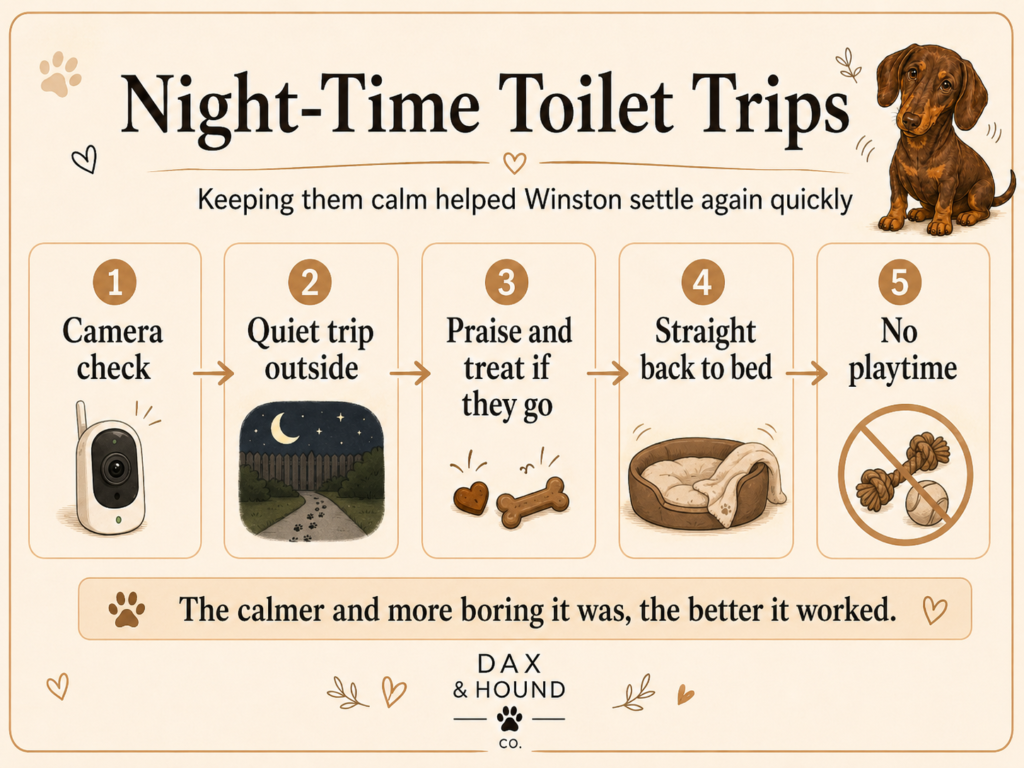
This is where the puppy camera helped us massively.
Sometimes we thought we heard him.
Sometimes we were sure he had made a noise.
Sometimes it was just us being exhausted and imagining puppy cries.
The camera let us check without disturbing him.
If he was awake and moving around, we went down.
If he was fast asleep, we left him.
That saved a lot of unnecessary rushing around.
We also found that taking his water bowl up about an hour before bedtime helped reduce night-time toilet trips for Winston. That worked for us, but every puppy is different, and they still need plenty of access to fresh water during the day. If you are unsure, speak to your vet.
How Long Did Toilet Training Take?
Winston was fully toilet trained within about two months of coming home.
Since then, he has not had an accident in the house.
But I would not treat that as a rule for every puppy.
Some puppies take longer.
Some have a few setbacks.
Some are affected by changes in routine, excitement, stress, illness, weather, or simply being very young.
What helped us was that we had time off work at the beginning, so we could be really consistent.
We were able to watch him closely, take him out regularly, and reward him every time he got it right.
That made a big difference.
If your puppy takes longer, it does not mean you are failing.
It just means they are still learning.
And sometimes learning takes a bit more kitchen roll than you expected.
Our Early Toilet Training Rhythm with Winston
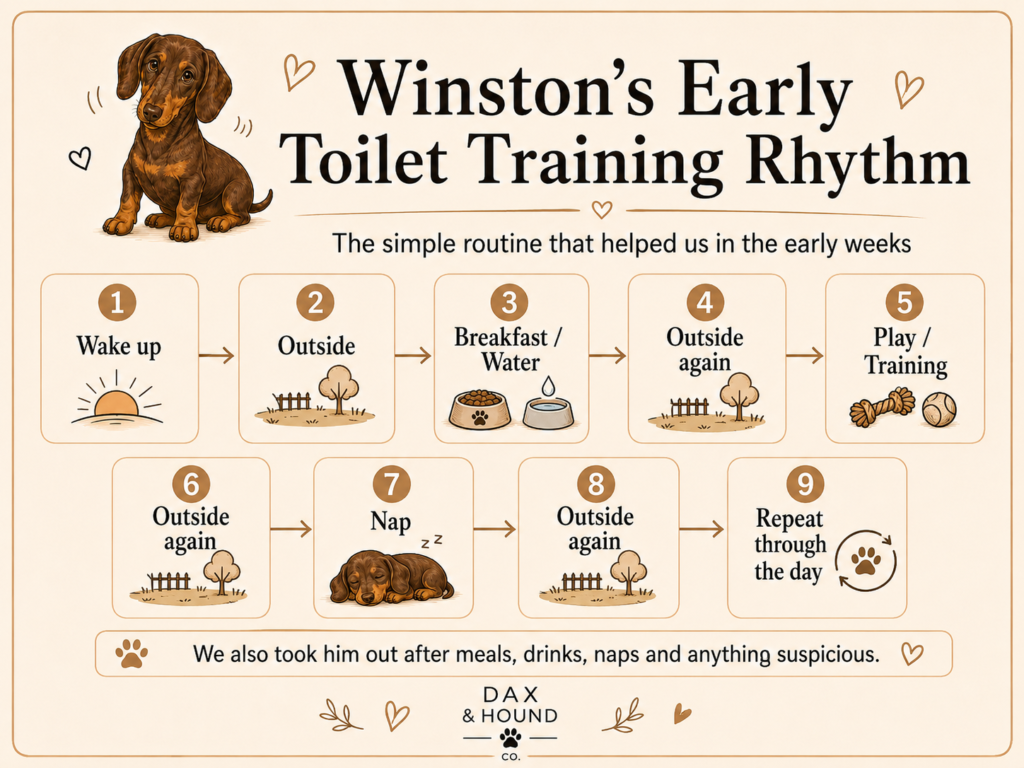
This was roughly how our days looked in the beginning:
- Wake up
- Straight outside
- Breakfast and water
- Outside again
- Play or training
- Outside again
- Nap
- Outside again
- Repeat through the day
At night, we kept things calm:
- toilet trip before bed
- alarms if needed
- camera check if we thought he was awake
- outside quietly
- praise and reward if he went
- back to bed
- no exciting play
The night-time part is important.
A sleepy 3am toilet trip is not the time to accidentally convince your puppy that it is now party hour.
One little thing that really helped Winston settle again after night-time toilet trips was his jumper.
This was the jumper we had sent to the breeder before he came home, so it smelt like us and the place he had come from.
When we brought him back in after a night-time toilet trip, we would sometimes pop it in the tumble dryer very briefly so it was warm, then put it back in his crate.
He came to expect it as part of the routine.
He would burrow into it, tuck himself up, and settle back down much quicker.
It sounds like such a small thing, but in those early tired weeks, anything that helped him feel safe and go back to sleep felt like a win.
We talked more about Winston’s early crate and comfort setup in our full Dachshund Puppy Essentials Checklist.
What Helped Us Most
Looking back, these were the things that made the biggest difference with Winston.
Taking him out before he asked
We did not wait for him to tell us every time. In the early days, we took him out before he had much chance to get it wrong.
Watching his little habits
Once we learnt the pacing, sniffing and corner-wandering, we could react much faster.
Rewarding the right thing immediately
The timing of the reward really helped. He got praise and a treat as soon as he went outside.
Using puppy pads sensibly
For us, pads were helpful as a backup while he was tiny, but we still focused mainly on outdoor toilet training.
Cleaning properly
The enzyme cleaner was not exciting, but it was very useful.
Staying calm
Accidents happened. We cleaned them up and moved on.
That calmness helped us, too.
Because toilet training can feel like a lot when you are exhausted.
Common Toilet Training Mistakes
These are the things I would try to avoid if we were doing it again.
Waiting too long
Tiny puppies need to go often. Usually, more often than you think.
Expecting obvious signals straight away
Some puppies do not know how to ask yet. You have to learn their signs before they learn how to tell you.
Telling them off
If they do not understand what they have done wrong, telling them off will not help. It will only cause anxiety and make toilet training harder.
Forgetting the key moments
After food, drink, play, and naps were the big ones for Winston.
Not using the right cleaner
If the smell remains, they may return to the same area.
Expecting a straight line of progress
Some days feel better than others. That is normal.
Toilet training is repetitive, but repetition is what teaches them.
When to Speak to a Vet
Most toilet training is about time, routine, and consistency.
But if something feels off, it is worth speaking to your vet.
For example, get advice if your puppy:
- seems to be weeing constantly
- cries or strains when toileting
- has diarrhoea
- suddenly starts having accidents after being reliable
- drinks much more than usual
- seems unwell
- cannot seem to settle
- has any blood in their wee or poo
We are not vets, and this article is only based on our experience with Winston.
Sometimes toilet training issues are just part of puppy life.
But sometimes there can be another reason, so it is always better to check if you are worried.
What We Would Do Again
If we were toilet training Winston again, we would absolutely do these things:
- take time off work if possible
- take him out very regularly
- use puppy pads as a backup in the early stage
- reward every outdoor toilet trip
- watch for pacing, sniffing and corner wandering
- keep towels by the door
- use an enzyme cleaner from the start
- keep night-time toilet trips calm
- use the puppy camera
- remind ourselves that accidents are normal
It felt intense at the time.
But it did not last forever.
And once Winston understood, he really understood.
Final Thoughts
Toilet training a dachshund puppy is one of those puppy stages that feels endless when you are in it.
You are tired.
You are watching them constantly.
You are celebrating tiny wees in the garden like they have just won an award.
And somehow, your life temporarily becomes organised around naps, meals, drinks, play sessions, and whether the puppy has started sniffing near that one suspicious corner again.
But it does get easier.
For us, toilet training Winston was one of the first times we really learnt how important routine was. We learnt to read him better, he learnt what we were asking of him, and slowly it all started to click.
It was wet, repetitive, and tiring at times.
But every little success helped.
And once he got it, all those early rushed trips outside, tiny treats, damp towels and late-night alarms felt completely worth it.
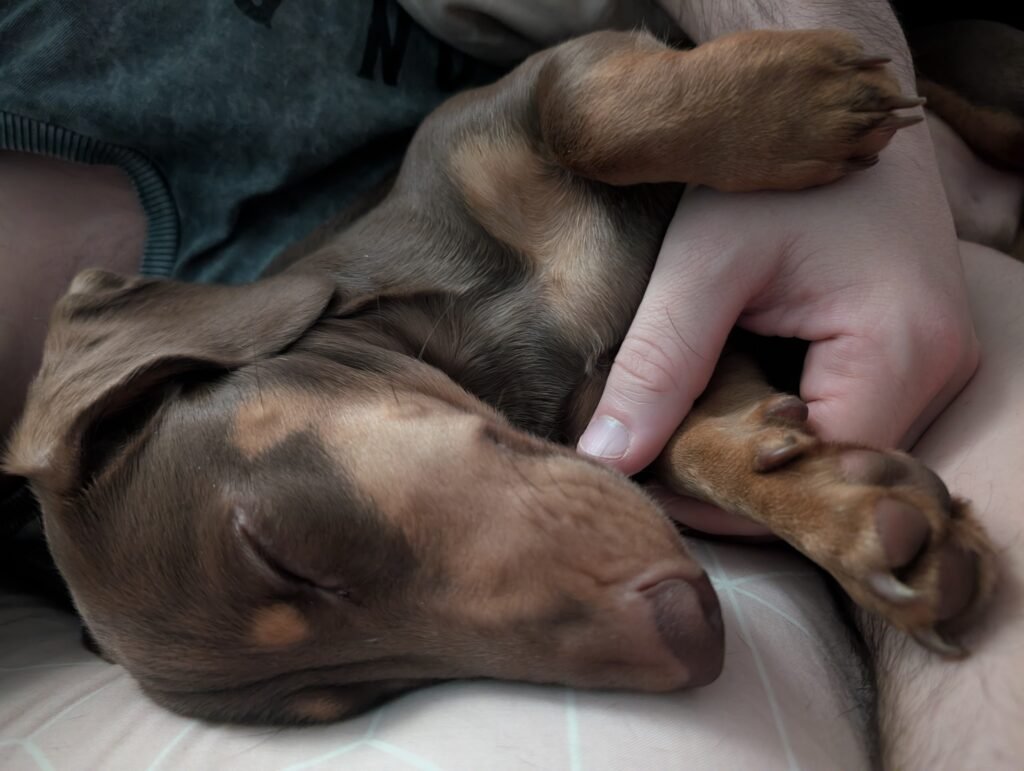
At Dax & Hound Co., we share these guides from real life with Winston and the things we’re still learning as dachshund owners. We’re not vets, just two people who care a lot about helping little long-backed dogs live happy, safe and comfortable lives.

Leave a Reply