
Quick answer: Puppy-proofing for a dachshund means doing all the usual puppy safety checks — cables, cleaning products, food, small objects and anything chewable — but also thinking about their long back, tiny size and surprising ability to squeeze into places you thought were impossible. We used stair gates, ramps, playpen panels, non-slip mats and gradual access to different areas rather than giving Winston free run of the whole house and garden immediately.
Before Winston came home, we went around the house trying to look at everything from puppy height.
Which is surprisingly difficult when puppy height is approximately ankle level.
Cables.
Shoes.
Cleaning products.
Food.
Bins.
Tiny objects.
Anything chewable.
Anything climbable.
Anything we particularly did not want dachshund teeth introduced to.
And because Winston is a dachshund, we had another layer to think about too.
Stairs.
Furniture.
Slippery floors.
Jumping.
Garden steps.
And gaps that look perfectly harmless until you imagine a very determined sausage dog trying to fit through them.
We did quite a lot before Winston arrived, but one of the best decisions we made was not giving him access to everything at once.
His world grew as he did.
And that worked really well for us.
This post may contain affiliate links. If you buy through one of our links, we may earn a small commission at no extra cost to you.
Start with the Obvious Puppy Hazards
The first job was the normal puppy-proofing stuff.
We moved or blocked anything Winston might chew, swallow, knock over or get himself tangled in.
That included things like electrical cables, cleaning products, shoes, food, medicines, bins and small objects.
We even put guards around our TV cabinet because there were far too many interesting-looking things underneath it.
Including my Nintendo Switch.
Winston has never actually been a particularly destructive dog, but at that stage we had no idea what sort of puppy he was going to be.
And personally, I would rather move something unnecessarily than find out the hard way that my puppy has developed an interest in electrical engineering.
Blue Cross recommends removing or securing things such as wires, human food, medicines and cleaning products before a puppy arrives, while Dogs Trust similarly advises covering electrical leads and moving anything dangerous or precious out of reach.
Most puppy-proofing is incredibly boring.
It is also much less boring than an emergency vet visit.
Cables Really Do Need Checking
Despite all our preparation, there was one cable I missed.
Our internet cable where it connected to the PCs upstairs.
Winston found it.
Winston sampled it.
And I learnt the hard way that broadband cables are apparently not immune to dachshund teeth.
I ended up having to buy a new cable and reroute the whole thing through the walls from downstairs.
So when guides tell you to check cables, they really do mean all the cables.
Not:
“All the obvious ones apart from that one hidden behind something because surely the puppy will never find it.”
They will find it.
PDSA specifically recommends keeping wires out of reach or using cable covers because puppies may chew through live electrical cables.
Winston thankfully chose the internet rather than the mains.
Still inconvenient.
We Put Baby Gates on Both Ends of the Stairs
Because Winston is a dachshund, stairs were one of the things we had decided on before he even came home.
We have a baby gate at the bottom.
And another at the top.
He has never been allowed to freely run up or down the stairs.
If we want him upstairs, we carry him.
And because this has simply always been the rule, he does not really question it.
Now, at 14 months old, he even knows our evening routine.
When it is time to go upstairs, Winston will sometimes wander over to the staircase and stand with his front paws on the bottom step.
Waiting.
Apparently the dachshund lift service is open.
We pick him up and take him with us.
He does not try to charge upstairs himself because that has never been part of his normal routine.
PDSA also suggests using baby gates when introducing puppies to a home, both to control access and to keep them away from hazards such as stairs.
For us, setting that boundary immediately was much easier than trying to undo it later.
We Did Not Give Him the Whole House Straight Away
When Winston first came home, his main world was the lounge and kitchen.
Even within that area, if he became too overstimulated or clearly needed sleep, we would settle him back into his crate and pen area.
At night, he was initially restricted to his pen.
Then his freedom gradually increased.
At around two months, he was trusted with the whole lounge.
Later, lounge and kitchen.
Now, at 14 months, he can freely access both rooms and even the sofa when we are not sitting on it with him.
And we have had no issues with him chewing furniture or destroying things he should not.
At night, though, we still restrict him to the lounge.
Not because we do not trust him.
He simply seems to settle and sleep better there.
I think gradually increasing his freedom helped.
Rather than suddenly giving a tiny puppy an entire house to patrol, he learnt one manageable space at a time.
PDSA and Dogs Trust both recommend using gates and separate puppy-safe areas to control access while a puppy settles into their new home.
We Did the Same Thing in the Garden
We took exactly the same approach outside.
Before Winston arrived, we checked the garden carefully for gaps.
Remember, miniature dachshund puppies are tiny.
Winston was so small that our concerns initially included gaps under fences and, somewhat less rationally, being carried away by a seagull.
But even though our garden was secure, we did not immediately give him access to all of it.
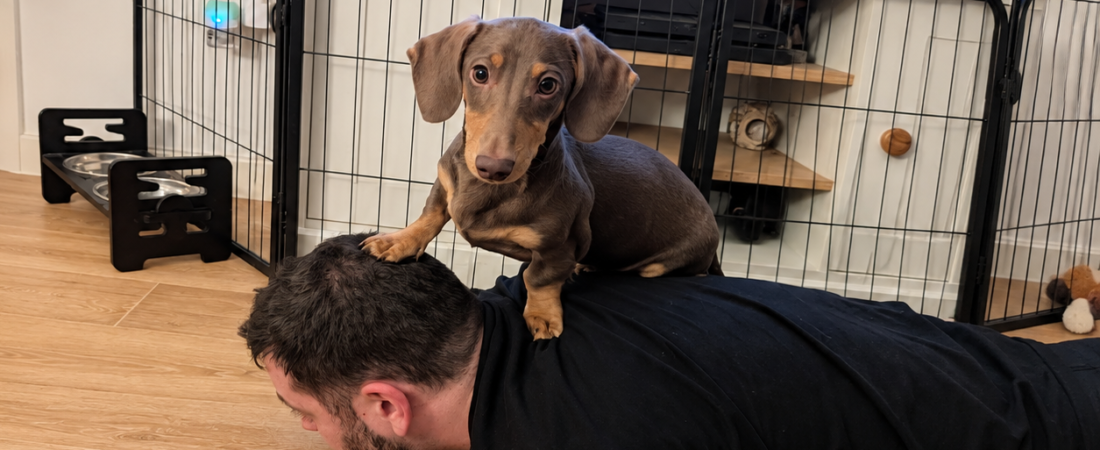
At first, we created a very small outdoor area using the panels from his puppy playpen.
That gave him somewhere controlled for toilet training and exploring.
Once he became more confident, we moved the panels and made his area larger.
Then larger again.
Eventually, we switched to temporary fencing mesh so he could access much more of the garden while still being contained.
The mesh we used was the Amazon product you supplied (B071YLHJKJ) — this is where I’d insert your affiliate link in the published article.
Finally, once we were confident about the garden and about Winston, we opened the whole thing up to him.
Blue Cross actually suggests extendable pens as a way of creating a secure outdoor puppy area while also recommending owners check fences, gates, plants and garden chemicals carefully.
For Winston, gradually making the garden bigger worked brilliantly.
Each expansion was basically a new adventure.
Sofa Access Was Earned Too
Winston was allowed on the sofa when he was little.
But only while supervised.
We were already very conscious of jumping because of his dachshund back, so we were not comfortable letting a tiny puppy freely climb around on furniture and decide how he was getting down.
A few months later, we introduced his sofa ramp/steps.
Even then, the ramp was initially only available when we were supervising him.
We wanted him to learn to use it properly rather than treat the sofa and ramp as some sort of miniature dachshund agility course.
As he got older and became more reliable, that changed.
The ramp is now always available.
Winston can be trusted to use it.
And he regularly takes himself onto the sofa, rolls onto his back and sleeps with his belly in the air as though he personally paid the mortgage.
Giving him freedom gradually meant that by the time he had it, he actually knew what to do with it.
Hard Floors Were Useful — But We Added Grip Where Needed
When we bought our house, we deliberately chose hard flooring downstairs because we knew we wanted a dog eventually.
That decision was incredibly helpful during puppyhood.
Toilet accident?
Easy to clean.
Wet dachshund after two months of British rain?
Easy to clean.
Mysterious puppy mess that appeared approximately eleven seconds after you last checked?
Easy to clean.
But hard floors can also be slippery.
So we used washable mats in the areas where Winston needed extra grip.
That gave us the best of both worlds.
Easy cleaning for us.
More secure footing for him.
Give Them Something Better to Do
I do think Winston’s personality is partly responsible for the fact that he has never destroyed furniture.
Some dogs are simply bigger chewers than others.
But I also think management helped.
We watched him closely.
If he started focusing on something he should not, we redirected him.
We gave him proper things to chew.
We used lick mats.
Snuffle mats.
Puzzle toys.
Training.
Play.
Naps.
We tried not to leave him bored with nothing to do except inspect the structural integrity of our sofa.
Blue Cross specifically recommends providing toys, food enrichment and games alongside puppy-proofing so puppies have appropriate ways to keep themselves occupied.
That is something we still believe strongly.
Sometimes the solution is not simply:
“Stop chewing that.”
It is:
“Here is something better to do instead.”
Puppy-Proofing Is Really About Preventing Practice
The more I think about it, the biggest thing we did was prevent Winston from repeatedly practising behaviours we did not want.
He could not run upstairs because there was a gate.
He could not jump off the sofa freely because sofa access was supervised.
He could not wander around the whole house looking for trouble because his access was gradually expanded.
He could not immediately disappear into the far end of the garden because we created smaller safe zones first.
And when he did find something inappropriate, we redirected him rather than simply waiting until he destroyed it.
Dogs Trust makes a similar point in its puppy guidance: from a puppy’s perspective, anything they can reach is potentially theirs, so preventing access in the first place is much easier than constantly trying to retrieve things afterwards.
That really sums up our approach.
Make getting it right easy.
Make getting it wrong difficult.
Our Dachshund Puppy-Proofing Checklist
If we were preparing our home for another dachshund puppy tomorrow, I would check:
- stair gates at both ends of the stairs
- electrical and internet cables completely inaccessible
- cleaning products and medicines securely stored
- food and bins out of reach
- shoes, remotes and valuables put away
- anything small enough to swallow removed
- garden fences and gates checked for puppy-sized gaps
- toxic garden products/plants checked
- a small secure garden area ready initially
- crate/pen or safe resting space prepared
- ramps or steps ready where appropriate
- sofa access supervised
- washable non-slip mats on slippery flooring
- suitable chews, enrichment and toys available
And then I would get down near floor level and look again.
Because puppies see opportunities humans somehow completely miss.
Final Thoughts
Puppy-proofing Winston’s home was not about turning the house into an empty padded room.
It was about controlling how much responsibility we gave him before he was ready for it.
His world started small.
A crate.
A pen.
The lounge.
The kitchen.
A little patch of garden.
Then, as he grew and learnt the rules, that world expanded.
More garden.
More rooms.
The sofa.
More independence.
Now we trust him enormously.
He does not chew our furniture.
He does not attempt the stairs.
He uses his ramp.
He knows where he is allowed to go.
And he waits patiently at the bottom of the stairs for his evening lift.
Would he have turned out exactly the same if we had simply given him free run of everything from day one?
Maybe.
But I am glad we did not test that theory.
Especially after the internet cable incident.
At Dax & Hound Co., our puppy guides come from what actually worked — and occasionally what very much did not work — with Winston. Every home and puppy is different, but for us, good puppy-proofing was less about constantly saying “no” and more about creating an environment where Winston had plenty of chances to make the right choice.


Leave a Reply