
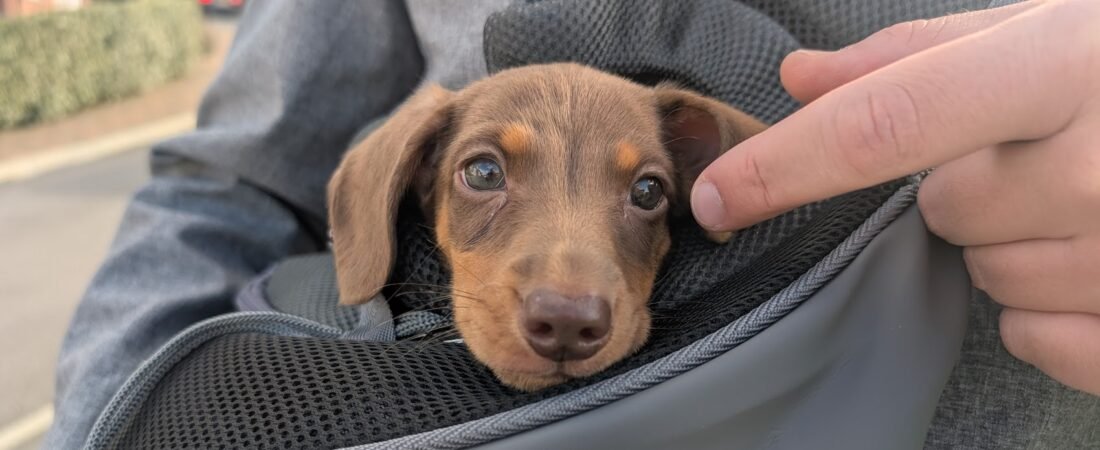
Quick answer: You can start socialising a dachshund puppy before they have completed their vaccinations without putting them down in public places. We carried Winston in a puppy sling, introduced him to new sights, sounds, people and places in very short sessions, and rewarded him for calmly looking back at us. We kept him off public ground completely until he was fully covered by his vaccinations.
One of the things I think we misunderstood slightly before getting Winston was what puppy socialisation actually meant.
You hear:
“Make sure you socialise your puppy.”
And it is very easy to imagine that means your puppy needs to meet loads of people, play with lots of dogs and experience as much as physically possible while they are young.
That was not really the approach we ended up taking.
For us, socialisation became much more about teaching Winston:
The world can be exciting, noisy and sometimes a bit strange — but you do not have to react to everything in it.
And because he was not yet fully vaccinated, we had to find ways of showing him that world without simply putting him down and walking him around.
That is where his puppy sling became one of our favourite early purchases.
This article is based on our experience with Winston and is not veterinary advice. Vaccination schedules and local disease risks can vary, so always ask your own vet when your puppy can safely start walking on public ground.
We Started Almost Straight Away
We gave Winston his first day at home to get used to everything.
And honestly, he had enough to process already.
New house.
New humans.
New smells.
New crate.
New garden.
New routine.
So we were not in a rush to immediately take him sightseeing.
But the following day, we started.
Very slowly.
His first “outing” was literally being carried to the front of the house in his sling for about a minute.
That was it.
No grand adventure.
No trip around town.
Just:
Here is the front of the house.
Here are some noises.
Here are some things moving around.
And now we are going home.
Over the following days, we gradually increased it.
We went a little further up the road.
Then to the top of the road.
Then slightly longer distances.
Eventually, Winston could comfortably come with us on longer little trips while still safely tucked into the sling.
Dogs Trust recommends starting socialisation early, but making new experiences gradual, controlled and positive rather than overwhelming a puppy. They also specifically suggest carrying puppies outside in a carrier or sling before they are ready to walk on public ground.
That gradual approach really suited Winston.
Our Aim Was to Come Home Before He Had Had Enough
This became one of our main rules.
We did not want to wait until Winston was completely overwhelmed before taking him home.
We wanted to finish while things were still going well.
So his early trips were deliberately short.
If we went to our local supermarket, we would stand near the entrance for no more than about five minutes.
He could watch:
People walking past.
Trolleys.
Cars.
Different voices.
Different clothing.
People carrying bags.
All the very ordinary human things that are completely new to a puppy.
Then we went home.
When we took him into our work office, it was similar.
A quick visit.
A few hellos.
A little fuss.
Then home again.
The vet obviously took as long as the appointment needed to take, although Winston has always loved the vets because, as far as he is concerned, it is another building full of people who might fuss him.
Still true now.
We Learnt Winston’s “I’m Done” Signs
Because the sessions were short, Winston normally coped really well.
But he did make it obvious when he had had enough.
He would become:
- wriggly
- whiny
- restless
- more interested in climbing out of the sling
Trying to escape the sling was generally the point where the adventure was officially over.
That was useful for us because it taught us to watch him, rather than deciding in advance how long an outing should last.
If he had coped beautifully for three minutes, that was enough.
There was no benefit in pushing for ten just because we had planned ten.
PDSA similarly recommends keeping socialisation positive and removing a puppy from a situation if they start showing signs of anxiety or becoming overwhelmed.
Sometimes more socialisation is not better socialisation.
Sometimes the best thing you can do is go home.
Socialisation Does Not Mean Meeting Everyone
This is probably the biggest thing we learnt.
Socialisation is not:
“Hello puppy, here are 400 strangers. Good luck.”
It is not making your puppy greet every dog.
It is not letting every person pick them up.
And it is not teaching them that every interesting thing they see means they get to rush over and investigate it.
We actually wanted almost the opposite.
We wanted Winston to notice things without feeling that he had to interact with them.
That is where one of our earliest training cues became really useful.
“Look at me.”
We taught Winston to look at us on cue using treats.
At first, it was simple.
Say the cue.
Winston looks at us.
Reward.
Then we started using it around distractions.
Something interesting appears?
“Look at me.”
Reward.
Dog in the distance?
Look at us.
Person walking past?
Look at us.
Something unfamiliar or a little strange?
Check in with us.
And that is something we still notice now that he is older.
When Winston sees something new, exciting or potentially worrying, he quite often looks at us first.
Almost as though he is asking:
“What are we doing about this then?”
And that is exactly what we wanted.
We would much rather he looks to us for direction than feels he has to make every decision himself.
The Sling Was One of Our Best Puppy Purchases
Before Winston was fully vaccinated, the puppy sling was brilliant.
He could come with us and experience normal life while staying safely off public ground.
He saw:
- people
- dogs
- cars
- traffic
- shops
- the vets
- our office
- different streets
- different voices
- general everyday noise
But he experienced those things while tucked safely against us.
He was warm.
He was secure.
And if anything became too much, we could simply turn around and take him home.
PDSA also suggests carrying puppies in public before they are fully vaccinated so they can safely experience new people, places, sights and sounds.
The sling we used with Winston was this one:
Puppy Sling Carrier
https://www.amazon.co.uk/Sling-Carrier-Breathable-Adjustable-Travel/dp/B087CTQ683/
We would absolutely use one again.
We Did Not Put Winston on Public Ground
There is advice around lower-risk environments before a puppy’s vaccination course is complete, and individual vets may give slightly different advice depending on the puppy, vaccine used and local disease risk.
But personally, we were not taking any chances.
Until Winston was fully covered by his vaccinations, the only place we allowed him on the ground outdoors was our own garden.
Everywhere else, he was carried.
That was simply the level of risk we were comfortable with.
Current Dogs Trust and PDSA advice similarly says puppies can be carried outside before their vaccination course is complete, but owners should speak to their vet about when it is safe for their particular puppy to start walking outside.
Your vet should always be the one to give you the final go-ahead.
Socialisation Started at Home Too
Going outside was only part of it.
A lot of Winston’s early socialisation happened without leaving the house at all.
We deliberately introduced him to everyday noises.
Using Alexa, we played recordings of:
- fireworks
- thunderstorms
- knocking at the door
- doorbells
We did this regularly during his first couple of months.
Not blasting them at him.
Not trying to frighten him.
Just letting those sounds exist around him at a manageable level while life carried on normally.
And whether that work is entirely responsible or Winston is naturally fairly laid-back, we cannot know.
But today:
Fireworks barely bother him.
Storms seem to send him to sleep.
And somebody knocking at the door generally earns mild curiosity rather than complete dachshund meltdown.
I will take that.
One Thing We Think Really Paid Off
I remember taking Winston into the vets when he was still tiny.
There were two other dogs there barking like mad.
Winston was in his sling.
And what did he do?
He fell asleep.
That moment has always stuck with me.
Because he noticed dogs.
He noticed noise.
But he did not seem to believe it was automatically something he needed to react to.
Even now, Winston does not bark when he sees dogs, people or cats while we are out walking.
Cats running through his garden are apparently covered by an entirely different legal framework.
But out and about, he is generally very calm.
I genuinely think teaching him to observe first and interact second helped.
What We Would Do Again
If we brought home another dachshund puppy tomorrow, I would do almost exactly the same thing.
I would:
- start gentle exposure within the first few days
- use a sling again
- keep outings extremely short at first
- gradually increase the distance
- come home before the puppy became overwhelmed
- reward calm behaviour
- teach a focus cue like “look at me”
- let them watch people and dogs without needing to meet them
- introduce everyday noises at home
- keep them off public ground until our vet said it was safe
- pay attention to the puppy rather than trying to complete a socialisation checklist
That last one is important.
Socialisation should not become another thing owners feel they have to race through.
You are not collecting experiences.
Your puppy does not need to meet seven people, three Labradors, two buses and a man wearing a hat before Tuesday.
The quality of the experience matters.
Final Thoughts
Before getting Winston, I thought puppy socialisation was mostly about getting a puppy out there and introducing them to things.
What we learnt was slightly different.
For us, it became about teaching Winston that the world is normal.
Dogs can bark.
People can walk past.
Cars can drive by.
Doorbells can ring.
Strangers can exist.
Something unfamiliar can appear.
And none of those things automatically requires a reaction.
Sometimes you can just watch.
Sometimes you can look back at your humans.
Sometimes nothing needs to happen at all.
The puppy sling gave us a way to start teaching that before Winston was ready to walk on public ground, and I genuinely think those tiny five-minute outings were some of the most valuable training we did with him.
At Dax & Hound Co., we share what actually worked for us with Winston rather than pretending there is one perfect way to raise a dachshund puppy. We are not vets or behaviourists, so always follow your vet’s vaccination advice and go at the pace your own puppy is comfortable with.


Leave a Reply