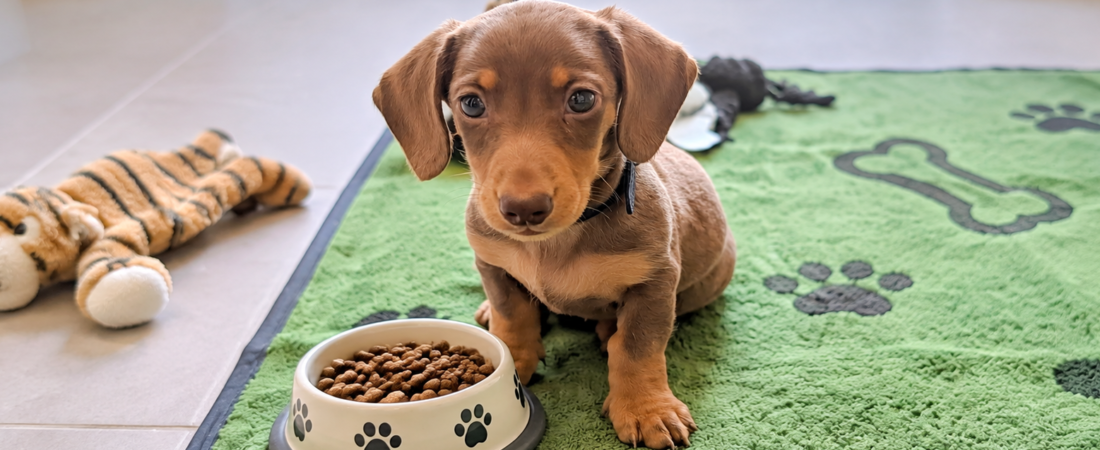
Quick answer: There is no single amount that every dachshund puppy should eat. We fed Winston three meals a day, weighed his food, used calorie information from the manufacturers, allowed part of his daily calories for treats, and adjusted things as he grew. We also learnt very quickly that food changes need to be gradual and that a slow feeder can be extremely useful when your tiny dachshund appears determined to inhale dinner whole.
Feeding Winston was one of those things we thought would be fairly straightforward.
Buy a good puppy food.
Measure it out.
Feed puppy.
Done.
Obviously, Winston had other ideas.
Within about two days we had bought a slow feeder, started researching calories, found ourselves dividing tiny training treats into quarters, and learnt that one small dachshund can have surprisingly strong opinions about what should and should not be served for lunch.
The biggest thing we learnt is that feeding guides are useful, but your individual puppy matters more.
Their age.
Their current weight.
Their body condition.
Their activity.
The calorie density of the food.
The treats they are getting.
And, occasionally, whether they have decided they would rather negotiate for something better.
This is not a veterinary feeding plan, and it is not meant to tell you exactly how many grams your dachshund puppy needs. Puppies are growing, and their nutritional needs change quickly, so speak to your vet or vet nurse if you are unsure about their food, weight, growth or appetite.
This is simply how we approached feeding Winston and the things we learnt along the way.
This post may contain affiliate links. If you buy through one of our links, we may earn a small commission at no extra cost to you.
Winston Had Three Meals a Day
When Winston came home, he had:
Breakfast: around 7–7:30am
Lunch: around 12–1pm
Dinner: around 6–7:30pm
That basic routine has actually stayed fairly similar as he has grown.
The main difference now is lunch.
Winston decided for himself that lunch did not need to be quite as substantial anymore.
We did not deliberately announce:
“Right Winston, you are older now, lunchtime cuts begin Monday.”
He simply became less interested in having as much food in the middle of the day.
So we paid attention and adjusted.
He still has breakfast, lunch and dinner, but lunch is now a much smaller part of his daily food.
That has probably been one of the main themes of feeding him:
have a plan, but pay attention to the dog in front of you.
We Preferred Calories to Cups
One thing we decided very early was that we wanted to understand roughly how many calories Winston was eating rather than relying only on phrases like:
“half a cup”
or:
“one scoop.”
That just felt too vague to us.
Different foods can have very different calorie densities, so the same physical amount of two foods may provide very different amounts of energy.
We found the calories per 100g from the manufacturers’ websites and then used several online calorie calculators to get a rough idea of Winston’s daily requirement.
Rather than trusting one calculator completely, we compared a few.
We entered things such as:
- his current weight
- breed/size
- body condition
- activity level
- age/life stage
Then we looked at the results collectively and used that as a sensible starting estimate.
The Pet Nutrition Alliance calorie calculator is a particularly useful one because it considers body-condition score and can also build in a 10% treat allowance.
WSAVA also provides nutrition resources, including body-condition scoring and calorie guidance, which can be useful when discussing your puppy’s weight and feeding with your veterinary team.
The important word here is estimate.
We did not treat an online calculator as though it knew Winston personally.
We still watched his weight, body shape, growth, appetite and activity, and adjusted where necessary.
We Set Aside 10% for Treats
Because Winston was incredibly food motivated, we knew training treats could add up very quickly.
Tiny dog.
Lots of training.
Lots of opportunities to say:
“Good boy!”
And suddenly half his calories have arrived via snacks.
So once we had our estimated daily calorie target, we took approximately 10% away for treats.
That became his treat allowance for the day.
We put those treats into a small plastic tub.
Nothing fancy.
Just cheap little food-storage tubs from the shop.
Then we prepared his main food allowance separately in tubs too.
It sounds ridiculously organised when I write it down, but it made life so much easier.
Especially when we were tired.
We did not have to remember:
“Has Winston already had loads of treats today?”
We could look at the tub.
If it was nearly empty, apparently Winston had already been very clever that day.
PDSA similarly recommends weighing daily food portions rather than relying entirely on guesswork, particularly because keeping dogs at a healthy weight is important.
Eventually, We Started Using His Normal Food for Training Too
For a while, Winston started becoming slightly less enthusiastic about eating some of his normal food at lunchtime and dinner.
Naturally, we worried.
Was he bored of it?
Was something wrong?
Had he suddenly become fussy?
Then we started wondering if he had simply become very good at negotiating.
Because Winston knew that after meals there would often be training, play or another activity.
And those activities sometimes involved something tastier.
So why eat boring dinner when there may be premium payment available shortly afterwards?
Reasonable dachshund economics.
We started using more of his normal daily food allowance during training and play instead.
And strangely enough, enthusiasm returned.
He will happily work for part of his meal and then eat the rest from his bowl.
I genuinely think he sometimes prefers earning his food.
There is something very dachshund about that.
Weighing His Food Has Been One of the Best Habits
We have weighed Winston’s food from the beginning.
And I would absolutely do that again.
It makes changing foods much easier because you can work from the calorie information rather than assuming the same number of grams of every food is equivalent.
It also makes it easier to account for:
- training treats
- chews
- wet food
- dry food
- enrichment toys containing food
- changes in activity
- changes in weight
Winston has maintained a really healthy body condition, and I think being aware of what he actually eats has played a big part in that.
PDSA advises using packet guidance as a starting point but weighing portions and adjusting them according to the dog’s actual weight and body condition.
Especially with dachshunds, keeping them lean is something we take seriously because they already have enough work to do carrying around that long little body.
Winston Needed a Slow Feeder Almost Immediately
This one took approximately one day to discover.
Winston did not politely eat his puppy food.
He inhaled it.
He would eat so quickly that he sometimes brought it back up.
So on the second day, we bought a slow feeder.
Problem dramatically improved.
It spread the meal out, made him work around the grooves and stopped dinner being treated like an emergency competitive eating event.
Not every dachshund puppy will need one.
Winston absolutely did.
Interestingly, he is nowhere near as frantic with food now.
He waits patiently for meals and is actually very polite around food.
But puppy Winston?
Different creature entirely.
The Food Winston Came Home On
Winston’s breeder had been feeding him:
Wainwright’s Complete Puppy Freeze Dried Raw Dog Food – Chicken
That is what we initially continued with, because suddenly changing a puppy’s diet at the same time as changing their entire home and routine is generally something worth avoiding.
PDSA recommends initially keeping puppies on the food they are accustomed to and changing diets gradually if you later want to move them onto something else.
However, Winston started having loose stools.
So after he had settled in, we decided to move him onto:
Wainwright’s Puppy Dry Dog Food – Salmon with Rice
That seemed gentler on his stomach.
How We Changed Winston’s Food
Whenever we intentionally changed Winston onto a different food, we did it gradually.
Our rough transition looked like this:
Days 1–2: 75% old food / 25% new food
Days 3–4: 50% old / 50% new
Days 5–6: 25% old / 75% new
Days 7–8: 10% old / 90% new
Then: fully onto the new food
That worked well for Winston.
It is not a timetable I would say every puppy must follow exactly, though.
Some dogs may need a slower change, particularly if they have a sensitive stomach.
PDSA currently advises making food changes gradually and notes that sudden dietary changes can cause diarrhoea and other stomach problems; its general guidance suggests transitions may take around 7–14 days.
So our eight-day approach sat roughly within that kind of gradual transition, but I would always slow things down if your puppy’s stomach was telling you to.
Our Move Towards Platinum
Before getting Winston, we had done quite a lot of research into different dog foods.
Our long-term plan was to transition him onto Platinum Puppy Chicken, which had also been recommended to us by other dog owners.
We liked that it is marketed as a complete puppy food and uses a meat-based formulation with a relatively high fresh-meat content.
But, as with any food, what matters most is whether it is nutritionally appropriate for your puppy and actually agrees with them.
So we did not immediately bin everything else and switch him overnight.
We transitioned gradually.
For quite a while, his meals were a combination while his stomach adjusted.
We Wanted Winston to Have Wet and Dry Food
We always liked the idea of Winston having some variety rather than eating exactly the same texture at every meal.
Initially, he mainly had dry puppy food.
Then, as he got older, his enthusiasm for dry food at lunch and dinner started dropping.
That was when we introduced wet food.
For a while, Lily’s Kitchen was a big hit.
His favourites were:
- Cottage Pie
- Chicken & Turkey Casserole
- Sunday Lunch
Of course, because Winston is Winston, eventually he became a little less excited about those too.
Then we tried a Platinum wet food trial box.
That changed things again.
He absolutely loves it.
At the moment, he generally has Platinum dry food for breakfast and Platinum wet food for lunch and dinner, although lunch is much smaller than it used to be.
PDSA notes that dogs can be fed wet food, dry food or a mixture, provided the overall diet is complete and the total amount is adjusted appropriately rather than effectively feeding two full meals at once.
That last bit matters.
If you are mixing wet and dry, you still have to think about the whole day’s calories.
When Winston Was Properly Unwell
There is a big difference between:
“My puppy’s poo is a bit soft after changing food”
and:
“My puppy is actually unwell.”
We learnt that too.
There was one period where Winston had diarrhoea and vomiting and was clearly not himself.
That was when we involved the vet.
For a short period while his stomach recovered, we gradually used bland foods such as plain chicken and rice or potato before carefully returning him to his normal diet.
He has thankfully been fine for several months now.
I would be careful with this part because a bland homemade diet is not a nutritionally complete long-term puppy diet.
PDSA advises contacting a vet when vomiting/diarrhoea is significant, persistent or accompanied by your dog seeming unwell, and recommends only short-term bland feeding where appropriate before gradually returning to normal food.
With puppies in particular, I would rather ask the vet too early than assume everything is just a sensitive tummy.
If Your Puppy Suddenly Stops Eating, Don’t Automatically Assume They’re Fussy
Winston has definitely experimented with what I would call food negotiations.
But that does not mean every puppy refusing food is being stubborn.
Reduced appetite can also happen because of:
- stomach problems
- dental pain
- illness
- stress
- infections
- other medical problems
PDSA advises contacting your vet if your dog’s eating habits change, particularly if they stop eating altogether or have other symptoms.
So we learnt to look at the whole Winston.
Is he energetic?
Is his poo normal?
Is he drinking?
Does he want treats but reject dinner?
Is he behaving normally?
There is quite a difference between:
“I don’t fancy this, what else have you got?”
and a puppy who genuinely feels unwell.
Our Simple Feeding System
If I had to summarise what worked for us, it would be:
- Feed three predictable meals.
- Use a complete puppy food appropriate for growth.
- Check the manufacturer’s calorie information.
- Use calorie calculators only as a starting estimate.
- Keep an eye on body condition and weight.
- Allow part of the daily calories for treats.
- Weigh food rather than guessing.
- Prepare the day’s food and treats in advance.
- Use normal food for training where possible.
- Use a slow feeder if your puppy eats too quickly.
- Change foods gradually.
- Watch how the individual puppy responds.
None of that is particularly glamorous.
But it made feeding Winston much easier.
What We Would Do Again
If we were feeding another dachshund puppy tomorrow, I would absolutely:
- feed on a routine
- weigh everything
- track calories
- reserve some of the daily allowance for training
- use normal food as rewards
- monitor weight regularly
- use a slow feeder if needed
- make diet changes slowly
- keep a close eye on poo and stomach changes
- speak to the vet if something did not feel right
The thing I would avoid is getting obsessed with one number.
A calculator does not know your puppy.
The back of a food packet does not know your puppy.
An article on the internet — including this one — does not know your puppy.
They give you starting points.
Your puppy’s growth, weight, body condition, behaviour and veterinary advice tell you whether you are actually getting it right.
Final Thoughts
Feeding a dachshund puppy turned out to involve far more maths than I expected.
Calories.
Grams.
Treat percentages.
Food transitions.
Meal tubs.
And one miniature dachshund apparently running his own lunch negotiation department.
But I am glad we took the time to understand it.
We did not want Winston’s food to just be something we poured into a bowl.
It became part of his routine.
Part of his training.
Part of his enrichment.
And one of the ways we could keep an eye on his long-term health.
These days he is much calmer around food, waits beautifully for his meals, and quite often seems happier earning part of dinner through training than simply having it handed to him.
Tiny head.
Big brain.
Very strong opinions about catering.
At Dax & Hound Co., these guides are based on our real life with Winston rather than a belief that every dachshund should be treated exactly the same. We are not vets or canine nutritionists, so if you are unsure how much your puppy should eat, they are losing or gaining weight unexpectedly, or their stomach/appetite changes, speak to your veterinary team.


Leave a Reply