
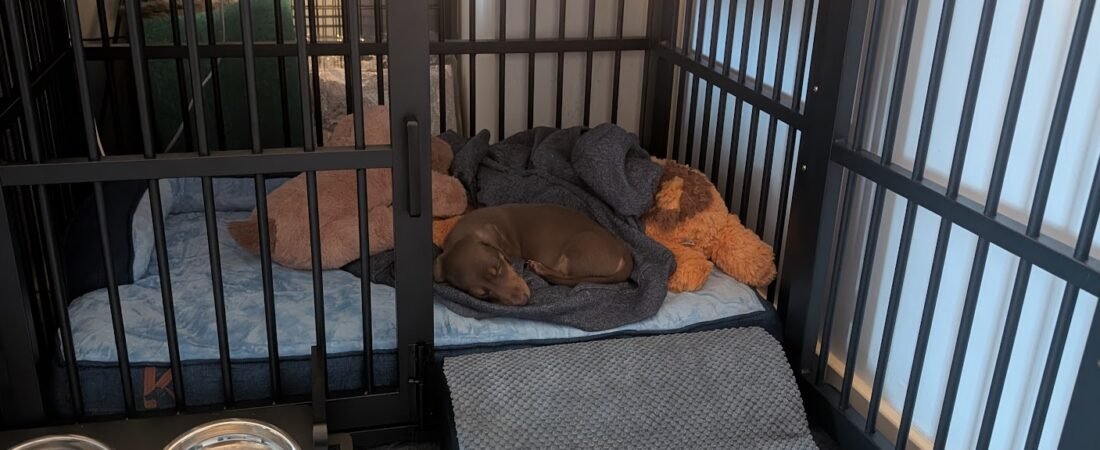
Quick answer: On Winston’s first night, we kept everything quiet, introduced him to his toilet area and crate/pen straight away, and one of us slept nearby on the sofa. He woke around twice for the toilet but otherwise slept surprisingly well. We think the familiar-smelling jumper from his breeder, heartbeat toys, warmth and simply knowing one of us was nearby all helped him settle into a completely new home.
We had been waiting weeks to bring Winston home.
We had visited him when he was tiny.
Prepared the house.
Bought the crate.
Built the pen.
Bought toys.
Researched toilet training.
Talked endlessly about what his first day would be like.
And then suddenly there was an actual miniature dachshund puppy in the car with us.
A very, very tiny one.
His journey home was 51 minutes.
We put him into his puppy carrier with the jumper we had given to his breeder about a month earlier, so it already carried familiar smells from where he had come from as well as us.
I sat in the back beside him.
We were prepared for crying.
Restlessness.
Possibly 51 minutes of wondering whether we were terrible people for taking him away from everything he knew.
Instead?
He fell asleep almost immediately.
And slept the entire way home.
Typical Winston.
The First Thing We Did Was Take Him Outside
Before showing Winston the house, introducing him to toys or doing anything particularly exciting, we took him straight into the garden.
We wanted to start toilet training immediately.
PDSA currently recommends taking a new puppy to their toilet area as soon as they arrive home, particularly after a journey, before gradually introducing them to the house.
That had always been our plan too.
Afterwards, we took Winston into the lounge and placed him into the crate and pen area we had already prepared for him.
Then we sat with him.
We did not immediately give him the entire house to explore.
There was already enough going on.
New smells.
New sounds.
New people.
No mum.
No sister.
No familiar home.
So for those first few hours, his little pen area became his base while we stayed close and let him process everything.
Dogs Trust similarly recommends keeping the first day relatively quiet and introducing a puppy to their new surroundings gradually rather than overwhelming them with too much at once.
Then the British Weather Ruined Our Toilet-Training Plan
Our intention was to continue taking Winston outside regularly that evening.
And then Cornwall welcomed him home with a torrential storm.
Of course it did.
We took this absolutely tiny puppy outside into sideways rain, trying to shelter him with an umbrella that was itself attempting to leave the county.
After a while, we just felt horrible.
This tiny little thing had only just left his home, his mum and his sister, and now we were repeatedly placing him outside in what felt like the apocalypse.
So for that evening, we compromised.
We used puppy pads inside his pen and did a little bit of training with those instead.
Then we went back to outdoor toilet training properly afterwards.
Not exactly the flawless first-night plan we had imagined.
But puppy ownership teaches you very quickly that sometimes you need to adapt.
One of Us Slept Beside His Crate
For the first few nights, one of us slept downstairs on the sofa next to Winston’s crate.
We took turns.
Lights off.
No television.
No chatting to him all night.
We were just there.
We did not want him to go from sleeping around his mum and littermate to suddenly being completely alone in a strange house and expected to simply understand that everything was fine.
Dogs Trust actually describes sleeping near a puppy initially as one approach to helping them become comfortable sleeping alone, then gradually increasing the distance as they settle.
For Winston, it worked really well.
He knew somebody was nearby.
But nighttime was still nighttime.
We Kept Night-Time Interaction Boring
Unless Winston became restless, we did not interact with him during the night.
No playing.
No exciting cuddles.
No turning all the lights on and beginning a 2am dachshund party.
If he started moving around and clearly needed the toilet, we dealt with that.
Then back to bed.
During those first few nights, he woke us roughly twice each night for toilet breaks.
Other than that?
He slept.
We may have been lucky.
Very lucky, judging by some puppy stories.
But I also think several things helped.
His Familiar Jumper Came Home with Him
About a month before collecting Winston, we gave his breeder a jumper.
The idea was that it would collect familiar scents before coming home with him.
So when Winston suddenly found himself somewhere completely new, he still had something in his sleeping area that did not smell completely unfamiliar.
I would absolutely do this again.
PDSA recommends bringing home something carrying familiar smells from a puppy’s previous home, such as a blanket, because it can help comfort them while they settle.
For Winston, his jumper became a huge comfort during those early weeks.
Later, we even started warming it briefly after nighttime toilet trips before placing it back in his crate.
He would dive into it, burrow down and go back to sleep.
We Used Heartbeat Toys Too
Winston also had two heartbeat puppy toys.
Inside them, we used the heartbeat mechanism along with warming pads.
So his sleeping area had:
- his familiar jumper
- soft bedding
- warmth
- heartbeat sounds
- one of us nearby
Was one particular thing responsible for him settling so well?
Impossible to know.
It was probably the combination.
But our aim was simply to make the transition from sleeping alongside other warm little bodies to sleeping in a new house feel a little less abrupt.
And judging by how peacefully he slept, something worked.
Don’t Expect a Tiny Puppy to Sleep Through Without the Toilet
Winston slept well, but he still needed nighttime toilet trips.
That is normal.
Puppies have very small bladders, and both Dogs Trust and PDSA advise owners to expect that young puppies may need to toilet during the night for a while.
The first few nights helped us learn Winston’s timing.
Once we had a better idea of when he was normally waking, we could start anticipating it rather than waiting for him to get desperate.
That became useful later when we stopped sleeping downstairs with him.
Staying Close Did Not Make Winston Dependent on Us
This is something I think new puppy owners can worry about.
If I sleep near my puppy…
If I comfort them…
If I reassure them…
Will they never learn to sleep alone?
That was not our experience at all.
We stayed downstairs near Winston for roughly the first two weeks.
Then we stopped.
Once we understood his nighttime routine, we went back upstairs and set alarms for his expected toilet breaks.
He stayed downstairs.
And he was absolutely fine.
PDSA specifically says it is okay to comfort a worried new puppy at night; their guidance notes that a puppy has just entered an unfamiliar environment and may need reassurance while gaining confidence.
For us, being nearby seemed to help Winston feel secure enough to become independent.
It did not make him clingier.
Quite the opposite.
He Has Slept Downstairs Happily Ever Since
From around week two, Winston slept downstairs by himself without any problem.
As a puppy, we obviously still got up for his planned toilet breaks.
But outside of those?
He slept through.
And now, at 14 months old, Winston actually seems to prefer having his proper nighttime sleep downstairs by himself.
He may snooze with us elsewhere during the evening.
He may have a nap on the sofa.
He may spend plenty of time attached to us like a tiny brown shadow.
But when it is proper bedtime?
Downstairs suits him.
So I certainly do not look back and think sleeping beside him for those first couple of weeks made a mistake.
I think it gave him exactly what he needed at the time.
What We Would Do Again on a Puppy’s First Night
If we brought home another dachshund puppy tomorrow, I would keep things very similar:
- keep the journey home calm
- bring something carrying familiar smells
- take them to the toilet area immediately
- introduce one small part of the house first
- have the crate/pen ready beforehand
- keep the evening quiet
- expect nighttime toilet breaks
- keep toilet trips boring and calm
- sleep nearby initially if the puppy needs reassurance
- gradually increase independence rather than forcing it immediately
- accept that the beautifully planned routine may be destroyed by a torrential storm
That last one is perhaps slightly Cornwall-specific.
But the general principle stands.
Have a plan.
Be prepared to adapt it.
What If Your Puppy Cries on the First Night?
Our experience with Winston was relatively easy.
Not every puppy will settle that quickly.
And if yours cries, I would not automatically assume they are being naughty or trying to manipulate you.
Think about what has just happened from their perspective.
They may have spent every night of their life sleeping beside their mum and littermates.
Then, in one day:
New humans.
New journey.
New building.
New smells.
New bed.
And suddenly nobody familiar is there.
That is a massive change.
Check whether they need the toilet.
Keep things calm.
Give them reassurance if they need it.
And build the independence gradually.
Dogs Trust advises going at the puppy’s pace; if moving away at night causes distress, their guidance is to slow the process down rather than simply continuing regardless.
You have plenty of time to teach independence.
The first night does not need to be a test.
Final Thoughts
Our first night with Winston was far less dramatic than we expected.
The weather certainly tried its best.
But Winston himself?
He surprised us.
He slept the whole journey home.
Explored his little pen.
Accepted his crate.
Woke us when he needed the toilet.
Then went back to sleep.
I think we got lucky with his temperament, but I also think making that first night feel safe helped.
He had his familiar jumper.
His heartbeat toys.
Warmth.
His crate.
And one of us sleeping a few feet away.
We were not trying to teach him on night one that he could cope without us.
We were trying to teach him something much simpler:
This strange new place is safe.
The independence came afterwards.
And considering that two weeks later he was happily sleeping downstairs by himself — and still prefers it that way now — I would do it exactly the same again.
At Dax & Hound Co., our puppy guides are based on what actually worked with Winston rather than pretending every puppy will behave in exactly the same way. Some puppies settle quickly, some need much more reassurance, and neither means you are doing it wrong. Give them time, keep things calm, and remember just how enormous that first night feels to something so small.



Leave a Reply