
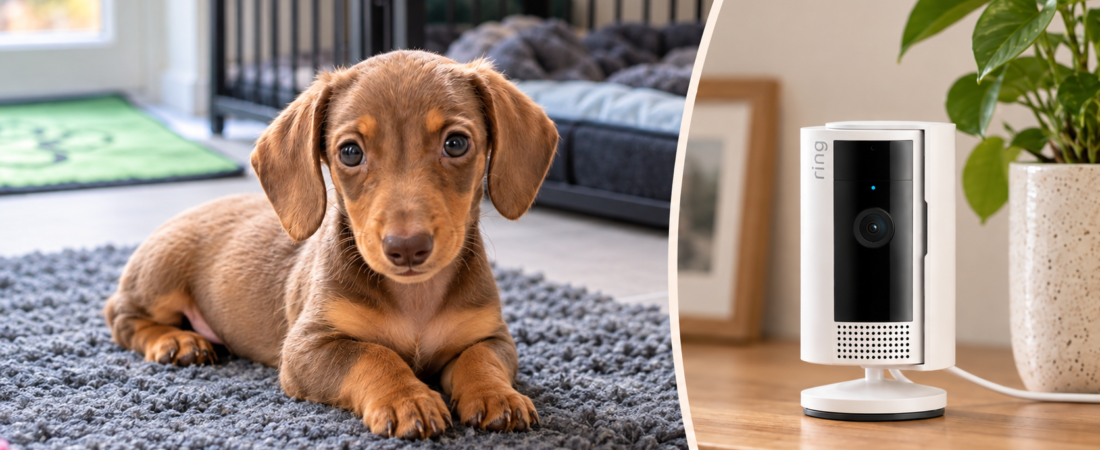
Quick answer: You do not need a puppy camera, but ours became one of the most useful things we bought for Winston. It helped us learn his sleeping and toilet patterns, check whether he genuinely needed us at night, build up separation training gradually, and see how he behaved when we were not in the room. The only downside? At first, it made it very difficult for us to switch off too.
Before Winston came home, we bought a camera to point over his crate and puppy pen.
At the time, it felt like one of those things that would probably be nice to have.
Useful occasionally.
A bit of reassurance.
Nothing essential.
Then Winston actually came home.
And suddenly we were checking that camera constantly.
Is he asleep?
Did he move?
Was that a cry?
Does he need the toilet?
Is he settling?
Is he chewing something?
Did I just hear him?
Was that even Winston?
For the first few months, that little camera probably knew Winston’s routine almost as well as we did.
And while you absolutely can raise a puppy without one, if we brought another puppy home tomorrow, I would buy one again without hesitation.
This post may contain affiliate links. If you buy through one of our links, we may earn a small commission at no extra cost to you.
The Camera We Used with Winston
We used a Ring Indoor Camera, which we positioned on our TV stand looking over Winston’s entire crate and pen area.
The one we bought is here:
Ring Indoor Camera
https://www.amazon.co.uk/dp/B0B6GKH3C2?th=1
From that position, we could see pretty much everything we needed to.
His crate.
His pen.
His sleeping area.
His movements.
And, importantly during those early weeks, whether he was actually awake or whether two exhausted new puppy owners had imagined hearing something.
Which happened far more often than I would like to admit.
The Phantom Crying Was Real… Except It Wasn’t
Nobody warned me about phantom puppy crying.
You finally get the puppy settled.
You creep away.
You sit down.
And then—
Was that him?
You both freeze.
Listen.
Definitely sounded like him.
So you check the camera…
And Winston is completely unconscious.
Fast asleep.
Has not moved.
Not even slightly.
Meanwhile, you are standing there ready to launch yourself downstairs because your brain has apparently started manufacturing dachshund noises.
The camera was brilliant for this.
Instead of immediately disturbing him every time we thought we heard something, we could check first.
If he was sleeping, we left him alone.
If he was awake and moving around, then we could work out whether he needed the toilet or was struggling to settle.
That helped us enormously at night.
It Helped Us Learn Winston’s Routine
For the first few months, we often had the live view open whenever Winston was alone.
And one of the unexpected benefits was how much it taught us about him.
We started noticing patterns.
When he woke.
How long he normally slept.
What he did just before he needed the toilet.
How he moved around when he was settling.
What restless looked like compared with simply repositioning himself.
Those little observations helped with toilet training too.
Instead of everything feeling completely random, we gradually started understanding his rhythm.
A camera will not toilet train your puppy for you.
Unfortunately.
But being able to see what they are doing when you are not physically beside them can give you useful information.
It Was Really Useful for Separation Training
This is probably where the camera became most valuable.
We started teaching Winston to spend small amounts of time without us from the beginning.
Very small amounts.
At first, that could mean seconds rather than minutes.
We would leave the room, watch him on the camera, and see how he responded.
The useful thing was that we did not have to wait for Winston to become really upset before knowing we had gone too far.
We could often see the earlier signs.
Getting restless.
Looking around.
Starting to move differently.
Beginning to look for us.
If we saw that he was reaching his limit, we knew the next attempt needed to be easier or shorter.
Dogs Trust recommends increasing alone time very gradually and monitoring how a puppy responds, reducing the duration again if they show signs of anxiety. Their separation guidance specifically mentions cameras as a way of checking that a dog remains relaxed while you are out of sight.
That matches what we found with Winston.
The camera let us train based on what he was actually coping with rather than guessing.
We Tried to Return While Winston Was Calm
One thing we paid attention to during separation training was not repeatedly teaching Winston:
I make lots of noise → Mum and Dad immediately appear.
Our aim was to build the time gradually enough that he stayed calm in the first place.
The camera helped with that because we could see when he was approaching the point where he might become unsettled and adjust the training accordingly.
That is slightly different from leaving a distressed puppy to “cry it out.”
That was never our goal.
If Winston was struggling, that told us we had asked too much and needed to make the next session easier.
PDSA similarly recommends beginning with very short periods apart, returning while the puppy is calm, and gradually increasing the time. If a dog is genuinely struggling with being left, they recommend going back to easier steps rather than simply pushing through the distress.
The camera made that much easier to judge.
Sometimes We Used the Two-Way Audio
When we eventually had to leave Winston for longer periods, the camera gave us another useful option: we could talk to him.
We did not constantly speak through it.
Most of the time, if he was sleeping or settled, we left him completely alone.
But on the rare occasion that we checked and he was having a little cry, hearing our voices often helped Winston settle again.
That worked for him.
I would not assume every puppy will respond the same way. Some dogs may find a disembodied voice confusing rather than comforting.
But with Winston, a quick bit of reassurance through the camera could be enough for him to relax again.
Even now, we occasionally use it that way.
The Camera Showed Us That Returning to Work Was Going Better Than We Thought
Going back to work after our time off with Winston was probably one of the hardest parts for us.
Between us, we had spent about a month at home with him.
We had been training him.
Watching him.
Feeding him.
Taking him outside.
Practising separation.
Basically organising our entire existence around a very small brown sausage.
Then suddenly we had to leave him.
I hated that.
We were convinced he would be miserable.
The camera showed us something completely different.
He mostly slept.
One of us would return at lunchtime, spend time with him, sort out his needs, and then after we left again he would generally settle back down until we finished work.
Seeing that with our own eyes was enormously reassuring.
Without the camera, I think I would have spent the whole day imagining absolute devastation.
In reality, Winston was apparently quite happy having a nap.
A Camera Can Show Problems You Would Otherwise Miss
There is another side to having a camera too.
Sometimes dogs who struggle with being left do things their owners never actually see because the behaviour stops before they get home.
That might include:
- pacing
- whining
- barking
- repeatedly checking doors
- panting
- toileting
- destructive behaviour
- difficulty settling
PDSA specifically suggests using a pet-monitoring camera if you are unsure whether your dog has a separation-related problem, because some signs only happen while the owner is away.
So a camera is not only useful for reassurance.
Sometimes it can tell you:
Actually, my dog isn’t coping as well as I thought.
And that is useful information too.
If your puppy is repeatedly distressed when left, rather than just having the occasional little unsettled moment, I would speak to your vet or a qualified behaviourist rather than relying on the camera itself to solve the problem.
The Downside: We Watched It Too Much
This is the part I think is worth admitting.
The camera reassured us.
But initially, it also made us more tired.
Because we never really switched off.
Winston could be downstairs completely asleep, and instead of thinking:
“Brilliant. Puppy is sleeping. Let’s relax.”
We would be upstairs…
Watching a livestream of Winston sleeping.
Why?
No idea.
Apparently we needed to make absolutely certain that he continued to be asleep every eight seconds.
It was helpful.
But it also became another thing to monitor.
And looking back, there is probably a lesson there.
A puppy camera should help you feel more confident about leaving your puppy.
It should not become a reason you never mentally leave them at all.
Eventually we learnt to trust him.
And ourselves.
Do We Still Use It Now?
Yes.
But nowhere near as much.
As Winston grew up and proved that he could settle happily by himself, we naturally stopped checking constantly.
We trust him much more now.
We still tend to check on him when we are out, because the camera is there and it takes seconds.
Every so often he might have a little cry.
When that happens, we can speak to him briefly through the camera and he normally settles again.
But we are no longer sitting there watching his every movement.
Which is progress for everybody involved.
What We Actually Used the Camera For
Looking back, the puppy camera helped with far more than we originally expected:
- checking whether he was really crying at night
- learning his sleeping patterns
- learning his toilet timings
- watching how he settled
- separation training
- spotting early signs that he was becoming unsettled
- checking him when we were out
- seeing how he coped when we returned to work
- giving occasional reassurance through the speaker
- reassuring us
That last one was probably just as important as the rest.
So, Do You Need a Puppy Camera?
No.
A puppy camera is not an essential requirement for owning a dachshund.
People raised perfectly happy puppies long before we could watch them in HD from our phones.
But would I recommend one?
Absolutely.
Especially if you are:
- crate or pen training
- toilet training
- teaching your puppy to sleep separately
- working on separation training
- preparing to return to work
- worried about how they behave when left
- prone to hearing imaginary puppies crying at 2am
For us, it turned out to be much more useful than simply checking whether Winston was okay.
It helped us understand him.
And during those first few months, when everything felt new and we were still learning what every little noise and movement meant, that was incredibly valuable.
Final Thoughts
The puppy camera did not train Winston.
It did not make him independent.
It did not prevent separation problems by itself.
What it did was give us information.
We could see when he was comfortable.
We could see when he was approaching his limit.
We could learn his routine.
We could make better decisions during training.
And, perhaps most importantly during those exhausted first weeks, we could check whether the puppy we were absolutely convinced was crying was actually sprawled out asleep without a care in the world.
Would we buy one again?
Without question.
Would I spend quite as much time watching my sleeping puppy next time?
I would like to say no.
But if the puppy was as cute as Winston was, I make no promises.
At Dax & Hound Co., we share what genuinely helped us with Winston rather than things we think every dachshund owner must buy. A camera worked brilliantly for us, but it is a tool rather than a replacement for gradual training, routine and helping your puppy learn that being alone is safe.

Leave a Reply